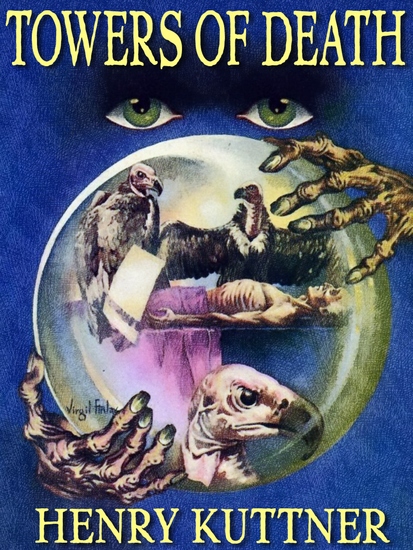
Towers of Death
Henry Kuttner
Maison d'édition: Wildside Press
Synopsis
The old man dallied with evil magic, and sought to double his span of life at his nephew’s expense, but the world ended for him at the Towers of Silence in a Persian cemetery
Maison d'édition: Wildside Press
The old man dallied with evil magic, and sought to double his span of life at his nephew’s expense, but the world ended for him at the Towers of Silence in a Persian cemetery
The survivors lived through the horrifying first days of the plague and its aftermath. They've found their friends, their family . . . but others are still missing. Finding them means leaving the only safety they have, which may not be so safe after all. It's the dawn of a new era. One of violence, war, destruction, and horror. Just when they feel as if they've gotten a grip on the situation, fate throws another curveball their way. Every day is a new struggle, a new terrible reality. The only way forward is through it. They have new allies at their backs, and the promise of answers just out of reach on the horizon. If they can just hold out, just hold on, just keep going . . . they have a chance. But a chance isn't a guarantee.Voir livre
Margaret Gabrielle Vere Campbell was born on the 1st November 1885 on Hayling Island in Hampshire. Her childhood was fraught with problems, her alcoholic father left early in her life and was later found dead on a London Street. Life thereafter was poverty with an uncaring mother. However, her talents took her to the Slade School of Fine Art and later to study in Paris. Her first fiction, written at a mere 16, was a violent medieval historical novel, ‘The Viper of Milan’. Initially rejected by several publishers it went on to become a best-seller After this her prolific writings were the main financial support for the family. Her literary output numbered over 150 volumes, mainly under the pseudonym of Marjorie Bowen but she also used the names Joseph Shearing, George R Preedy, John Winch, Robert Paye and Margaret Campbell. Within this output she assigned the pseudonyms to the various genres she worked across, from Historical fiction to supernatural short stories. Perhaps her best known work is the 1909 book ‘Black Magic’, a Gothic horror novel about a medieval witch. Several of her works were also adapted into films. She was married twice. The first to Zefferino Emilio Constanza (they had two children), who died of tuberculosis, and then to Arthur L Long (and another two children). Marjorie Bowen died on the 23rd December 1952 at St Charles Hospital in North Kensington, London after suffering a serious concussion from a fall in her bedroom. She was 67.Voir livre
Clare de Lune, writer of graphic erotica and horror, has included these five unpublished tales of erotica and horror in Five Little Deaths. Previously published in the Big Book of Bizarro Anthology, Horror Library and various erotica zines, the author takes the reader on five disturbing, graphic and erotic rides. These tales of sex and horror are graphic, bloody, disturbing and downright salacious. Prepare yourself to be drawn into the strange world of vengeful vampire ghosts, a blood-thirsty succubus, a doctor-stalking pain freak, a drug-addicted dreamer, and a female serial killer with a voracious appetite for pleasure and pain.Voir livre
A boy and his dog face a deadly small-town secret in this haunting coming-of-age horror novel. Brighton Falls is a typical small town, with its bad baseball team, clean sidewalks, and nosy neighbors. But that all changes when someone’s pet is brutally killed, and other animals start going missing. When young Tommy Watson’s dog Artie falls gravely ill, the middle schooler sets out to save his canine friend—and begins to unravel an evil, small-town secret that goes back centuries . . . With a community on edge and time running out, it’s up to Tommy—and his dog—to finally put the menace to rest. But as his courage and love are put to the test, he’ll have to make the hardest decision of his life.Voir livre
Terror rises from the deep in this gripping maritime horror from the master of early science fiction. When a retired tea-dealer named Mr. Fison takes a casual afternoon walk along the cliffs of Sidmouth, he expects nothing more than sea breeze and sunshine. Instead, he becomes the first living witness to a new species — a swarm of massive, intelligent, and shockingly aggressive cephalopods known as Haploteuthis ferox. What begins as curiosity quickly spirals into a frantic fight for survival as these tentacled predators crawl out of the surf, hunt along the tide pools, and launch deadly attacks on boats, swimmers, and the unprepared towns along the coast. Blending scientific speculation with relentless suspense, H. G. Wells delivers a chilling tale of nature unchecked — a reminder that the ocean still holds secrets powerful enough to swallow humanity whole. With vivid performances by narrator Salathiel Reagan, this classic short story comes alive with atmospheric dread and pulse-pounding tension. Perfect for fans of sea monsters, Victorian horror, and classic speculative fiction.Voir livre
Ernst Theodor Wilhelm Hoffman was born on the 24th January 1776, the youngest of three children, in Königsberg, then in Prussia but now part of the Kaliningrad Russian enclave. His parents separated when he was two and for many years life was to be provincial and, despite his talents for the creative arts and the classics, much was passing him by. At 20 Hoffman obtained employment as a clerk and to the art that now surrounded him. Two years later he was in Berlin attempting a career as a composer with an operetta called ‘Die Maske’. His gift for drawing caricatures and sharing them often got him into trouble that was easier to avoid. The years of Napoleon ravaging Europe were bad for Hoffman; he moved often and took on works as varied as theatre management and music critic. In this his talents were now more evident. His works on Beethoven where highly regarded by the master himself. His literary breakthrough came in 1809, with ‘Ritter Gluck’, about a man who believes he has met the composer 20 years after his death. However the various jobs and the wars continued and plagued any career advancement despite his constant travel for opportunities, often through dangerous territories. In the wake of Napoleon’s defeat in 1814, Hoffmann returned to Berlin where his opera ‘Undine’ was performed by the Berlin Theatre. Life was now more settled and many of his most famous works were written at his time. From 1819, Hoffmann was struggling with both legal disputes and ill health. Alcohol abuse and syphilis were physically weakening him and from 1822 paralysis set in. His last works were dictated to his wife or to a secretary as all around him society descended into an anti-liberal agenda, stifling dissent with threats of legal action and even treason. The ailing Hoffman was among them. E T A Hoffmann died on the 25th June 1822 in Berlin of syphilis. He was 46.Voir livre