Rejoignez-nous pour un voyage dans le monde des livres!
Ajouter ce livre à l'électronique
Grey
Ecrivez un nouveau commentaire Default profile 50px
Grey
Abonnez-vous pour lire le livre complet ou lisez les premières pages gratuitement!
All characters reduced
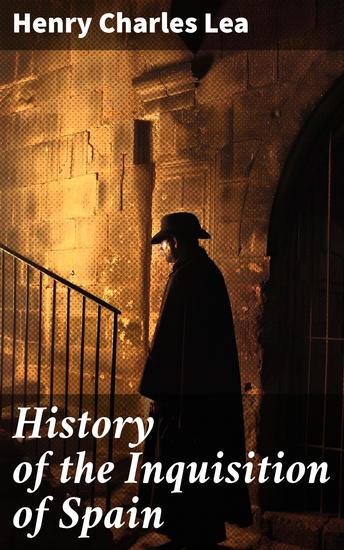
History of the Inquisition of Spain - Unveiling the Shadows of Religious Persecution in Spain - cover

History of the Inquisition of Spain - Unveiling the Shadows of Religious Persecution in Spain

Henry Charles Lea

Maison d'édition: Good Press

  • 0
  • 0
  • 0

Synopsis

In 'History of the Inquisition of Spain,' Henry Charles Lea meticulously chronicles the development and implementation of the Spanish Inquisition, unveiling its political, social, and religious ramifications. Through a blend of rigorous historical research and vivid narrative, Lea exposes the complex interplay between ecclesiastical authority and state power, while employing a critical lens towards primary sources that illuminate the darker aspects of this tumultuous period. His work not only serves as a comprehensive examination of the Inquisition's mechanism of control but also situates it within the broader tapestry of 15th to 17th-century Spain, highlighting its role in shaping national identity and intolerance. Henry Charles Lea was a prominent American historian and advocate of religious liberty, whose background in law and strong interest in social justice profoundly influenced his writing. His extensive research into European history and the dynamics of religious persecution informed his nuanced understanding of the Inquisition's impact on both victims and society at large. Lea's personal commitment to liberal causes and profound sense of empathy for the oppressed drive the moral urgency of his narrative. This seminal work is essential reading for scholars and general readers alike who seek to comprehend the intricate relationships between faith, power, and violence. Lea'Äôs blend of scholarly rigor and narrative flair makes it an invaluable contribution to the understanding of religious intolerance and its enduring legacy.
Disponible depuis: 17/12/2023.
Longueur d'impression: 2447 pages.


D'autres livres qui pourraient vous intéresser

  • Meditations - The Original Writings of Marcus Aurelius on Stoicism in a New Translation for Contemporary Readers (Novelaris Classics) - cover

    Meditations - The Original...

    Marcus Aurelius

    • 0
    • 0
    • 0
    This new translation of Meditations by Marcus Aurelius presents the personal reflections of one of Rome's most significant emperors. Marcus Aurelius, emperor and Stoic philosopher, explores fundamental questions of existence in this work. His writings cover topics such as ethics, duty, and the nature of the universe. The book provides insight into the emperor's approach to reconciling philosophical ideals with the realities of governance and personal challenges. 


    This e-book edition of the Meditations by Marcus Aurelius is the perfect manual for anyone striving for emotional resilience and philosophical clarity. It offers a personal journey into the mind of an emperor, offering universal truths on leadership, mortality, and self-mastery that remain relevant in contemporary contexts.
    Voir livre
  • Discourse on Metaphysics - Unabridged - cover

    Discourse on Metaphysics -...

    Gottfried Wilhelm Leibniz

    • 0
    • 0
    • 0
    Written in 1686 by the celebrated German polymath Gottfried Wilhelm von Leibniz, Discourse on Metaphysics is a short, early work in which Leibniz explains how the Earth, which was created by God (an undeniably perfect being), is therefore blessed with the same purity and perfection as its creator.  Leibniz was one of the most important philosophers of the Enlightenment era and was a contemporary of Isaac Newton. But today, Leibniz's best remembered for his work in developing differential and integral calculus. A renowned rationalist - ranked with Rene Descartes and Baruch Spinoza - Leibniz himself made extraordinary discoveries in the fields of - among others- philosophy, politics, theology, history, philology, law and politics.  A seeming autodidact, Leibniz authored tens of thousands of letters and manuscripts on such disparate topics as physics, biology, geology and computer science.
    Voir livre
  • End of History and the Last Man The: Book Summary & Analysis - cover

    End of History and the Last Man...

    Briefly Summaries

    • 0
    • 0
    • 0
    This is a concise summary and analysis of The End of History and the Last Man, by  
    Francis Fukuyama.
     
    It is not the original book and is not affiliated with or endorsed by Francis Fukuyama.
     
    Ideal those seeking a quick and insightful overview.
    The End of History and the Last Man explores the profound idea that history, as a dynamic process driven by ideological conflict, may have reached its conclusion with the triumph of liberal democracy. Combining political philosophy, history, and sociology, this groundbreaking work examines how liberal democracy emerged as the dominant form of governance, its strengths and vulnerabilities, and whether human fulfillment can truly be achieved within this framework. The book delves into the implications of this "end of history," questioning whether material progress and individual freedoms are enough to satisfy the human desire for recognition, identity, and meaning.
    Voir livre
  • The Relevance of Buddhism in the Modern World - cover

    The Relevance of Buddhism in the...

    Princess Poon Pismai Diskul

    • 0
    • 0
    • 0
    This is an audiobook of Bodhi Leaves No. 43 by Princess Poon Pismai Diskul, The Relevance of Buddhism in the Modern World narrated by Gregory M. Dams. The print edition can be found in the Pariyatti Edition of Collected Bodhi Leaves Vol. 2. The eBook of Bodhi Leaves No. 43 can be downloaded from the BPS website.
     
    Excerpt:
     
    Throughout history, the practice, adherence and belief in religion has been a virtually universal aspect of human society. And as a rule, the increase in complexity and sophistication of a given culture has borne with it an accompanying increase in the level of ethical and philosophical development of that society’s religious thought.
     
    Today, however, the world witnesses a level of civilization and social complexity far surpassing that of any previous era. Yet out of the great thoughts and discoveries of our time, no new major religion has evolved. Whatever new religious concepts may have appeared, they have failed to reach the masses of humanity in the form of altering basic beliefs and practices. Most of the new reforms that modern institutions sometimes announce with pride are actually negative in character; that is, the termination of outmoded practices and the relinquishment or reinterpretation of embarrassing dogmas. ...
    Voir livre
  • The American Imperative - Reclaiming Global Leadership through Soft Power - cover

    The American Imperative -...

    Daniel F. Runde

    • 0
    • 0
    • 0
    It's time for America to get back in the international leadership game. 


    What should our global strategy look like in an age of renewed great power competition? And what must America offer to a newly empowered developing world when we're no longer the only major player? 


    In The American Imperative, international development expert Daniel Runde makes the case for building a new global consensus through vigorous internationalism and the judicious use of soft power. Runde maps out many of the steps that we need to take—primarily in the non-military sphere—to ensure an alliance of stable and secure, like-minded, self-reliant partner nations in order to prevent rising authoritarian powers such as China from running the world.
    Voir livre
  • I Came to Cast Fire - An Introduction to René Girard - cover

    I Came to Cast Fire - An...

    Fr. Elias Carr

    • 0
    • 0
    • 0
    The Catholic anthropologist René Girard (1923–2015) has emerged as one of the most important thinkers of the past century. His sweeping mimetic theory changed the landscape of both the social sciences and Christian theology. And with the rise of social media, political polarization, and globalized conflict, Girard’s ideas have only proven increasingly prophetic with every passing year. But where to begin with this “new Darwin of the human sciences”? His massive body of work remains daunting and disorienting, and secondary literature either academic in tone or limited in scope. General readers—if Girard shows up on their radar at all—face a high barrier of entry to understanding his theory and applying it to daily life.I Came to Cast Fire offers a timely solution: a comprehensive but accessible introduction to the thought of René Girard. In short and digestible chapters, Fr. Elias Carr takes readers through the basics of mimetic theory and how it plays out through history—from the violent origins of religion and culture to the radical revelation that unfolds in Christ—weaving in compelling personal anecdotes along the way. The perfect first step for those new to Girard, I Came to Cast Fire will not only inspire readers to see the world in a new light—the fire of the Paraclete proclaiming the innocence of the victim—but more importantly, to enter into it. 
    Voir livre