¡Acompáñanos a viajar por el mundo de los libros!
Añadir este libro a la estantería
Grey
Escribe un nuevo comentario Default profile 50px
Grey
Suscríbete para leer el libro completo o lee las primeras páginas gratis.
All characters reduced
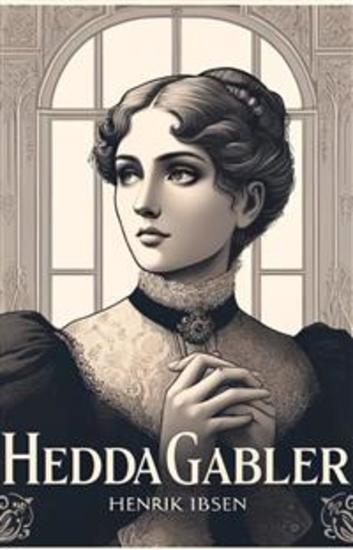
Hedda Gabler(Illustrated) - cover

Hedda Gabler(Illustrated)

Henrik Ibsen

Editorial: Micheal Smith

  • 0
  • 0
  • 0

Sinopsis

Illustrated Edition: Features 20 stunning illustrations capturing key moments of the play.
	Includes a Comprehensive Summary: A detailed synopsis that brings the essence of Ibsen's classic to life.
	Character List: An insightful guide to the complex characters who inhabit Ibsen's world.
	Author Biography: A compelling look into the life and legacy of Henrik Ibsen, the father of modern drama.

Step into the captivating world of "Hedda Gabler," a timeless masterpiece by Henrik Ibsen, now brought to life in this beautifully illustrated edition. Known as one of the great classics of the theatre, Ibsen's play is as relevant today as when it first took the stage. This edition not only brings you the complete text of Ibsen's groundbreaking play but also enhances your experience with 20 striking illustrations that vividly bring the drama and characters to life.
Set in the late 19th century, "Hedda Gabler" unfolds the story of its eponymous protagonist, a woman of formidable presence and complex psychology. Hedda, trapped in a life that she finds suffocating, navigates the constraints of societal norms with a mix of manipulation and desperation. As she interacts with characters like the ambitious George Tesman, her former lover Eilert Lövborg, and the influential Judge Brack, Hedda's actions set off a chain of events that lead to a dramatic and tragic climax.
This edition is designed to deepen your understanding and appreciation of the play. Alongside the full text, it includes:
A detailed summary that captures the essence and nuances of the play.
An extensive list of characters, providing insights into their roles and relationships.
A biography of Henrik Ibsen, offering a glimpse into the life of the playwright who forever changed the landscape of modern drama.
Whether you're a student, a lover of classic literature, or a newcomer to Ibsen's work, this illustrated edition of "Hedda Gabler" is a must-have for your collection. Immerse yourself in the world of Hedda Gabler, where societal pressures, personal desires, and the quest for identity collide in a story that is both profoundly personal and universally resonant. Experience Ibsen's genius in a whole new way, with each page and illustration drawing you deeper into the captivating world he created.
 
Disponible desde: 12/01/2024.

Otros libros que te pueden interesar

  • Purple Pileus The (Unabridged) - cover

    Purple Pileus The (Unabridged)

    H. G. Wells

    • 0
    • 0
    • 0
    "Mr. Coombes was sick of life. He walked away from his unhappy home, and, sick not only of his own existence but of everybody else's, turned aside down Gaswork Lane to avoid the town, and, crossing the wooden bridge that goes over the canal to Starling's Cottages, was presently alone in the damp pine woods and out of sight and sound of human habitation. He would stand it no longer. He repeated aloud with blasphemies unusual to him that he would stand it no longer.
    Ver libro
  • Medea - (National Theatre of Scotland version) - cover

    Medea - (National Theatre of...

    Euripides

    • 0
    • 0
    • 0
    'She's chucked out like an old coat that nae langer fits him…'
    Medea and Jason, clinging together as refugees in Corinth, have struggled to bring up their beloved offspring in this alien and unsympathetic society. Now Jason has a plan to better integrate himself. Unfortunately, this involves abandoning his wife, the mother of his children…
    Spurned, destitute, desperate, Medea exacts her terrible retribution.
    Liz Lochhead's Scots-inflected version of Euripides' classic revenge tragedy was first performed by Theatre Babel in 2000 and won the Saltire Society Scottish Book of the Year Award. It was revived by the National Theatre of Scotland as part of the 2022 Edinburgh International Festival, with Adura Onashile as Medea, directed by Michael Boyd.
    Ver libro
  • Arch Rascal An - From their pens to your ears genius in every story - cover

    Arch Rascal An - From their pens...

    Knut Hamsun

    • 0
    • 0
    • 0
    Knud Pedersen was born in Lom in the Gudbrandsdal valley of Norway on the 4th of August, 1859 in what was then the United Kingdoms of Sweden and Norway.  He was the fourth son of seven children born to poor parents who, when he was three, were invited to an uncle’s farm to work his land. 
    When he was nine he moved away from his family to help another uncle who ran a post office.  Whilst with him he was beaten and starved which manifested in a series of chronic nervous difficulties.  The treatment endured for six years until he managed to escape back to Lom. 
    For some time he now took any job that was available to him, including store clerk, peddler, shoemaker's apprentice, sheriff's assistant, elementary-school teacher and ropemaker's apprentice.  At about the same time, with the wealth of these gained experiences, he began to explore his literary talents. 
    In 1877 he published his first book ‘The Enigmatic Man: A Love Story from Northern Norway’, others soon followed but real success only came in 1890 with ‘Hunger’, an influential work for later novelists with its internal monologue and bizarre logic.  His work is often associated with Pantheism; where nature and mankind are unified in a strong and often mystical bond.   
    His work was so influential that in 1920 he was awarded the Novel Prize for Literature. 
    Shortly after this point his works became fewer and his interests darker.  During World War II he became a fervent admirer of the Nazi’s, even meeting Hitler, even though German armies had overrun Norway.  With the war’s end he was detained on charges of treason.  His old age was apparently the primary reason given for Hamsun receiving only a fine.  Other reasons also sought to excuse his abhorrent behaviour but it was clear that whilst he was loved for his literature he was detested for his politics and morals. 
    His literary canon includes more than 20 novels, a poetry collection, short stories, plays, a travelogue, other works of non-fiction and essays. 
    Knut Hamsun died on the 19th February 1952 in Grimstad. He was 92.
    Ver libro
  • Pygmalion - cover

    Pygmalion

    George Bernard Shaw

    • 0
    • 0
    • 0
    Pygmalion is a play by George Bernard Shaw, named after the Greek mythological figure. It premiered at the Hofburg Theatre in Vienna on 16 October 1913 and was first presented in German on stage to the public in 1913. Its English-language premiere took place at Her Majesty's Theatre in the West End in April 1914 and starred Herbert Beerbohm Tree as phonetics professor Henry Higgins and Mrs Patrick Campbell as Cockney flower girl Eliza Doolittle.
    In ancient Greek mythology, Pygmalion fell in love with one of his sculptures, which then came to life. The general idea of that myth was a popular subject for Victorian era British playwrights, including one of Shaw's influences, W. S. Gilbert, who wrote a successful play based on the story called Pygmalion and Galatea that was first presented in 1871. Shaw would also have been familiar with the musical Adonis and the burlesque version, Galatea, or Pygmalion Reversed. Shaw's play has been adapted numerous times, most notably as the 1938 film Pygmalion, the 1956 musical My Fair Lady and its 1964 film version.
    Shaw mentioned that the character of Professor Henry Higgins was inspired by several British professors of phonetics: Alexander Melville Bell, Alexander J. Ellis, Tito Pagliardini, but above all, the cantankerous Henry Sweet.
    Ver libro
  • Mutiny - A womans quest for social advancement meets a reporter investigating the truth aboard a ship - cover

    Mutiny - A womans quest for...

    Dorothy Edwards

    • 0
    • 0
    • 0
    Dorothy Edwards, an only child, was born on the 18th August 1902 at Ogmore Vale in Glamorgan. 
     
    Her father was a headmaster and an early activist in the Independent Labour Party.  At age 9 Dorothy, dressed in red, welcomed Keir Hardy on to the stage at Tonypandy during the national coal strike of 1912. She was taught that revolution was at hand, that class barriers would be a thing of the past. 
      
    Dorothy won a scholarship and boarded at Howell's School for Girls in Llandaff before moving to University College of South Wales and Monmouthshire where she read Greek and philosophy. 
     
    Her early hopes to be an opera singer were set to one side after graduating and the death of her father. Instead she took on part-time work to supplement her mother’s pension with whom she now lived. 
     
    Dorothy managed to write a number of short stories which appeared in the literary journals of the day.  She spent several months with her mother in Vienna, all the time revising or writing before embarking on ‘Winter Sonata’, a short novel published in 1928. 
     
    Introductions to several members of the Bloomsbury Group meant a move to London and a division of her time between child-care for the family of Bloomsbury author David Garnett and the promise of an advance payment for her work on a new volume of stories. 
     
    However, Dorothy’s life was starting to spiral out of control; she was attracted to the Welsh nationalist movement but felt that her Welsh provincialism made her, in London at least, feel socially inferior. Leaving her mother dependent on a hired companion consumed her with guilt as did the end of an affair with a married musician. 
     
    On the 5th January 1934, having spent the morning burning her papers, Dorothy Edwards threw herself in front of a train near Caerphilly railway station.  
     
    Her suicide note read: "I am killing myself because I have never sincerely loved any human being all my life. I have accepted kindness and friendship and even love without gratitude, and given nothing in return."
    Ver libro
  • The Horse of Selene - cover

    The Horse of Selene

    Juanita Casey

    • 0
    • 0
    • 0
    On a remote island off the West coast of Ireland in the 1970s, young farmer Miceal catches sight of a girl on a beach with long hair so blonde it could be white. Befriending the girl and her travelling companions, a world of possibility opens up to Miceal – but where there's opportunity, there is also peril ... Juanita Casey's astounding first novel is a cult classic ready to be rediscovered by a new generation of readers. Drawing on her own life and speaking for her marginalised community, Casey offers a feminist and class-conscious story that explores the eternal choices of youth, between the comfort of a stifling domesticity and the promise and risk of the unknown, characterised in the incomparable wildness of the West of Ireland. The bestselling Casey takes her place alongside such writers as JM Synge and Kevin Barry – the missing connection between the two.
    Ver libro