Rejoignez-nous pour un voyage dans le monde des livres!
Ajouter ce livre à l'électronique
Grey
Ecrivez un nouveau commentaire Default profile 50px
Grey
Abonnez-vous pour lire le livre complet ou lisez les premières pages gratuitement!
All characters reduced
Ghosts - cover

Ghosts

Henrik Ibsen

Maison d'édition: Memorable Classics eBooks

  • 0
  • 0
  • 0

Synopsis

Ghosts by Henrik Ibsen Ghosts (Danish: Gengangere) is a play by the Norwegian playwright Henrik Ibsen. It was written in 1881 and first staged in 1882 in Chicago, Illinois, in a production by a Danish company on tour.

Like many of Ibsen's plays, Ghosts is a scathing commentary on 19th-century morality. Because of its subject matter, which includes religion, venereal disease, incest, and euthanasia, it immediately generated strong controversy and negative criticism. Since then the play has fared better, and is considered a “great play” that historically holds a position of “immense importance”.

Theater critic Maurice Valency wrote in 1963, "From the standpoint of modern tragedy Ghosts strikes off in a new direction.... Regular tragedy dealt mainly with the unhappy consequences of breaking the moral code. Ghosts, on the contrary, deals with the consequences of not breaking it."

Helen Alving is about to dedicate an orphanage she has built in memory of her late husband. Despite his affairs, Mrs. Alving stayed with him to protect her son Oswald from the taint of scandal and for fear of being shunned by the community.
Disponible depuis: 01/06/2022.
D'autres livres qui pourraient vous intéresser

  • The Tenderness of Silent Minds - Benjamin Britten and his War Requiem - cover

    The Tenderness of Silent Minds -...

    Martha C. Nussbaum

    • 0
    • 0
    • 0
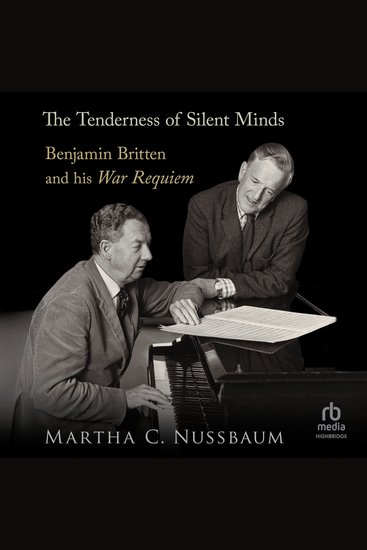
    The human body is the primary instrument of war, yet those waging war often confront soldiers' bodies in a detached or merely intellectual way. In The Tenderness of Silent Minds, Martha C. Nussbaum, a leading thinker on emotion, morality, and justice, conducts a pioneering study of Benjamin Britten's musical representations of the tender male body amidst the brutality of war, and their ability to transform consciousness by evoking potent, non-personal emotions. 


    Offering a reading of Britten's views about the value and beauty of the body that situates these in the context of his thirty-nine year partnership with his lover, the singer Peter Pears, and also surveying pacifist themes in works written both before and after War Requiem, Nussbaum presents a compelling framework for critically assessing Britten's oeuvre. Nussbaum engages with a remarkably wide range of Britten's works, examining his treatment of aggression and its roots in his collaborations with the poet W. H. Auden, offering readings of the value placed on the body in early partnerships with Britten's beloved and singer Peter Pears, and surveying pacifist themes in Britten's earlier works. The analysis throughout is enriched with perspectives from Britten's personal letters and thoughtful study of the social and political backdrop of fear and homophobic disgust in mid-twentieth century Britain.
    Voir livre
  • Quatrain from the Rubaiyat - cover

    Quatrain from the Rubaiyat

    Omar Khayyám

    • 0
    • 0
    • 0
    LibriVox volunteers bring you 12 recordings of Quatrain from The Rubáiyát of Omar Khayyám. Translated by Henry George Keene. This was the Weekly Poetry project for June 26, 2011.The popularity of the celebrated translation of the Rubaiyat of Omar Khayyam by Edward Fitzgerald has cast many other worthy translations into undeserved obscurity. Among the earlier translators was Henry George Keene (1781-1856) whose translation of one quatrain appeared in 'Fundgruben des Orients' in 1816.Instead of the image of the wine and cup popularly associated with the Rubaiyat, the stanza translated by Keene refers to an image even more thoroughly explored in the poem : the potter and his clay. It may be said that while the wine represents the chemistry of Omar's universe, the clay represents the physics. In this context, wine can be seen, not merely as an intoxicant, but rather as the mysterious elixir which enables the clay figures to enjoy a brief experience of life before they crumble into dust.(Summary by Algy Pug.)
    Voir livre
  • we be theorizin - black poiēsis no 1 vol 44 - cover

    we be theorizin - black poiēsis...

    Kendra Nicole Bryant Aya

    • 0
    • 0
    • 0
    we be theorizin: black poiēsis no. 1. vol. 44 is a collection of haikus, tankas, sonnets, free verse, and spoken word poems written in the Black Arts Movement tradition. Compiled of 44 poems and 149 end notes, we be theorizin reflects the protest of the Black Arts and Civil Rights Movements, while giving homage to the theoretical dexterity from which Black feminism and womanism were born. we be theorizin is organized into three parts: "thru morning pulses"; "we be theorizin"; and "Black life unexpected"—each of which includes a prose essay as introductory matter to the poems compiled in each section. From poems acknowledging the Black Lives Matter Movement to others recalling 20th century Black literature and critical race thoughts, we be theorizin loves on Black culture, while talkin b(l)ack to the empire. "Ey yo!" writes Kendra in her opening poem, "callin Òrìṣàs: . . . come out come out wherever you are."
    Voir livre
  • The Poetry of John Dryden - England's first Poet Laureate that turned literature in Restoration England into "the Age Of Dryden" - cover

    The Poetry of John Dryden -...

    John Dryden

    • 0
    • 0
    • 0
    John Dryden was born on August 9th, 1631 in the village rectory of Aldwincle near Thrapston in Northamptonshire and grew up in a nearby village.  In 1644 he was sent to Westminster School as a King's Scholar and then obtained his BA in 1654, graduating top of the list for Trinity College, Cambridge that year.  
    Returning to London during The Protectorate, Dryden found work with Cromwell's Secretary of State, John Thurloe.  At Cromwell's funeral on November 23rd 1658 he found company with the Puritan poets John Milton and Andrew Marvell.  The setting was to be a sea change in English history. From Republic to Monarchy and from one set of lauded poets to what would soon become the Age of Dryden. Later that year he published the first of his great poems, Heroic Stanzas (1658), a eulogy on Cromwell's death.  
    With the Restoration of the Monarchy in 1660 Dryden celebrated in verse with Astraea Redux, an authentic royalist panegyric and with the re-opening of the theatres he began to also write plays. His first, The Wild Gallant, appeared in 1663 and whilst not successful, he was contracted to produce three plays a year for the King's Company, in which he became a shareholder. During the 1660s and '70s, theatrical writing was his main source of income.    
    In 1667, he published Annus Mirabilis, a lengthy historical poem which described the English defeat of the Dutch naval fleet and the Great Fire of London.  This work established him as the pre-eminent poet of his generation, and was crucial in his attaining the posts of Poet Laureate in 1668 and a couple of years later, historiographer royal (1670) as his talent encompassed many forms; from Poetry to Plays to translations. 
    In 1694 he began work on what would be his most ambitious and defining work as translator, The Works of Virgil (1697), which was published by subscription. It was a national event.  
    John Dryden died on May 12th, 1700, and was initially buried in St. Anne's cemetery in Soho, before being exhumed and reburied in Westminster Abbey ten days later. 
     This volume comes to you from Portable Poetry, a specialized imprint from Deadtree Publishing.  Our range is large and growing and covers single poets, themes, and many compilations.
    Voir livre
  • American Family Shakespeare Entertainment An - cover

    American Family Shakespeare...

    Stefan Rudnicki, Charles Lamb,...

    • 0
    • 0
    • 0
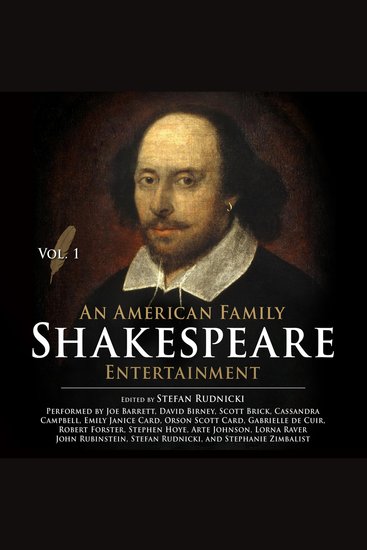
    Blackstone Audio presents An American Family Shakespeare Entertainment, a sparkling adaptation based on Tales from Shakespeare by Charles and Mary Lamb, augmented by miscellaneous scenes and soliloquies from Shakespeare’s plays. Read by a full cast and featuring Elizabethan songs and dances in new arrangements for stringed instruments, this production is entertaining and accessible for young and old alike! 
    THE TWO GENTLEMEN OF VERONA read by Stephen Hoye THE COMEDY OF ERRORS read by Arte Johnson THE TAMING OF THE SHREW read by Robert Forster SCENE: Petruchio & Kate read by Gabrielle de Cuir & Stefan Rudnicki A MIDSUMMER NIGHT’S DREAM read by John Rubinstein ROMEO AND JULIET read by Orson Scott Card THE MERCHANT OF VENICE read by David Birney SOLILOQUY: “Hath not a Jew...” read by David Birney MUCH ADO ABOUT NOTHING read by Scott Brick MUSIC: “It Was a Lover and his Lass...” by Stefan Rudnicki AS YOU LIKE IT  read by Stephanie Zimbalist HAMLET read by Joe Barrett SOLILOQUY: “O What a Rogue... “ read by Joe Barrett TWELFTH NIGHT read by Cassandra Campbell ALL’S WELL THAT ENDS WELL read by Emily Janice Card MEASURE FOR MEASURE  read by Lorna Raver
    Voir livre
  • Short Poetry Collection 087 - cover

    Short Poetry Collection 087

    Various

    • 0
    • 0
    • 0
    This is a collection of poems read by LibriVox volunteers for the month of March 2010.
    Voir livre