Rejoignez-nous pour un voyage dans le monde des livres!
Ajouter ce livre à l'électronique
Grey
Ecrivez un nouveau commentaire Default profile 50px
Grey
Abonnez-vous pour lire le livre complet ou lisez les premières pages gratuitement!
All characters reduced
Down The Belliard Steps - Discovering the Brontes in Brussels - cover

Down The Belliard Steps - Discovering the Brontes in Brussels

Helen MacEwan

Maison d'édition: Grosvenor House Publishing

  • 0
  • 0
  • 0

Synopsis

'A craze blown across the Channel from Britain to Brussels - people who meet to talk about the works of the Brontë sisters.' (From a Brussels press article about the newly-formed Brussels Brontë Group).
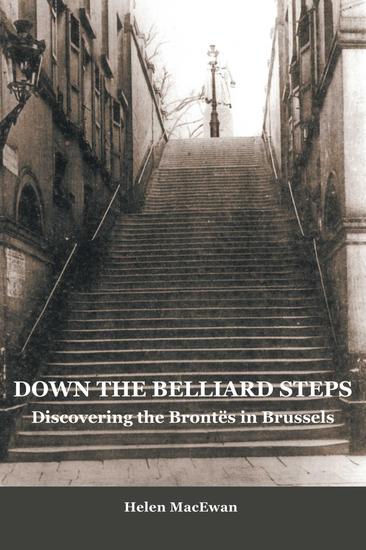
In 1842 Charlotte and Emily Brontë arrived in Brussels to study French at the Pensionnat Heger boarding school at the bottom of the 'Belliard steps'. Their stay in the Belgian capital is the least-known episode of their lives, despite the importance of Charlotte's years in Belgium for her life and work; two of her novels ('Villette' and 'The Professor') were inspired by her time in Brussels and her love for her teacher, Constantin Heger. 'Down the Belliard Steps' tells the story of a group of enthusiasts coming together in Brussels to explore the sisters' time in the city.
Beginning with her personal experience as a newcomer to 'the capital of Europe' in 2004, Helen MacEwan tells of her journey of discovery into the history of a vanished quarter of Brussels and her quest to seek out fellow Brontë enthusiasts - a quest that leads to the formation of a literary society, the Brussels Brontë Group. 'Down the Belliard Steps' describes the people she encounters and the adventures she has along the way. We meet an Heger descendant, learn about the re-discovery of a lost Brontë 'devoir' (one of the Brontës' 40 extant French essays written under Heger's direction) and search in Brussels cemeteries for the tomb of a friend of the Brontës who died in a Brussels school. We meet researchers and people inspired creatively by the Brontës. We delve into what it is that draws so many people, from all walks of life, to feel an affinity with members of the world's most famous literary family.
Today, the Brussels Brontë Group is a flourishing, multinational literary community, promoting interest in the Brontës through talks, guided walks and reading groups. 'Down the Belliard Steps', crammed with information and anecdotes about Charlotte and Emily's time in the Belgian capital, is a light-hearted but intensely personal and romantic account of the Group's genesis and flowering.
The book is a 'must-read' for literary enthusiasts and if any encouragement were needed to visit the Brontës' Brussels, it would be difficult to find anything more seductive than this enchanting narrative.
Disponible depuis: 20/06/2024.
Longueur d'impression: 154 pages.

D'autres livres qui pourraient vous intéresser

  • A Perplexing Case - From their pens to your ears genius in every story - cover

    A Perplexing Case - From their...

    H D Everett

    • 0
    • 0
    • 0
    Henrietta Dorothy Huskisson was born in January 1851 in Gillingham, Kent. 
    Little reliable information on her life is available and almost nothing on her early life.   
    The first concrete information concerns her marriage at age 18 to the solicitor Isaac Edward Everett. 
    It was only at the age of 44 that she began her literary career under the pseudonym of Theo Douglas, a popular device in a society that still frowned upon women writing for income. 
    During her lifetime she was a popular author and wrote 22 books and those were published by 17 different publishers. 
    Although she wrote some historical novels her main output was centered on fantasy and supernatural themes. 
    Henrietta Dorothy Everett died in Weston-on-Trent in Derbyshire in September 1923.
    Voir livre
  • The War-Time Journal of a Georgia Girl 1864-1865 - cover

    The War-Time Journal of a...

    Eliza Frances Andrews

    • 0
    • 0
    • 0
    "The War-Time Journal of a Georgia Girl, 1864-1865" is an evocative and historically significant diary penned by Eliza Frances Andrews, which vividly captures the tumult and transformation of the American South during the waning days of the Civil War and the onset of Reconstruction. Through Andrews' keen observations and personal reflections, readers are offered a rare glimpse into the domestic life, social upheavals, and the shifting political landscape of Georgia in this era. Her writing not only sheds light on the challenges and changes faced by individuals and communities but also provides a nuanced perspective on the broader societal implications of the war and its aftermath. As a document of historical record and personal endurance, Andrews' journal stands as a poignant testament to the resilience and complexity of the human spirit in times of national crisis.
    Voir livre
  • Days on the Road: Crossing the Plains in 1865 - cover

    Days on the Road: Crossing the...

    Sarah Raymond Herndon

    • 0
    • 0
    • 0
    Days on the Road is an autobiographical account of a young woman who traveled over the Great Plains toward the Rocky Mountains by wagon train with her mother and two younger brothers. Barely a month after the end of the Civil War, Sarah Raymond Herndonheaded westwith no certain idea of where to go but a strong desire to leave Missouri and start a new life in the West.
    Voir livre
  • Dwellings of the Damned - 15 Haunted House Stories - cover

    Dwellings of the Damned - 15...

    Robert Arthur, E. F. Benson, A....

    • 0
    • 0
    • 0
    A collection of stories concerning shunned and disreputable houses. 
    Contents: 
    Nobody's House by A. M. Burrage (1927) 
    The history of a haunted house. 
    A Night of Horror by Dick Donovan (1899) 
    A haunted castle in the hills of Wales. 
    The Room in the Tower by E. F. Benson (1912) 
    A recurring nightmare. 
    The House of the Nightmare by Edward Lucas White (1906) 
    A night at a remote country house. 
    The Shunned House by H. P. Lovecraft (1937) 
    An abandoned house in Providence. 
    The Red Lodge by H. Russell Wakefield (1928) 
    A dreadful rental experience. 
    The Specter Priestess of Wrightstone by Herman F. Wright (1925) 
    A legend surrounding an English castle. 
    The Secret of the Vault by J. Wesley Rosenquest (1938) 
    A charnel chamber beneath an old house. 
    Black Was the Night by Laurence Bour, Jr. (1940) 
    An encounter in a crumbling house. 
    Six Flights to Terror by Manly Banister (1946) 
    How do you bury a building? 
    Up Under the Roof by M. W. Wellman (1938) 
    Something stalks the space between the roof-peak and the ceiling. 
    The Believers by Robert Arthur (1941) 
    A radio host broadcasts from a crumbling, haunted mansion. 
    Pigeons from Hell by Robert E. Howard (1938) 
    A deserted plantation mansion haunted by ghostly pigeons. 
    The Ghost of a Hand by Sheridan Le Fanu (1863) 
    A house haunted by a partially visible ghost. 
    Dark Mummery by Thorp McClusky (1944) 
    Beware of 'reputedly' haunted houses.
    Voir livre
  • A Knot of Ribbon - From their pens to your ears genius in every story - cover

    A Knot of Ribbon - From their...

    Laurence Alma-Tadema

    • 0
    • 0
    • 0
    The bookshelves of British literature are incredible collections that have gathered together centuries of very talented authors.  From these Isles their fame spread and whilst among their number many are now forgotten or neglected their talents endure.  Among them is Laurence Alma-Tadema.
    Voir livre
  • Oscar Wilde - Letters Volume 4 1897-1898 - cover

    Oscar Wilde - Letters Volume 4...

    Oscar Wilde

    • 0
    • 0
    • 0
    The correspondence of Oscar Wilde volume four. 
     
    This fourth collection of the correspondence of Oscar Wilde includes the letters Wilde wrote while living in Berneval, in the months after his release from prison, and in Naples, where he shared a villa with his former lover, Lord Alfred Douglas. In a long letter to the editor of the Daily Chronicle, Wilde describes the cruelties of prison life. At this time Wilde was writing The Ballad of Reading Gaol, and the poem is a frequent topic in his letters to his friend, Robert Ross, and publisher, Leonard Smithers. 
     
    Oscar Fingal O'Flahertie Wills Wilde was an Irish poet and playwright. After writing in different forms throughout the 1880s, he became one of the most popular playwrights in London in the early 1890s
    Voir livre