Begleiten Sie uns auf eine literarische Weltreise!
Buch zum Bücherregal hinzufügen
Grey
Einen neuen Kommentar schreiben Default profile 50px
Grey
Jetzt das ganze Buch im Abo oder die ersten Seiten gratis lesen!
All characters reduced
Modern Criminal Investigation - cover

Modern Criminal Investigation

Harry Soderman, John J. O'Connell

Verlag: Edizioni Savine

  • 0
  • 0
  • 0

Beschreibung

In the story of progress, art always precedes science. Mankind meets its problem first by learning from experience. As an understanding of underlying forces becomes necessary, a science is developed. This is the history of every profession. This is the story of the development of police practise.
Verfügbar seit: 06.10.2022.

Weitere Bücher, die Sie mögen werden

  • Residual Governance - How South Africa Foretells Planetary Futures - cover

    Residual Governance - How South...

    Gabrielle Hecht

    • 0
    • 0
    • 0
    In Residual Governance, Gabrielle Hecht dives into the wastes of gold and uranium mining in South Africa to explore how communities, experts, and artists fight for infrastructural and environmental justice. Hecht outlines how mining in South Africa is a prime example of what she theorizes as residual governance—the governance of waste and discard, governance that is purposefully inefficient, and governance that treats people and places as waste and wastelands. She centers the voices of people who resist residual governance and the harms of toxic mining waste to highlight how mining's centrality to South African history reveals the links between race, capitalism, the state, and the environment. In this way, Hecht shows how the history of mining in South Africa and the resistance to residual governance and environmental degradation is a planetary story: the underlying logic of residual governance lies at the heart of contemporary global racial capitalism and is a major accelerant of the Anthropocene.
    Zum Buch
  • Hamilton at War - cover

    Hamilton at War

    Robert Child

    • 0
    • 0
    • 0
    As the story opens, young Alexander Hamilton marches with the Continentals at Fort Lee, New Jersey. He is frustrated by being relegated to the end of the line and missing out on the action. He desperately wants to make a name for himself. His fortunes soon change at the Raritan River when the vanguard of British infantry catches up to Washington's army. 
     
    Hamilton, and his cannons are the only defense line available to prevent the army from being destroyed. Successfully protecting the Continental army and allowing their escape with his rear-guard action, Hamilton catches the attention of George Washington. 
     
    The future President asks the twenty-year-old Hamilton to join his staff. Sent on one daring mission after another Hamilton s stature grows, creating great political mistrust among his rivals. When ambition overtakes Hamilton, he threatens to overthrow Congress, which he sees as corrupt. Challenging a Congressman to a duel who views Hamilton as treasonous immigrant his world nearly self-destructs. 
     
    With the end of the American Revolution looming and his visions of his own glory fading, Hamilton becomes determined to leave Washington s staff and return to the battlefield. Washington, the only man who can help him, does all in his power to deny him. One daring assignment remains, however, that will determine the outcome of the final battle and the entire war. It is at a place called Yorktown.
    Zum Buch
  • All the Wide Border: Wales England and the Places Between - cover

    All the Wide Border: Wales...

    Mike Parker

    • 0
    • 0
    • 0
    A Waterstones Travel Book of the Year 2023 
    A funny, warm and timely meditation on identity and belonging, following the scenic route along the England–Wales border: Britain’s deepest faultline. 
    There is a line on the map: to one side Wales, small, rugged and stubborn; on the other England, crucible of the most expansionist culture the world has ever seen. It is a line that has been dug, debated, defined and defended for twenty centuries. 
    All the Wide Border is a personal journey through the places, amongst the people, and across the divides of the border between England and Wales. Taking in some of our loveliest landscapes, and our darkest secrets, this is a region of immeasurable wonder and interest. It is here that the deepest roots and thorniest paradoxes of Britishness lie. The border between the countries, even as a concept, is ragged, jagged and many-layered. 
    Garlanded author Mike Parker has adored and explored these places his entire life. Born in England but settled in Wales, he finds himself typical of many in being pulled in both directions. His journey is divided into three legs, corresponding with the watersheds of the three great border rivers: the Dee in the north, the Severn in the centre, the Wye in the south. Neither quite England nor Wales, the furzy borderland he uncovers — the March — is another country. 
    Picking apart the many notions and clichés of Englishness, Welshness and indeed Britishness, Mike Parker plays with the very idea of borders: our fascination with them, our need for them, and our response to their power. In his hands, the England–Wales frontier is revealed to be a border within us all, and it is fraying, fast. 
    Mike Parker's All the Wide Border is a compelling exploration of the England-Wales border, blending history and social commentary in a series of insightful essays. This new addition to his collection of travelogues is a top pick for anyone interested in European history and culture. 
    For fans of Mark Wallington (The Day Job), Tom Bullough (Sarn Helen), Gavin Ortlund (Why God Makes Sense in a World That Doesn't), Tim Hannigan (The Granite Kingdom), and Chloe Dalton (Raising Hare). 
    HarperCollins 2023
    Zum Buch

  • Global Disasters - The Escalating Crisis of Natural and Man-Made Calamities - cover

    Global Disasters - The...

    Marcus Klein

    • 0
    • 0
    • 0
    The world is increasingly vulnerable to a wide array of disasters, both natural and man-made, that threaten our lives, economies, and ecosystems. These crises, which range from catastrophic earthquakes to the far-reaching impacts of climate change, have become more frequent, intense, and interconnected. While the planet has always been subject to the forces of nature, human activity has amplified many of these events, while also introducing new, unprecedented risks. Natural disasters, like hurricanes, wildfires, and floods, have become an inevitable part of the global landscape, but they are now exacerbated by the ongoing environmental degradation we’ve caused. Likewise, man-made calamities, from industrial accidents to nuclear disasters, have demonstrated how human innovation can have disastrous consequences when not properly managed. 
      
    The interwoven nature of these crises has led to a compounded sense of urgency. Events like pandemics, which have a devastating impact on public health, can be worsened by the social and economic disarray that follows a natural or political disaster. The global interconnectivity in the age of globalization means that no disaster remains confined to one region; effects ripple across borders, affecting distant countries and societies. With climate change creating new uncertainties, the boundaries between natural and man-made disasters are becoming increasingly blurred. Rising temperatures contribute to more severe weather events, droughts, and wildfires, while deforestation, industrial pollution, and resource depletion are accelerating these destructive trends.
    Zum Buch
  • Death Glitch - How Techno-Solutionism Fails Us in This Life and Beyond - cover

    Death Glitch - How...

    Tamara Kneese

    • 0
    • 0
    • 0
    An accessible yet erudite deep dive into how platforms are remaking experiences of death 


    Since the internet's earliest days, people have died and mourned online. In quiet corners of past iterations of the web, the dead linger. But attempts at preserving the data of the dead are often ill-fated, for websites and devices decay and die, just as people do. Death disrupts technologists' plans for platforms. It reveals how digital production is always collaborative, undermining the entrepreneurial platform economy and highlighting the flaws of techno-solutionism. 


    Big Tech has authority not only over people's lives but over their experiences of death as well. Ordinary users and workers, though, advocate for changes to tech companies' policies around death. Drawing on internet histories along with interviews with founders of digital afterlife startups, caretakers of illness blogs, and transhumanist tinkerers, the technology scholar Tamara Kneese takes listeners on a vibrant tour of the ways that platforms and people work together to care for digital remains. What happens when commercial platforms encounter the messiness of mortality?
    Zum Buch
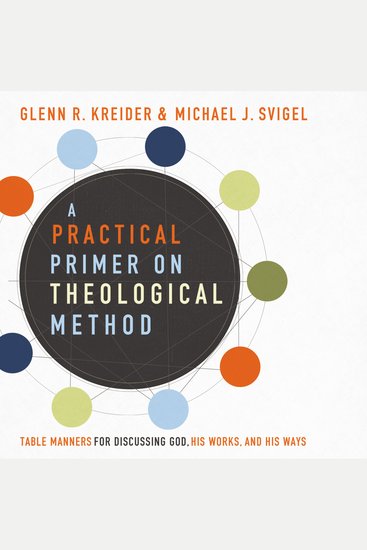
  • A Practical Primer on Theological Method - Table Manners for Discussing God His Works and His Ways - cover

    A Practical Primer on...

    Glenn R. Kreider, Michael J. Svigel

    • 0
    • 0
    • 0
    Around a table sit men and women with distinct roles: The Interpreter, the Theologian, the Virtuous, the Philosopher, the Scientist, the Artist, the Minister, and the Historian. Each is ready to engage in a passionate discussion centered on God, his works, and his ways. Regardless of which role you play at the same table, you're invited. You simply need to pull up a chair and join the conversation. But how? What do you say when you take your seat? Where do you start? What are the "rules" of the dialogue? 
    A Practical Primer on Theological Method will help you answer these questions. This primer is not only a "how-to" manual for doing theology, but a handbook of etiquette for doctrinal discussions with other believers. This popular-level introductory text presents the proper manner, mode, and means of engaging fruitfully in theology.
    Zum Buch