
Rejoignez-nous pour un voyage dans le monde des livres!
Ajouter ce livre à l'électronique
Grey
Ecrivez un nouveau commentaire Default profile 50px
Grey
Abonnez-vous pour lire le livre complet ou lisez les premières pages gratuitement!
All characters reduced
Puzzle Origins - cover

Puzzle Origins

Harriet Bookman

Traducteur A AI

Maison d'édition: Publifye

  • 0
  • 0
  • 0

Synopsis

Puzzle Origins explores the rich history of puzzles, revealing how they've shaped human intellect and culture. From ancient riddles to modern brain teasers, the book showcases puzzles not just as diversions, but as tools for critical thinking and creativity.

 
Did you know that ancient civilizations used riddles for both entertainment and intellectual sparring? Or that the Victorian era saw a boom in mechanical puzzles due to industrial advancements? 

 
The book journeys through time, beginning with ancient riddles in Egypt, Greece, and China, then moves to mechanical puzzles influenced by the Industrial Revolution. Finally, it examines logic and mathematical puzzles, connecting them to mathematics, computer science, and AI.

 
The book argues that the history of puzzles mirrors human ingenuity, demonstrating our cognitive abilities and problem-solving skills. Each section analyzes the broader impact of puzzle types on human cognition.

 
This reference work offers a comprehensive survey of puzzles, integrating perspectives from history, mathematics, and cognitive science. It presents a narrative non-fiction style, blending historical accounts with insightful analysis, making it accessible to a broad audience.
Disponible depuis: 31/03/2025.
Longueur d'impression: 63 pages.

D'autres livres qui pourraient vous intéresser

  • The Passenger: California - cover

    The Passenger: California

    Passenger The

    • 0
    • 0
    • 0
    The best new writing, photography, art, and reportage from and about California—in the “rich and engrossing” series for travelers and armchair travelers (Times Literary Supplement). 
     
    From the Gold Rush to Hollywood’s golden age to the rise of Silicon Valley, California has long stood as the brightest symbol of the American dream. In recent years, however, the country’s mainstream media has been declaring with increasing frequency—and thinly veiled schadenfreude—the “end of California as we know it.” 
     
    The pessimists point to rising inequality, racial tensions, and the impact of climate change as evidence that the Californian dream has been shattered. Between extreme heat, months-long droughts, devastating wildfires, and rising sea levels, looking at California is like watching the trailer for what awaits the world if we don’t act to reduce global warming. Faced with these pressures, more and more Californians are leaving the state, leading to an unprecedented decline in population that could change the cultural and political balance of power in the country at large. 
     
    That said, demographic decline and climate disasters don’t tell the whole story of one of the most dynamic and diverse states in the Union—one that continues to drive technological and political innovation and define the evolution of work, food, entertainment, and social relations. This volume offers a fascinating picture of California in all its complexity and contradictions—an attempt to understand the laboratory where much of the world’s future continues to be written—with pieces including: 
     
    Growing Uncertainty in the Central Valley by Anna Wiener • How Does It Feel to Be a Solution? by Vanessa Hua • The Burning of Paradise by Mark Arax • Plus: direct democracy and unsustainable development, the rise of the “land back” movement, the cultural renaissance of Los Angeles in defiance of rampant gentrification, and much more . . .  
     
    “The Passenger readers will find none of the typical travel guide sections on where to eat or what sights to see. Consider the books, rather, more like a literary vacation.” —Publishers Weekly
    Voir livre
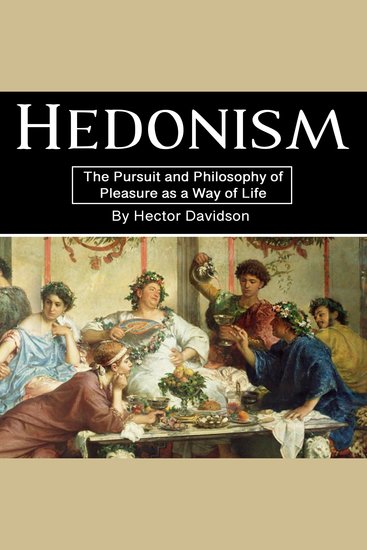
  • Hedonism - The Pursuit and Philosophy of Pleasure as a Way of Life - cover

    Hedonism - The Pursuit and...

    Hector Davidson

    • 0
    • 0
    • 0
    Hedonism, at its core, is the philosophy that pleasure is the highest good and the ultimate goal of human life. Its allure lies in the simplicity of its premise: that the pursuit of pleasure, whether physical, emotional, or intellectual, is essential to living a fulfilling life. This view is not just a modern indulgence but has deep roots in the history of philosophy, tracing back to the ancient Greeks, who were the first to systematically explore the nature of pleasure and its role in human existence. 
    The term “hedonism” derives from the Greek word hēdonē, meaning pleasure, and throughout history, philosophers have debated whether this pursuit is inherently selfish or whether it can contribute to the greater good. The Greek philosopher Aristippus of Cyrene is often credited with being one of the first to advocate for a form of hedonism, suggesting that the ability to master one’s pleasures was the key to happiness. On the other hand, Epicurus, another Greek philosopher, argued that the pursuit of simple pleasures, rather than indulgence in excess, leads to the greatest happiness. These foundational ideas have sparked ongoing discussions about the nature of pleasure and how it fits into the human quest for meaning. 
    In the centuries that followed, hedonism evolved in different directions. During the Enlightenment, thinkers like Jeremy Bentham and John Stuart Mill reinterpreted hedonism through the lens of utilitarianism, positing that the greatest happiness of the greatest number should be the guiding principle of ethical decision-making. Today, hedonism is often understood not only as a personal pursuit of pleasure but also as a cultural phenomenon that shapes modern consumerism, self-care movements, and even digital experiences.
    Voir livre
  • Life Earth and Politics - Ideas for the Next 400 Years - cover

    Life Earth and Politics - Ideas...

    Sherman Lewis

    • 0
    • 0
    • 0
    Science, not speculative philosophy, is the only guide, however imperfect, to the nature of existence. Science culture uses and supports science. The social brain experiences free will and needs religious faith. Empathy is a choice based on intuition. We need a better scientific understanding of dogma and chauvinism, and this book explores these issues. It also describes the Crisis of the Anthropocene, described in under a hundred pages, is a wakeup that needs to overcome ignorance and naïve optimism, and reach our deepest emotions. Topics include climate change, biodiversity, pollutants, population, and political causes behind the collapse. This book also presents data from Internationalcomparisons.org that demonstrates that the US is neither advanced nor a democracy and has failed to deal with guns, reproductive rights, taxation, social welfare, fiscal discipline, and other issues. Even with these already significant problems Americans must face, there is even more: Trumpism and Putinism are existential threats to American freedom and democracy. This book presents a framework for others to act in the time of these issues.
    Voir livre
  • Mexican Drug Cartels - Their Origins Their Background and Their Conflicts - cover

    Mexican Drug Cartels - Their...

    Kelly Mass

    • 0
    • 0
    • 0
    The Mexican drug war, also known as the Guerra contra el narcotráfico en México, is the Mexican theater of the global war on drugs, a campaign led by the United States federal government. This war has resulted in a protracted, asymmetric low-intensity conflict between the Mexican government and various drug trafficking organizations. The Mexican government’s main objective when it intervened militarily in 2006 was to curb drug-related violence, which had escalated in the preceding years. The government’s stated aim, in collaboration with U.S. officials, was to eliminate the cartels and reduce the demand for drugs trafficking. 
    Violence erupted after the 1989 arrest of Miguel Ángel Félix Gallardo, who was the leader and founder of Mexico’s first major drug cartel, the Guadalajara Cartel. His arrest led to the dissolution of the cartel as high-ranking members splintered off to create their own groups. This fragmentation gave rise to the Sinaloa, Juarez, Tijuana, and Sonora cartels, among others, which began to battle for control over lucrative trafficking routes and territories. This marked a new chapter in the drug war, with the cartels becoming increasingly violent in their efforts to secure dominance. 
    Mexican drug trafficking organizations have been a powerful force for decades, but their power surged significantly in the 1990s after the collapse of the Colombian Cali and Medellín cartels. By 2007, Mexican criminal groups controlled an overwhelming 90% of the cocaine entering the United States. Efforts to arrest cartel leaders, including those in the Tijuana and Gulf cartels, often resulted in even more violence, as smaller gangs competed for control over key drug trade routes into the U.S.
    Voir livre
  • The Great Famine of 1315-1317 - Europe's Darkest Hour - cover

    The Great Famine of 1315-1317 -...

    Sarah Willards

    • 0
    • 0
    • 0
    The Great Famine of 1315-1317 stands as one of the darkest periods in European history, marking a time of immense suffering, social upheaval, and devastation. It was not a single event but rather a prolonged crisis, which compounded existing vulnerabilities within medieval European society. The origins of the famine can be traced back to a confluence of environmental, social, and economic factors, all of which led to one of the worst food shortages ever experienced on the continent. 
    The famine’s roots can be found in the dramatic climatic changes of the early 14th century. The period known as the Little Ice Age brought cooler temperatures, and the years leading up to the famine saw unusual weather patterns. Prolonged rain, particularly during the summer months of 1315, led to flooding and crop failure, especially in regions dependent on staple grains like wheat, oats, and barley. The disastrous harvests were compounded by already strained food supplies and a growing population. 
    The impact of the famine was felt most acutely by the poorer classes, whose subsistence farming could not sustain them through such harsh conditions. The majority of the population in rural areas relied on farming for food and income, and with crops failing, their livelihoods were destroyed. Urban centers, though slightly better equipped to withstand hardship, faced sharp increases in food prices, making it difficult for even the wealthier classes to procure sustenance. Starvation, malnutrition, and poverty became widespread, leading to mass suffering across the continent.
    Voir livre
  • See the World Clearly - Be Happier and More Fulfilled - cover

    See the World Clearly - Be...

    Martin K. Ettington

    • 0
    • 0
    • 0
    Even in our modern technological age where Science is supposed to be preeminent we live in a fog of delusions and misinformation about our world.Our problems are a lot deeper than Pandemic issues and current political struggles. While our religions are important to human wellbeing many religious dogmas stop us from asking questions which results in hiding the truths of deeper spirituality from most of us.Through my experiences, research, and writing on topics like longevity, the paranormal, legendary beings, time and dimensional travel, aliens and UFOs, and many other subjects I have found many inconsistencies and a lack objective analysis of these subjects. Even scientists make assumptions about their topics which may not be correct.Misinformation and delusional thinking also leads to unnecessary unhappiness and to us limiting ourselves in our career choices and work endeavors.We also don’t realize that the Unconditional Love of others and our world is out there waiting for us. Once we realize this it makes us much happier and more satisfied in our lives.My goal in this book is to help readers to think more openly and clearly about the real truths which exist in our world and universe. Changing your point of view and becoming more open minded will also help you live a happier and more fulfilling life. It will also help you learn to live in the all-encompassing love of life which is our heritage as human beings.
    Voir livre