Rejoignez-nous pour un voyage dans le monde des livres!
Ajouter ce livre à l'électronique
Grey
Ecrivez un nouveau commentaire Default profile 50px
Grey
Abonnez-vous pour lire le livre complet ou lisez les premières pages gratuitement!
All characters reduced
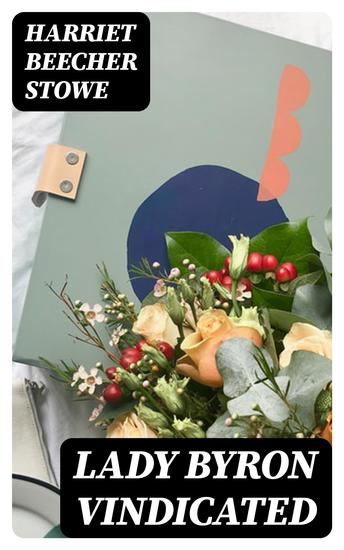
Lady Byron Vindicated - A History of the Byron Controversy - cover

Lady Byron Vindicated - A History of the Byron Controversy

Harriet Beecher Stowe

Maison d'édition: DigiCat

  • 0
  • 0
  • 0

Synopsis

In "Lady Byron Vindicated," Harriet Beecher Stowe presents a fascinating exploration of the life of Lady Byron, offering a counter-narrative to the prevailing perceptions of her character, particularly following the tumultuous marriage to the famous poet, Lord Byron. Stowe's literary style intertwines biography, social critique, and moral reflection, positioning the text within the broader context of 19th-century feminist discourse. Through meticulous research and empathetic imagination, she invites readers to reconsider Lady Byron not merely as a victim of her husband's notorious reputation but as a complex figure deserving of dignity and understanding. Harriet Beecher Stowe, best known for her groundbreaking work, "Uncle Tom's Cabin," was an ardent abolitionist and a prominent social reformer whose literary pursuits were deeply influenced by her commitment to social justice. Her interest in Lady Byron likely stemmed from her own experiences with societal norms surrounding women, marriage, and reputation, prompting her to champion Lady Byron's cause as emblematic of the struggles faced by women of her time, challenging societal expectations and injustices. This book is a compelling read for anyone interested in women's history, literary studies, or the intersections of personal and public life in the 19th century. Stowe's revival of Lady Byron's story not only serves as an engaging biography but also as a clarion call for empathy and justice, making it essential reading for those seeking to understand the deeper narratives that shape our literary and historical landscapes.
Disponible depuis: 05/09/2022.
Longueur d'impression: 247 pages.

D'autres livres qui pourraient vous intéresser

  • Another Word for Love - A Memoir - cover

    Another Word for Love - A Memoir

    Carvell Wallace

    • 0
    • 0
    • 0
    This program is read by the author.“Carvell Wallace narrates his beautiful memoir with poignant urgency-- and a whole lot of love…His voice, like his prose, has a poetic cadence. At times, his narration seems to fly, reaching higher and higher before culminating in an emotional crescendo.”—AudioFileA transformative memoir that reimagines the conventions of love and posits a radical vision for healing.  In Another Word for Love, Carvell Wallace excavates layers of his own history, situated in the struggles and beauty of growing up Black and queer in America.Wallace is an award-winning journalist who has built his career on writing unforgettable profiles, bringing a provocative and engaged sensitivity to his subjects. Now he turns the focus on himself, examining his own life and the circumstances that frame it—to make sense of seeking refuge from homelessness with a young single mother, living in a ghostly white Pennsylvania town, becoming a partner and parent, raising two teenagers in what feels like a collapsing world.With courage, vulnerability, and a remarkable expansiveness of spirit—not to mention a thrilling, and unrivaled, storytelling verve—Another Word for Love makes an irresistible case for life, healing, the fullness of our humanity, and, of course, love. It could be called a theory of life itself—a theory of being that will leave you open to the wonder of the world.A Macmillan Audio production from Farrar, Straus and Giroux.
    Voir livre
  • The Graeco-Roman Era - cover

    The Graeco-Roman Era

    Pericles, Julius Caesar, ...

    • 0
    • 0
    • 0
    Five speeches from the legendary orators Alexander the Great, Julius Caesar, Cicero, and Pericles.431 BCE: Pericles’ Funeral Oration is a valedictory and eulogy for the great age of Athenian democracy. Reported by Thucydides, it was given at the first annual public funeral for casualties of the Peloponnesian War. That war ended twenty-seven years later with the democratic government of Athens overthrown by an oligarchy known as The Four Hundred. 324BCE: Two speeches by Alexander the Great, reported by the historian Arrian in his Anabasis. Both speeches are a direct address to his army on embarking on a new campaign. The first was given in Opis, Mesopotamia, when rallying his armies to start a new campaign into Persia. The army took heart, and successfully conquered the Persian Empire, adding it to Alexander’s many existing conquests. The second speech is given after the first campaign is over. This time Alexander is ready to move into the Indian subcontinent. After travelling across the known world, the entire army took the offer to quit fighting and go home. This leaves Alexander understandably upset, and produces history’s most finely worded example of saying “After all I’ve done for you! Well, you can all get stuffed then, you bunch of ingrates. I hope you choke.”In 63BCE, the Cataline Conspiracy shook Rome. It was a deep shock to the Roman system, and risked civil war. Included here are speeches by the Consul Cicero and the only extant speech of Julius Caesar.Cicero’s First Speech is a rabble-rousing, impassioned, and slightly unhinged attack upon Cataline and his associates. It speaks to the outrage of the body politic and the masses.Caesar’s speech is a jurisprudential appeal to create no new laws to punish these crimes. Caesar argues that the republic would be ultimately harmed if they were not punished only under existing laws, as people remember the punishment but not the crime.
    Voir livre
  • Socrates - Socrates Philosophy and the Examined Life - cover

    Socrates - Socrates Philosophy...

    Hector Davidson

    • 0
    • 0
    • 0
    Socrates stands as one of the most influential figures in the history of philosophy, a thinker whose ideas and methods continue to shape intellectual inquiry. Born in Athens around 469 BCE, he never wrote a single philosophical text, yet his impact endures through the works of his students, particularly Plato. His approach to philosophy was rooted in dialogue, questioning, and an unwavering commitment to seeking truth. Unlike the Sophists of his time, who often prioritized rhetorical skill and persuasion, Socrates believed that wisdom was not about appearing knowledgeable but about recognizing one’s own ignorance. His method of relentless questioning, now known as the Socratic Method, remains a cornerstone of critical thinking and philosophical discourse. 
    Socrates lived during a period of great political and social upheaval in Athens. The city had emerged from the Peloponnesian War weakened and uncertain about its future. In this context, Socrates became both an admired and controversial figure. His insistence on questioning authority and challenging conventional beliefs made him a target for those who saw his influence as destabilizing. He did not align himself with any particular political faction but instead sought to examine the moral and ethical foundations of society. His discussions often exposed the contradictions in the reasoning of politicians, poets, and fellow citizens, leading many to view him as a disruptive force. 
    His trial in 399 BCE remains one of the most significant moments in philosophical history. Accused of corrupting the youth and impiety, Socrates defended himself in a manner that was both defiant and deeply philosophical. In The Apology, Plato’s account of the trial, Socrates argues that he was fulfilling a divine mission by encouraging people to think critically and examine their lives.
    Voir livre
  • William Wallace - The History Facts and Fight for Freedom of a Scottish Hero - cover

    William Wallace - The History...

    Kelly Mass

    • 0
    • 0
    • 0
    The Film "Braveheart" has it right on some points but does a bad job with historic precision with others, most likely because they're just attempting to dramatize a Hollywood film, not promoting dull precision. 
    Let's see what info we can learn from history about the real William Wallace. William Wallace was a Scottish knight. In order to comprehend the impact of that time's knight civilization and roles, we will discuss the idea itself. We will also discuss the brutal reign of Edward I of England, the sadistic murder of William Wallace (worse than you might think), and several other factors contributing to his capture, his resistance, and his following.
    Voir livre
  • The Yakuza - History and Background of Japan’s Most Powerful Criminal Gang - cover

    The Yakuza - History and...

    Kelly Mass

    • 0
    • 0
    • 0
    The Yakuza were members of large-scale organized criminal syndicates based in Japan, known for their deeply entrenched criminal activities and distinctive cultural identity. Officially referred to as "violent organizations" at the request of Japanese authorities, the Yakuza bear similarities to gangsters or mafia members in the West. Their reputation is tied to strict codes of conduct, an internally hierarchical and feudal structure, and an array of unique ritual practices. Among the most notorious of these customs is *yubitsume*, the ritualistic amputation of part of the left little finger, used as a form of atonement for mistakes or failure within the organization. This physical mark is often a telling sign of membership. Yakuza members were typically described as males in sharp suits, their bodies adorned with elaborate, full-body tattoos, and their hair slicked back in a signature style. They are regarded as one of the most powerful and financially successful criminal groups in the world. 
    At the height of their influence, the Yakuza wielded considerable power both in Japan and internationally. In the early 1960s, police estimates placed the total Yakuza membership at over 200,000 members, a number that has significantly declined in recent decades. The reduction in their ranks can be attributed to a combination of economic shifts and legal reforms that made it increasingly difficult for the Yakuza to operate as they once had. Despite this, the Yakuza remain involved in a wide variety of criminal enterprises today, ranging from drug trafficking to white-collar crime, and continue to instill fear among many Japanese citizens, who view them as a persistent threat to public safety.
    Voir livre
  • Under The Knife - Life Lessons From The Operating Theatre - cover

    Under The Knife - Life Lessons...

    Liz O'Riordan

    • 0
    • 0
    • 0
    Dr Liz O’Riordan is a breast cancer surgeon who has battled against social, physical and mental challenges to practise at the top of her field. Under the Knife charts Liz’s incredible highs: performing like a couture dressmaker as she moulded and reshaped women’s breasts, while saving their lives; to the heart-breaking lows of telling ten women a day that they had cancer. 
     
    But this memoir is more than just an eye-opening look at the realities of training to be a female surgeon in a man’s world. In addition to this high-powered, high-pressured role, Liz faced her own breast cancer diagnosis, severe depression and suicidal thoughts, in tandem with commonplace sexual harassment and bullying. And by revealing how she coped when her life crashed around her, she demonstrates there is always hope.
    Voir livre