Begleiten Sie uns auf eine literarische Weltreise!
Buch zum Bücherregal hinzufügen
Grey
Einen neuen Kommentar schreiben Default profile 50px
Grey
Jetzt das ganze Buch im Abo oder die ersten Seiten gratis lesen!
All characters reduced
Learning from Asia in Education - How the West Can Learn from the East in Education in the 21st Century - cover

Learning from Asia in Education - How the West Can Learn from the East in Education in the 21st Century

Halász Gábor, Setényi János

Verlag: MCC Press

  • 0
  • 0
  • 0

Beschreibung

This book is the outcome of two years of work for the Learning from Asia project, run by the Learning Institute of the Mathias Corvinus Collegium (MCC) in cooperation with several well-established international educational researchers and Asian doctoral students studying in Hungary. The chapters of the book are modified versions of papers presented by their authors at the Learning from Asia in Education conference held at MCC’s Budapest Center in Autumn 2023. Within the pages of this book, you will discover novel practices and innovative approaches, shedding light on how the West can learn from the East in education in the 21st century.The volume is organized into three parts, as follows: a framework, written by the leaders of the Learning from Asia project, conceptualizing its purpose and background; nine expert studies by invited academics, outstanding international experts who share their ideas about Asia–Europe learning; and eight chapters contributed by Asian doctoral students studying in Hungary, who present their research findings using the ‘Asia as method’ approach. The book concludes with an epilogue, reflecting on the whole book and the conception of the Learning from Asia project.Authors: János Setényi, Gábor Halász, János Gordon Győri, Yun You, Katherine Forestier, Chang Da Wan, Que Anh Dang, Yan Liu, Lucia Chauvet, Wei Zhang, Mark Bray, Byambasuren Nyamkhuu, Adrian Estrela Pereira, Sounantha Phavadee, Attila Czabaji Horváth, Thiri Pyae Kyaw, Moldir Pocstar, Pu Yu, Yang Yang, Anisa Trisha Oroc Pabingwit, Mária Hercz, Yingjie Xu, Diya Peng, Marhadi Marhadi, Cifebrima Suyastri, Aisi Li
Verfügbar seit: 01.11.2024.
Drucklänge: 420 Seiten.

Weitere Bücher, die Sie mögen werden

  • Immigration - The Complexities and Realities of Borderless Movements (2 in 1) - cover

    Immigration - The Complexities...

    Marcus Klein

    • 0
    • 0
    • 0
    This book consists of two titles, which are: 
    Border Control: In today’s interconnected world, the challenge of managing borders has become one of the most contentious issues facing governments, societies, and international organizations. Border control, at its core, is a delicate balance between maintaining national security and upholding human rights, between enforcing laws and fostering economic opportunities. As global mobility increases through migration, trade, and technology, managing borders has evolved into a complex issue that transcends national boundaries. It’s no longer just a matter of controlling who enters and exits a country; it’s about managing flows of people, goods, information, and even ideas in ways that protect citizens while also adhering to international law.  
    Refugees: The refugee crisis is one of the most pressing humanitarian challenges of our time. Across the globe, millions of individuals are forced to flee their homes due to conflict, violence, persecution, and natural disasters. These displaced individuals, known as refugees, face an uncertain future, often enduring unimaginable hardships in their quest for safety and stability. As of recent estimates, more than 100 million people have been forcibly displaced, with a significant portion seeking refuge in countries that already face their own social, political, and economic challenges. The sheer scale and complexity of the crisis demand urgent attention from governments, international organizations, and civil society to find sustainable solutions.
    Zum Buch
  • American Civil War in 1864 The: The History and Legacy of the War’s Penultimate Year - cover

    American Civil War in 1864 The:...

    Editors Charles River

    • 0
    • 0
    • 0
    Americans have long been fascinated by the Civil War, marveling at the size of the battles, the leadership of the generals, and the courage of the soldiers. Since the war's start over 150 years ago, the battles have been subjected to endless debate among historians and the generals themselves. The Civil War was the deadliest conflict in American history, and had the two sides realized it would take 4 years and inflict over a million casualties, it might not have been fought. Since it did, however, historians and history buffs alike have been studying and analyzing the biggest battles ever since.  
    	By the close of 1864, Abraham Lincoln had been reelected, the Union army had taken Nashville from General Hood, and Sherman had concluded his total war, “slash-and-burn” march of destruction to Savannah, Georgia, offering it as a Christmas present to Lincoln. Nevertheless, with everything seemingly falling to pieces, the South still held out hope of some sort of miracle, and Davis even attempted to send a peace delegation to meet with Lincoln in the early months of 1865. On January 28, 1865 as Union General Ulysses S. Grant was continuing to lay siege to Lee’s army at Petersburg, Virginia, Davis sent three commissioners headed by Vice-President Stephens to initiate informal peace talks with Lincoln. By February 3, however, the talks, known as the Hampton Roads Conference, came to a stalemate as Lincoln would accept nothing less than total union, while Davis would only accept Southern independence.  
    	Even at that point, the South was clearly on its last legs. General George H. Thomas destroyed John Bell Hood’s Confederate army at the battles of Nashville and Franklin, leaving only two large Confederate armies still in the field. Lee's army was weakened by desertion, lack of supplies and casualties, and Joseph E. Johnston’s army could barely resist against Sherman’s army as it was advancing north toward Virginia.
    Zum Buch
  • The New Science of the Enchanted Universe - An Anthropology of Most of Humanity - cover

    The New Science of the Enchanted...

    Marshall Sahlins

    • 0
    • 0
    • 0
    From the perspective of Western modernity, humanity inhabits a disenchanted cosmos. Gods, spirits, and ancestors have left us for a transcendent beyond. Yet the vast majority of cultures throughout human history treat spirits as very real persons, members of a cosmic society who interact with humans and control their fate. In most cultures, even today, people are but a small part of an enchanted universe misconstrued by the transcendent categories of "religion" and the "supernatural." The New Science of the Enchanted Universe shows how anthropologists and other social scientists must rethink these cultures of immanence and study them by their own lights. 


    In this, his last, revelatory book, Marshall Sahlins announces a new method and sets an exciting agenda for the field. He takes listeners around the world. In the process, Sahlins sheds new light on classical and contemporary ethnographies that describe these cultures of immanence and reveals how even the apparently mundane, all-too-human spheres of "economics" and "politics" emerge as people negotiate with, and ultimately usurp, the powers of the gods. 


    The New Science of the Enchanted Universe offers a road map for a new practice of anthropology that takes seriously the enchanted universe and its transformations from ancient Mesopotamia to contemporary America.
    Zum Buch
  • Slim by Design - Mindless Eating Solutions for Everyday Life - cover

    Slim by Design - Mindless Eating...

    Anonym

    • 0
    • 0
    • 0
    In Slim by Design, leading behavioral economist, food psychologist, and bestselling author Brian Wansink introduces groundbreaking solutions for designing our most common spaces—schools, restaurants, grocery stores, and home kitchens, among others—in order to make positive changes in how we approach and manage our diets. 
    Anyone familiar with Wansink’s Mindless Eating knows this is not a typical diet book. Wansink shares his scientific approach to eating, providing insight and information, so we can all make better choices when it comes to food. 
    The pioneer of the Small Plate Movement, Brian Wansink presents compelling research conducted at the Food and Brand Lab at Cornell University by way of cartoons, drawings, charts, graphs, floor plans, and more. Slim by Design offers innovative ways to make healthy eating mindlessly easy.
    Zum Buch
  • The Environmental Unconscious - Ecological Poetics from Spenser to Milton - cover

    The Environmental Unconscious -...

    Steven Swarbrick

    • 0
    • 0
    • 0
    Why has psychoanalysis long been kept at the margins of environmental criticism despite the theories of eco-Marxism, queer ecology, and eco-deconstruction available today? What is unique, possibly even traumatic, about eco-psychoanalysis? The Environmental Unconscious addresses these questions as it provides an innovative and theoretical account of environmental loss focused on the counterintuitive forms of enjoyment that early modern poetry and psychoanalysis jointly theorize. 


    Steven Swarbrick urges literary critics and environmental scholars to rethink notions of entanglement, animacy, and consciousness raising. Through close readings of Edmund Spenser, Walter Ralegh, Andrew Marvell, and John Milton, he reveals a world of matter that is not merely hyperconnected, as in the new materialism, but porous and off-kilter. And yet the loss these poets reveal is central to the enjoyment their works offer—and that nature offers. 


    The Environmental Unconscious offers a provocative challenge to ecocriticism that a new theory of disconnection is desperately needed. Tracing the propulsive force of the environmental unconscious from the early modern period to Freudian and post-Freudian theories of desire, Swarbrick not only puts nature on the couch in this book but also renews the psychoanalytic toolkit in light of environmental collapse.
    Zum Buch
  • AUSCHWITZ CHILDREN AND MENGELE EXPERIMENTS - The Immoral and Atrocious Research on Children in the Auschwitz Concentration Camp during World War II - cover

    AUSCHWITZ CHILDREN AND MENGELE...

    Jack Stew Barretta

    • 0
    • 0
    • 0
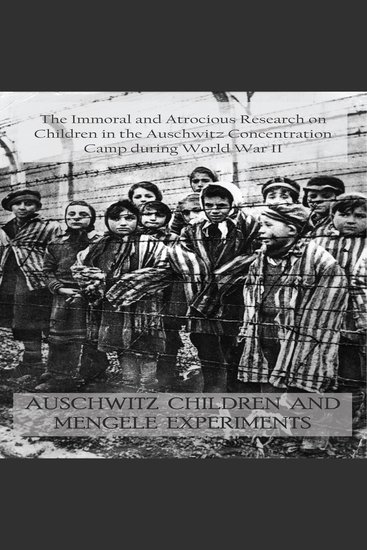
    In the name of humanity, that was the explanation of Dr. Claus Karl Schilling for the execution of malaria experiments on 1,200 inmates of the Dachau concentration camp during the Second World War. The reputable Schilling had come to Dachau with the personal permission of the Reichsführer-SS Heinrich Himmler in 1942 because he could use the prisoners as research subjects without the restriction of obtaining their consent. Schilling was not an exception.  
    Many Nazi doctors seized the unique opportunity to execute human experiments without legal and ethical restrictions during the war. The SS and the Wehrmacht either initiated or supported the research of the Nazi doctors. The central question that puzzled jurists and scientists is how these doctors, who were educated to heal people, could execute human experiments and deliberately harm and even kill people. To some scientists, their acts stand out as ‘exemplars of evil.’ This judgment is based on the fact that prisoners did not give their informed consent, the cruel and sometimes sadistic character of the experiments, and because never before in medical experiments was the death of the research subjects a central element of the research design. Many people think that ‘science went mad’ in the Third Reich and that Nazi doctors who committed these crimes were pseudo-scientists, sadists, and even monsters. However, thinking these perpetrators were madmen or monsters is a false explanation.  
    It is confronting to know that physicians belonging to the most advanced medical community in the world at the time, who had sworn to ‘do no harm, ' could commit these crimes. 
    On this trail, Dr. Josef Mengele’s pseudo-scientific research at the Auschwitz concentration camp during World War II led to immeasurable suffering among the camp’s children.
    Zum Buch