Rejoignez-nous pour un voyage dans le monde des livres!
Ajouter ce livre à l'électronique
Grey
Ecrivez un nouveau commentaire Default profile 50px
Grey
Abonnez-vous pour lire le livre complet ou lisez les premières pages gratuitement!
All characters reduced
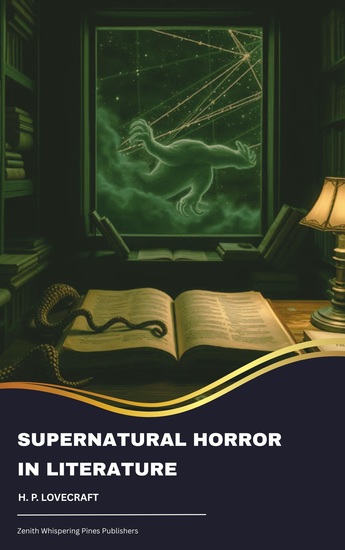
Supernatural Horror in Literature - cover

Supernatural Horror in Literature

H. P. Lovecraft

Maison d'édition: Zenith Whispering Pines Publishers

  • 0
  • 0
  • 0

Synopsis

What makes a story truly terrifying? H. P. Lovecraft, the master of cosmic dread, gives you the answer.

Supernatural Horror in Literature is not a story, but an essential work of literary criticism and history, written by the mind that defined modern horror. This comprehensive essay traces the evolution of the "weird tale" from the Gothic masters like Poe and Radcliffe to the modern fantasists, culminating in Lovecraft's own philosophy of cosmic horror.


Dive into Lovecraft's incisive analysis of the genre's greatest practitioners, including Edgar Allan Poe, Ambrose Bierce, Henry James, and Arthur Machen. Discover his famous defense of the literature of absolute terror and his argument that the most potent fear is derived from humanity's deep-seated unease about its place in an infinite, unknowable cosmos. This book provides a key to understanding Lovecraft's entire fictional universe—the Cthulhu Mythos—and is required reading for any serious student or fan of the genre.

Uncover the secrets of the supernatural. Click "Buy Now" to instantly download this definitive critical work and gain a new appreciation for the chilling history of horror.
Disponible depuis: 09/12/2025.
Longueur d'impression: 105 pages.
D'autres livres qui pourraient vous intéresser

  • Les Misérables: Volume 1: Fantine - Book 8: A Counter-Blow (Unabridged) - cover

    Les Misérables: Volume 1:...

    Victor Hugo

    • 0
    • 0
    • 0
    Victor-Marie Hugo (26 February 1802 - 22 May 1885) was a French poet, novelist, essayist, playwright, and dramatist of the Romantic movement. During a literary career that spanned more than sixty years, he wrote abundantly in an exceptional variety of genres: lyrics, satires, epics, philosophical poems, epigrams, novels, history, critical essays, political speeches, funeral orations, diaries, and letters public and private, as well as dramas in verse and prose.
    BOOK 8: A COUNTER-BLOW: The day had begun to dawn. Fantine had passed a sleepless and feverish night, filled with happy visions; at daybreak she fell asleep. Sister Simplice, who had been watching with her, availed herself of this slumber to go and prepare a new potion of chinchona.
    Voir livre
  • At Christmas Time - From their pens to your ears genius in every story - cover

    At Christmas Time - From their...

    Anton Chekhov

    • 0
    • 0
    • 0
    Anton Pavlovich Chekhov was born on 29th January 1860 in Taganrog, on the south coast of Russia.  
    His family life was difficult; his father was strict and over-bearing but his mother was a passionate story-teller, a subject Chekhov warmed to. As he later said; ‘our talents we got from our father, but our soul from our mother’.  
    At school Chekhov was distinctly average. At 16 his father mis-managed his finances and was declared bankrupt. His family fled to Moscow. Chekhov remained and eked out a living by various means, including writing and selling short sketches to newspapers, to finish his schooling. That completed and with a scholarship to Moscow University obtained he rejoined his family. 
    He was able to help support them by selling satirical sketches and vignettes of Russian lifestyles and gradually obtained further commissions. In 1884, he qualified as a physician and, although it earned him little, he often treated the poor for free, he was fond of saying ‘Medicine is my lawful wife, and literature is my mistress.’ 
    His own health was now an issue as he began to cough up blood, a symptom of tuberculosis.  Despite this his writing success enabled him to move the family into more comfortable accommodation.  
    Chekhov wrote over 500 short stories which included many, many classics including ‘The Kiss’ and ‘The Lady with a Dog’.  His collection ‘At Dusk’ won him the coveted Pushkin Prize when was only 26.  
    He was also a major playwright beginning with the huge success of ‘Ivanov’ in 1887.   
    In 1892 Chekhov bought a country estate north of Moscow. Here his medical skills and money helped the peasants tackle outbreaks of cholera and bouts of famine. He also built three schools, a fire station and a clinic.  It left him with less time for writing but the interactions with real people gained him detailed knowledge about the peasantry and their living conditions for his stories.  
    His most famous work, ‘The Seagull’ was received disastrously at its premiere in St Petersburg. It was later restaged in Moscow to highlight its psychological aspects and was a huge success. It led to ‘Uncle Vanya’, ‘The Three Sisters’ and ‘The Cherry Orchard’.  
    Chekhov suffered a major lung hemorrhage in 1897 while visiting Moscow. A formal diagnosis confirmed tuberculosis and the doctors ordered changes to his lifestyle.  
    Despite a dread of weddings the elusive literary bachelor quietly married the actress Olga Knipper, whom he had met at rehearsals for ‘The Seagull’, on 25th May 1901. 
    By May 1904 with his tuberculosis worsening and death imminent he set off for the German town of Badenweiler writing cheerful, witty letters to his family and assuring them his health was improving.  
    On 15th July 1904 Anton Chekhov died at Badenweiler.  He was 44.
    Voir livre
  • Essays and Lectures (Unabridged) - cover

    Essays and Lectures (Unabridged)

    Oscar Wilde

    • 0
    • 0
    • 0
    'Essays and Lectures' is a collection of essays and lectures by Oscar Wilde. 'Essays and Lectures' contains "The Rise of Historical Criticism", "The English Renaissance of Art", "House Decoration", "Art and the Handicraftsman", "Lecture to Art Students", "London Models" and "Poems in Prose".
    Voir livre
  • Home Life Relayed - BBC presents a live show from a family house with disastrous consequences - cover

    Home Life Relayed - BBC presents...

    E M Delafield

    • 0
    • 0
    • 0
    Edmée Elizabeth Monica Dashwood, née de la Pasture, and more commonly known as E M Delafield, was born in Steyning, Sussex on 9th June 1890.   
     
    Raised in the fading years of the Victorian era with its Empire and strict moral codes Delafield, not yet married at twenty-one, joined a French religious order, in Belgium, but soon decided that this was a totally wrong choice for her.   
     
    Her next challenge was her work during the horror of the First World War.  Delafield decided to take up a position as a nurse in a Voluntary Aid Detachment in Exeter.  It was whilst here that she managed to write her first novel, ‘Zella Sees Herself’.   
     
    With the end of the war new opportunities were sought and she now took up a position for the South-West Region of the Ministry of National Service in Bristol.  With it came enough time to write two more novels: ‘The War Workers’ (1918) and ‘The Pelicans’ (1918).   
     
    On 17th July 1919, she married Colonel Arthur Paul Dashwood, OBE, an engineer responsible for building the massive docks at Hong Kong Harbour.  The marriage produced two children; Lionel and Rosamund.  That same year her fourth novel, ‘Consequences’, was published.   
     
    The couple spent their early years in Malaya but returned to England to live in Croyle, an old house in Kentisbeare, Devon.  Delafield continued to collect responsibilities and organise whatever she could.  At the initial meeting of the Kentisbeare Women's Institute, Delafield was unanimously elected president, and also became a Justice of the Peace, raised the children and, of course, continued to write her best-selling novels.   
     
    Her greatest work is undoubtedly the largely autobiographical ‘Diary of a Provincial Lady’, which is a simply structured journal of the life of an upper-middle class Englishwoman, living mostly in a Devon village of the 1930s.  It spawned several best-selling sequels.  Her works also includes stage and radio plays, film scripts and short stories.  
     
    After the death of her son in 1940, her health began to markedly decline.    
     
    E M Delafield died on 2nd December 1943 after collapsing whilst giving a lecture in Oxford.  She was 53.
    Voir livre
  • The Eye of the Camera - From their pens to your ears genius in every story - cover

    The Eye of the Camera - From...

    Fred M. White

    • 0
    • 0
    • 0
    Richard Bernard Heldmann was born on 12th October 1857, in St Johns Wood, North London.  
    By his early 20’s Heldmann began publishing fiction for the myriad magazine publications that had sprung up and were eager for good well-written content.  
    In October 1882, Heldmann was promoted to co-editor of Union Jack, a popular magazine, but his association with the publication ended suddenly in June 1883.  It appears Heldman was prone to issuing forged cheques to finance his lifestyle.  In April 1884 he was sentenced to 18 months hard labour. 
    In order to be well away from the scandal and the damage that this had caused to his reputation Heldmann adopted a pseudonym on his release from jail.  Shortly thereafter the name ‘Richard Marsh’ began to appear in the literary periodicals.  The use of his mother’s maiden name as part of it seems both a release and a lifeline. 
    A stroke of very good fortune arrived with his novel ‘The Beetle’ published in 1897.  This would turn out to be his greatest commercial success and added some much-needed gravitas to his literary reputation.   
    Marsh was a prolific writer and wrote almost 80 volumes of fiction as well as many short stories, across many genres from horror and crime to romance and humour.   His unusual characters, plotting devices and other literary developments have identified his legacy as one of the best British writers of his time.   
    Richard Marsh died from heart disease in Haywards Heath in Sussex on 9th August 1915.  He was 57.
    Voir livre
  • These Old Shades - cover

    These Old Shades

    Georgette Heyer

    • 0
    • 6
    • 0
    The Georgian romance that launched the career of the New York Times–bestselling author is “the sort of tale which leaves us breathless with delight.” —Boston Evening Transcript   When the Duke of Avon encounters a mistreated young boy on the streets of Paris, he employs the lad as his page. As the duke’s closest friends ponder his actions, the precocious Léon soon becomes the talk of the aristocracy.   Léon cannot believe his good fortune after being saved from a brutal beating by his older brother. He follows the duke around like a loyal puppy, a constant source of amusement for the duke, who is seen by himself—and by society—as a devious scoundrel, well deserving of his nickname, Satanas.   But when Avon uncovers Léon’s biggest secret—that the boy is in fact a girl named Léonie—he acts honorably, taking her to his sister in London to learn the ways of the fairer sex, before he can adopt her. For Avon can’t believe his luck. A trump card has fallen into his hands. If Léonie is who the duke suspects she is, she’ll be the perfect weapon to use against his greatest nemesis. He embarks on his quest for revenge, never foreseeing just how Léonie’s transformation will change the game . . .   “Wonderful characters, elegant, witty writing, perfect period detail, and rapturously romantic.” —Katie Fforde   “A world of high romance, of adventure, of passions that shimmer just beneath the surface.” —Stephanie Laurens, #1 New York Times–bestselling author   “You’re in for a treat.” —Nora Roberts, #1 New York Times–bestselling authorThe Georgian romance that launched the career of the New York Times–bestselling author is “the sort of tale which leaves us breathless with delight.” —Boston Evening Transcript   When the Duke of Avon encounters a mistreated young boy on the streets of Paris, he employs the lad as his page. As the duke’s closest friends ponder his actions, the precocious Léon soon becomes the talk of the aristocracy.   Léon cannot believe his good fortune after being saved from a brutal beating by his older brother. He follows the duke around like a loyal puppy, a constant source of amusement for the duke, who is seen by himself—and by society—as a devious scoundrel, well deserving of his nickname, Satanas.   But when Avon uncovers Léon’s biggest secret—that the boy is in fact a girl named Léonie—he acts honorably, taking her to his sister in London to learn the ways of the fairer sex, before he can adopt her. For Avon can’t believe his luck. A trump card has fallen into his hands. If Léonie is who the duke suspects she is, she’ll be the perfect weapon to use against his greatest nemesis. He embarks on his quest for revenge, never foreseeing just how Léonie’s transformation will change the game . . .   “Wonderful characters, elegant, witty writing, perfect period detail, and rapturously romantic.” —Katie Fforde   “A world of high romance, of adventure, of passions that shimmer just beneath the surface.” —Stephanie Laurens, #1 New York Times–bestselling author   “You’re in for a treat.” —Nora Roberts, #1 New York Times–bestselling author
    Voir livre