Begleiten Sie uns auf eine literarische Weltreise!
Buch zum Bücherregal hinzufügen
Grey
Einen neuen Kommentar schreiben Default profile 50px
Grey
Jetzt das ganze Buch im Abo oder die ersten Seiten gratis lesen!
All characters reduced
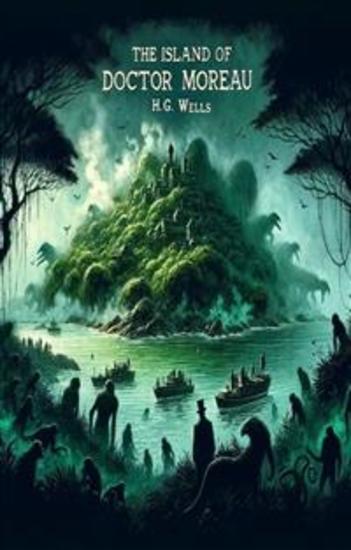
The Island of Doctor Moreau(Illustrated) - cover

The Island of Doctor Moreau(Illustrated)

H. G. Wells

Verlag: Micheal Smith

  • 0
  • 0
  • 0

Beschreibung

Illustrated Edition: Includes 20 stunning illustrations that bring the story's thrilling and unsettling moments to life.
	Bonus Features: Contains a detailed summary, a comprehensive list of characters, and a captivating biography of the author, H.G. Wells, providing deeper insight into the classic tale.

Dive into the heart of darkness and discovery with H.G. Wells's timeless science fiction masterpiece, The Island of Doctor Moreau. This illustrated edition breathes new life into Wells's chilling narrative, enriched with 20 evocative illustrations that capture the imagination and enhance the reading experience. Beyond the tale itself, this edition offers readers a comprehensive summary, an in-depth character list, and a fascinating biography of H.G. Wells, offering a complete package for both newcomers and returning fans.
Set on a secluded island, the story unfolds through the eyes of Edward Prendick, a shipwreck survivor who stumbles upon the secretive experiments of the notorious Doctor Moreau. Moreau, a scientist with godlike ambitions, has embarked on a quest to transform animals into human-like beings through vivisection and genetic engineering. What follows is a harrowing exploration of the boundaries of science and morality, civilization and savagery, and the essence of humanity itself.
As Prendick delves deeper into the mysteries of the island, he encounters a cast of unforgettable characters — from the tragic figures of the Beast Folk to the complex personalities of Moreau and his assistant, Montgomery. Each illustration in this edition highlights key moments and characters, enriching the narrative and inviting readers to visualize the story's most compelling scenes.
The Island of Doctor Moreau is not just a tale of adventure and horror; it is a profound commentary on human nature, scientific hubris, and the ethical dilemmas that arise when man seeks to play god. This illustrated edition, with its additional content, offers a comprehensive look at one of science fiction's most enduring stories, ensuring that Wells's thought-provoking novel remains accessible and engaging for today's readers.
Embark on a journey to The Island of Doctor Moreau, where the limits of humanity and the shadows of ambition intertwine in a timeless tale of science and survival. This illustrated edition promises not only a captivating reading experience but also a deep dive into the themes and ideas that make H.G. Wells's work a cornerstone of science fiction literature.
Verfügbar seit: 09.01.2024.
Weitere Bücher, die Sie mögen werden

  • Top 10 Short Stories The - Eastern Europe - The top ten short stories of all time written by authors from Eastern Europe - cover

    Top 10 Short Stories The -...

    Franz Kafka, Anton Chekhov,...

    • 0
    • 0
    • 0
    The Top 10 – Eastern Europe - An Introduction 
     
    From the Central plain of Europe to the Urals, many thousands of miles away, the nations of Eastern Europe have risen to become Empires and fallen underfoot to others.  Their literary tradition has always been strong and vibrant, bold and beguiling.  Within the many cultures and societies the narrative of the human condition is told in many startling and beautiful ways. 
     
    Short stories have always been a sort of instant access into an author’s brain, their soul and heart.  A few pages can lift our lives into locations, people and experiences with a sweep of landscape, narration, feelings and emotions that is difficult to achieve elsewhere. 
     
    In this series we try to offer up tried and trusted ‘Top Tens’ across many different themes and authors. But any anthology will immediately throw up the questions – Why that story? Why that author?  
     
    The theme itself will form the boundaries for our stories which range from well-known classics, newly told, to stories that modern times have overlooked but perfectly exemplify the theme.  Throughout the volume our authors whether of instant recognition or new to you are all leviathans of literature. 
     
    Some you may disagree with but they will get you thinking; about our choices and about those you would have made.  If this volume takes you on a path to discover more of these miniature masterpieces then we have all gained something. 
     
    Some you may disagree with but they will get you thinking; about our choices and about those you would have made.  If this volume takes you on a path to discover more of these miniature masterpieces then we have all gained something. 
     
    1 - The Top Ten - Eastern Europe - An Introduction 
    2 - A Hunger Artist by Franz Kafka 
    3 - The Lady with the Dog by Anton Chekhov 
    4 - The Cloak by Nikolai Gogol also known as 'The Overcoat' 
    5 - The District Doctor by Ivan Turgenev 
    6 - The Shot by Alexander Pushkin 
    7 - A Legend of Old Egypt by Boleslaw Prus 
    8 - Hide And Seek or Pliatki by Fyodor Sologub 
    9 - Silence by Leonid Nikolaevich Andreyev 
    10 - The Bundle of Letters by Moritz Jokai 
    11 - The Chamomile Drops by Jaroslav Hasek
    Zum Buch
  • The Facts in the Case of M Valdemar - cover

    The Facts in the Case of M Valdemar

    Edgar Allan Poe

    • 0
    • 0
    • 0
    Title: The Facts in the Case of M. Valdemar 
    Author: Edgar Allan Poe 
    Narrator: Jonathan Dunne 
    Original Publication: 1845 
    Public Domain: Yes 
    Series Placement: Number 48 in the Timeless Terrors series 
    Description: 
    The Facts in the Case of M. Valdemar is one of Edgar Allan Poe’s most macabre and unsettling tales — a dark blend of science, mesmerism, and the boundaries of death itself. 
    Told in the clinical yet horrified voice of a mesmerist, the story recounts an experiment performed on a dying man — one meant to test whether the human spirit can be held between life and death by hypnosis. What follows is a grotesque and unforgettable account of suspended mortality, decomposition, and the terrible price of curiosity. 
    A masterpiece of Gothic horror and proto-science fiction, Poe’s tale remains as shocking today as it was in 1845 — a story that anticipates both modern medical ethics and the existential terror of consciousness trapped beyond the grave. 
    Narrated by Amazon-bestselling horror author Jonathan Dunne, this performance channels Poe’s eerie precision and the suffocating dread of the impossible made real. While the text is in the public domain, this narration is an original performance and copyright © 2025 Jonathan Dunne. 
    Part of Timeless Terrors, a series devoted to resurrecting the masters of the macabre and uncanny, The Facts in the Case of M. Valdemar endures as one of Poe’s most chilling studies in the unnatural stillness between death and decay — where science dares to trespass upon the soul.
    Zum Buch
  • Lazarus - cover

    Lazarus

    Leonid Andreyev

    • 0
    • 0
    • 0
    What did Lazarus see beyond the veil of death?
    In this haunting masterpiece of psychological and philosophical fiction, Leonid Andreyev conjures a vision of resurrection unlike any ever imagined. Lazarus is not a tale of triumph over death—but of what death leaves behind.
    Strange, unsettling, and metaphysical, this is the story of a man raised from the grave only to cast a cold, unblinking gaze back upon the living. Wherever he walks, beauty withers, joy dissolves, and the veneer of meaning slips away. Those who look into his eyes do not die—they unravel.
    Written in a feverish prose that borders on the ecstatic and apocalyptic, Lazarus is a hypnotic meditation on the abyss that separates existence from extinction—and the unspeakable truth that might wait on the other side.
    Perfect for listeners drawn to existential horror, metaphysical fiction, or the eerie brilliance of Dostoevsky, Kafka, or Poe.
    Zum Buch
  • When I Was Dead - A creepy horror story exploring death - cover

    When I Was Dead - A creepy...

    Vincent O'Sullivan

    • 0
    • 0
    • 0
    Vincent O'Sullivan was born on the 28th November 1868 in New York City.  He was initially educated through the New York public school system before finishing his studies in England.  As a young man he remained in London and travelled often to Paris.  
    O’Sullivan lived a very comfortable life with income from the family coffee business.  He had no real need to work but decided that a literary lifestyle was for him.   
    In 1896 he released his first volume of supernatural fiction ‘A Book of Bargains’.  Within its pages were classic stories that involved pacts with the Devil, reanimated corpses and psychic vampires. 
    Over the course of his career, he wrote a mere 10 volumes of short stories, novels, poetry together with some occasional criticism. 
    In 1909 his brother, who ran the company, entered its resources into some terribly mis-timed trades in coffee futures and ruin for both the company and the family quickly followed. 
    From now until his death O’Sullivan was destitute, life was exceedingly difficult. 
    Vincent O’Sullivan died on the 18th July 1940 in Paris.  He was 71.  He was buried in a paupers grave along with the remains of others.
    Zum Buch
  • Gentle Breathing - From their pens to your ears genius in every story - cover

    Gentle Breathing - From their...

    Ivan Bunin

    • 0
    • 0
    • 0
    Ivan Alekseyevich Bunin was born on 22nd October 1870 in Voronezh province, in the South-West of the Russian Empire. 
    His early life was plagued by his Father’s gambling habits which caused his education to be erratic and the family to lose most of their wealth. 
    Bunin published his first poem in 1887 in St Petersburg and later in Oryol he worked for the local paper and became its editor, handily allowing him to publish his own poems and short stories.  There he met and married Varvara Pashchenko.  Ivan Bunin's debut book of poetry ‘Poems (1887–1891)’ was published in 1891. 
    This poetry and his translation of Longfellow garnered him his first Pushkin Prize.  Now he switched to writing prose and his novella ‘Antonov Apples’ is regarded as his first masterpiece.  Many more would follow. 
    The October Revolution of 1905 found Bunin in the Crimea.  Scenes of ‘class struggle’ he saw more as the oppressed people's craving for anarchy and destruction. 
    In November 1906 he began a passionate affair with Vera Muromtseva, within a few months they were touring through Egypt and Palestine.  ‘The Bird's Shadow’ collection was the result.   
    His second Pushkin Prize came in 1909 for Poems (1903–1906) and further translations.  He was now elected to the prestigious Russian Academy. 
    More widespread fame came in 1910 with ‘The Village’, a controversial and bleak portrayal of Russian country life.  Travel too beckoned them back to the Middle East, Ceylon (now Sri Lanka) and for winters in Capri with their friend Maxim Gorky.  
    That friendship suddenly ended in April 1917 as the revolution began to ferment in war-ravaged Russia.  After the Bolsheviks took power and the upheavals continued, he decided to leave Russia, finally achieving that in early 1920.  
    It would take some time to heal the wounds and stress he had been under and for his writing to begin again.  Settled in France, Bunin published many of his previous works and collections of novellas.  He also made regular contributions to the Russian emigre press.  
    Although reluctant to become involved in politics, Bunin was now feted as both a writer and the figurehead of non-Bolshevik Russian values and traditions.  In 1933 he became the first Russian to be awarded the Nobel Prize for Literature ‘for following through and developing with chastity and artfulness the traditions of Russian classic prose.’  
    In 1938 Bunin began working on the celebrated cycle of nostalgic, and erotically themed stories known Dark Avenues (or Dark Alleys).  
    As World War II broke out he chose to remain in Grasse spending the war at his remote Villa Jeanette, high in the mountains.  
    Ivan Bunin was a staunch anti-Nazi, and often, under difficult conditions, sheltered fugitives after Vichy was occupied by the Germans.  He wrote but did not publish during these years until on August 23rd the Nazi’s fled Grasse without a fight.  The next day the Americans came.  
    In May 1945 he returned to Paris and, apart from convalescing at times in Juan-les-Pins, he stayed for the rest of his life. 
    After 1948, with his health deteriorating, Bunin concentrated upon writing his memoirs and a book on Chekhov.  His last years were overshadowed by bitterness and despair at the situation in Russia and the treatment of its peoples.  He was suffering now from asthma, bronchitis and chronic pneumonia. 
    Ivan Alekseyevich Bunin died in a Paris attic flat on 8th November 1953.  Heart failure, cardiac asthma and pulmonary sclerosis were given as the causes of death.  He was 83.
    Zum Buch
  • Micromegas: A Philosophical History - cover

    Micromegas: A Philosophical History

    Voltaire

    • 0
    • 0
    • 0
    "Micromegas: A Philosophical History" by Voltaire, in this illustrated edition, offers a satirical and philosophical journey through the cosmos. Originally written in 1752, this short story is a reflection of Voltaire's wit and Enlightenment ideals.
    The narrative follows the adventures of Micromegas, an extraterrestrial being from a distant star, as he travels through the universe. Micromegas encounters various civilizations, engaging in conversations that serve as a vehicle for Voltaire to critique human nature, society, and the limitations of knowledge.
    In this illustrated edition, visual elements complement Voltaire's narrative, enhancing the reader's experience and providing a vibrant representation of the cosmic encounters described in the text.
    Voltaire's "Micromegas" is celebrated for its blend of humor and philosophical inquiry, challenging prevailing ideas and institutions of his time. This edition, enriched with illustrations, brings an additional layer of visual appeal to the timeless narrative, offering readers a captivating exploration of the universe and the human condition through the lens of one of the Enlightenment's most influential thinkers.
    Zum Buch