Begleiten Sie uns auf eine literarische Weltreise!
Buch zum Bücherregal hinzufügen
Grey
Einen neuen Kommentar schreiben Default profile 50px
Grey
Jetzt das ganze Buch im Abo oder die ersten Seiten gratis lesen!
All characters reduced
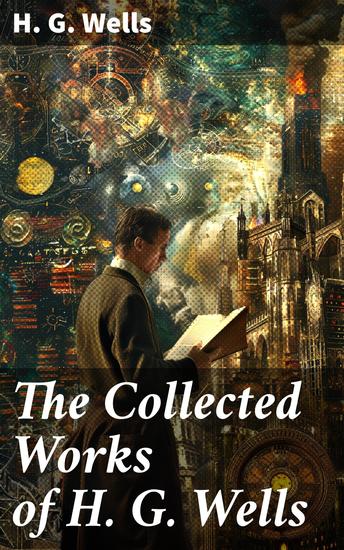
The Collected Works of H G Wells - Exploring Science Fiction & Social Commentary in Timeless Tales - cover

The Collected Works of H G Wells - Exploring Science Fiction & Social Commentary in Timeless Tales

H. G. Wells

Verlag: Good Press

  • 0
  • 0
  • 0

Beschreibung

In "The Collected Works of H. G. Wells," readers are invited to explore the multifaceted genius of one of the most significant figures in science fiction and social commentary. This comprehensive compilation encompasses Wells' visionary narratives, from the dystopian landscapes of "The Time Machine" to the social critique found in "The War of the Worlds." Through a meticulously crafted style that combines vivid imagination with incisive wit, Wells addresses the societal challenges of his time, reflecting the scientific advancements and philosophical inquiries of the late Victorian and early Edwardian eras. The collection is a rich tapestry of genres, demonstrating Wells'Äô prowess in blending speculative fiction with profound moral questions and social satire. H. G. Wells, often hailed as the 'father of science fiction,' emerged from modest beginnings in England, which fueled his lifelong fascination with science and societal progress. Having lived through significant historical shifts'Äîsuch as World War I and the rise of socialism'ÄîWells utilized his writing to critique contemporary issues and envision future possibilities, shaping the literary landscape with his innovative ideas and narrative techniques. His experiences as a teacher and journalist further enriched his perspective, bringing depth to his imaginative works. Readers interested in the evolution of speculative fiction, social commentary, or the interplay between science and society will find "The Collected Works of H. G. Wells" an indispensable addition to their library. This volume not only encapsulates the breadth of Wells' creativity but also serves as a testament to his enduring influence on both literature and thought. Engage with the visions of a pioneer whose insights remain remarkably relevant today.
Verfügbar seit: 29.12.2023.
Drucklänge: 2990 Seiten.


Weitere Bücher, die Sie mögen werden

  • The Facts in the Case of Monsieur Valdemar - From their pens to your ears genius in every story - cover

    The Facts in the Case of...

    Edgar Allan Poe

    • 0
    • 0
    • 0
    Edgar Poe was born in Boston Massachusetts on 19th January 1809. His father abandoned his family the following year and within a year his mother had died leaving him an orphan.   
    He was taken in by the Allan family but never formally adopted although he now referred to himself as Edgar Allan Poe.  His father alternatively spoiled or chastised him and tension was frequent over gambling debts and monies for his education.  His university years to study ancient and modern languages was cut short by lack of money and he enlisted as a private in the army claiming he was 22, it is more probable he was 18. After 2 years he obtained a discharge in order to take up an appointment at the military academy, West Point, where he failed to become an officer. 
    Poe had released his 1st poetry volume in 1827 and after his 3rd turned to prose and placing short stories in several magazines and journals.  At age 26 he obtained a licence to marry his cousin.  She was a mere 13 but they stayed together until her death from tuberculosis 11 years after. 
    In January 1845 ‘The Raven’ was published and became an instant classic.  Thereafter followed the prose works for which he is now so rightly famed as a master of the mysterious and the macabre. 
    Edgar Allan Poe died at the tragically early age of 40 on 7th October 1849 in Baltimore, Maryland. Newspapers at the time reported Poe's death as ‘congestion of the brain’ or ‘cerebral inflammation’, common euphemisms for death from disreputable causes such as alcoholism but the actual cause of death remains a mystery.
    Zum Buch
  • A Strange Story - Turgenev brings us a woman with countless options at her feet choosing to turn her back on society and go down a radically different path - cover

    A Strange Story - Turgenev...

    Ivan Turgenev

    • 0
    • 0
    • 0
    Ivan Sergeyevich Turgenev was born on 9th November 1818 in Oryol, Russia to parents from the nobility.  He and his two brothers were raised by their mother on the family estate.  Surrounded by foreign governesses he became fluent in French, German, and English.  Their father spent little time with them and this undoubtedly had an effect on him and his brothers.  When he was nine the family moved to Moscow to give their children a better education. 
     
    Turgenev studied for a year at the University of Moscow and then at the University of St Petersburg to study Classics, Russian literature, and philology.  During that time his father died from kidney stone disease.  In 1838 Turgenev studied philosophy and history at the University of Berlin for 3 years before returning to St Petersburg for his master's. 
     
    He started his career with the Russian Civil Service and it was only in 1852, after several earlier publications, that he made his name with his short story collection, ‘A Sportsman's Sketches’, based on his observations of peasant life and nature. 
      
    That same year he wrote an obituary for Nikolai Gogol: "Gogol is dead!... What Russian heart is not shaken by those three words?... He is gone, that man whom we now have the right (the bitter right, given to us by death) to call great."  The St Petersburg censor banned publication but the Moscow censor allowed it.  He was dismissed but Turgenev was held responsible and imprisoned for a month, and then exiled to his country estate.  
     
    Along with many other intellectuals Turgenev left Russia and settled in Paris in 1854.  During this period he wrote his finest stories and four novels.  
     
    Alexander II ascended the Russian throne in 1855, and the political climate relaxed.  Turgenev returned home.  
     
    ‘Fathers and Sons’, Turgenev's most famous and enduring novel, appeared in 1862. Its leading character is considered the first ‘Bolshevik’ in Russian literature. But the hostile reaction prompted Turgenev's decision to again leave Russia.  
     
    His health declined during his later years.  In January 1883, an aggressive malignant tumor was removed but by then it had metastasized in his upper spinal cord, causing him intense pain in his final few months of life.  
     
    Ivan Turgenev died on 3rd September 1883 of a spinal abscess, a complication of the metastatic liposarcoma, in his house near Paris.  He was buried in St Petersburg.  
     
    In this tale a young girl, Sophia, endures difficult circumstances before several years later becoming the companion of a devout, but pitifully poor, vagrant holy man wandering the countryside.
    Zum Buch
  • My Lady Ludlow - cover

    My Lady Ludlow

    Elizabeth Gaskell

    • 0
    • 0
    • 0
    Enter the serene yet socially complex world of "My Lady Ludlow" by Elizabeth Gaskell. This captivating novella centers around the aristocratic Lady Ludlow, who governs her rural estate with grace and a strong adherence to tradition. As she navigates the challenges of changing societal norms and the impact of industrialization, Lady Ludlow's interactions with her diverse tenants reveal her steadfast beliefs and underlying compassion. Through rich character development and poignant storytelling, Gaskell illuminates themes of social class, duty, and transformation, presenting a moving portrait of a bygone era.
    Zum Buch
  • A Dead Woman's Secret - From their pens to your ears genius in every story - cover

    A Dead Woman's Secret - From...

    Guy de Maupassant

    • 0
    • 0
    • 0
    Henri René Albert Guy de Maupassant was born on August 5th, 1850 near Dieppe in France.  
    Maupassant’s early life was badly torn when at age 11 (his younger brother Hervé was then five) his mother, Laure, a headstrong and independent-minded woman, risked social disgrace in order to obtain a legal separation from her husband. 
    After the separation, Laure kept custody of her two boys. With the father now forcibly absent, Laure became the most influential and important figure in the young boy's life.   
    Maupassant’s education was such that he rebelled against religion and other societal norms but a developing friendship with Gustave Flaubert began to turn his mind towards creativity and writing. 
    After graduation he volunteered for the Franco-Prussian war. With its end he moved to Paris to work as a clerk in the Navy Department.  Gustave Flaubert now took him under his wing.  Acting as a literary guardian to him, he guided the eager Maupassant to debuts in journalism and literature.  For Maupassant these were exciting times and the awakening of his creative talents and ambitions. 
    In 1880 he published what is considered his first great work, ‘Boule de Suif’, (translated as as ‘Dumpling’, ‘Butterball’, ‘Ball of Fat’, or ‘Ball of Lard’) which met with a success that was both instant and overwhelming.  Flaubert at once acknowledged that it was ‘a masterpiece that will endure.’ Maupassant had used his talents and experiences in the war to create something unique.  
    This decade from 1880 to 1891 was to be the most pivotal of his career.  With an audience now made available by the success of ‘Boule de Suif’ Maupassant organised himself to work methodically and relentlessly to produce between two and four volumes of work a year.  The melding of his talents and business sense and the continual hunger of sources for his works made him wealthy. 
    In his later years he developed a desire for solitude, an obsession for self-preservation, and a fear of death as well as a paranoia of persecution caused by the syphilis he had contracted in his youth.  
    On January 2nd, 1892, Maupassant tried to commit suicide by cutting his throat.  Unsuccessful he was committed to the private asylum of Esprit Blanche at Passy, in Paris.  It was here on July 6th, 1893 that Henri René Albert Guy de Maupassant died at the age of only 42.
    Zum Buch
  • Statement of Randolph Carter The (Unabridged) - cover

    Statement of Randolph Carter The...

    H. P. Lovecraft

    • 0
    • 0
    • 0
    "The Statement of Randolph Carter" is the first person testimony of the titular character, who has been found wandering through swampland in an amnesiac shock. In his statement, Carter attempts to explain the disappearance of his companion, the occultist Harley Warren. Warren has come into the possession of a book, written in an unknown language, the exact contents of which he never revealed to Carter. Carter mentions that Warren has other "strange, rare books on forbidden subjects", several of which are in Arabic. From his mysterious book, Warren apparently deduces that doors or stairways exist between the surface world, and the underworld. He encourages Carter to travel with him to the location of one such portal, an ancient graveyard near Big Cypress Swamp. Upon arriving, Warren locates a particular tomb, and opens it to reveal a staircase that descends into the earth. Taking a lantern, he leaves Carter on the surface, and follows the stairs into the darkness, communicating with his companion by a telephone wire. After several minutes of silence, Warren suddenly begins to make vague, panicked outbursts that culminate in a desperate plea for Carter to flee. Finally, after Warren is silent for several minutes, Carter calls to him down the line, only to hear an alien voice telling him that Warren is dead.
    Zum Buch
  • Note on Realism A (Unabridged) - cover

    Note on Realism A (Unabridged)

    Robert Louis Stevenson

    • 0
    • 0
    • 0
    Robert Louis Stevenson was a Scottish novelist, essayist, poet and travel writer. Born and educated in Edinburgh, Stevenson suffered from serious bronchial trouble for much of his life, but continued to write prolifically and travel widely in defiance of his poor health. As a young man, he mixed in London literary circles, receiving encouragement from Andrew Lang, Edmund Gosse, Leslie Stephen and W. E. Henley, the last of whom may have provided the model for Long John Silver in Treasure Island.
    A NOTE ON REALISM: Style is the invariable mark of any master; and for the student who does not aspire so high as to be numbered with the giants, it is still the one quality in which he may improve himself at will. Passion, wisdom, creative force, the power of mystery or colour, are allotted in the hour of birth, and can be neither learned nor simulated.
    Zum Buch