Rejoignez-nous pour un voyage dans le monde des livres!
Ajouter ce livre à l'électronique
Grey
Ecrivez un nouveau commentaire Default profile 50px
Grey
Abonnez-vous pour lire le livre complet ou lisez les premières pages gratuitement!
All characters reduced
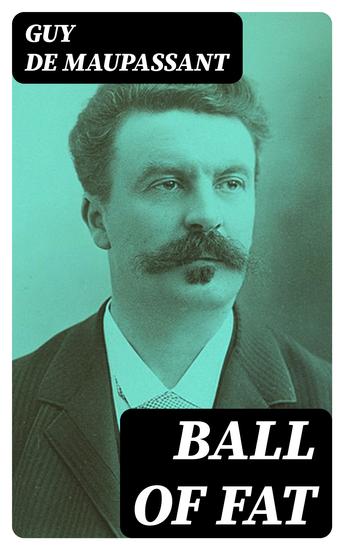
Ball of Fat - cover

Ball of Fat

Guy de Maupassant

Maison d'édition: DigiCat

  • 0
  • 0
  • 0

Synopsis

In "Ball of Fat" (Boule de Suif), Guy de Maupassant masterfully explores the complexities of human character and societal norms against the backdrop of the Franco-Prussian War. Through a gripping narrative, he chronicles the plight of a group of French citizens who find themselves stranded in a coach during the war, forced to confront their prejudices and moral dilemmas. The novella is renowned for its realistic portrayal of social classes and the hypocrisy of the bourgeoisie, infused with Maupassant's signature naturalism and keen psychological insight, revealing the conflicting motivations that drive each character's actions. Guy de Maupassant, an illustrious figure of 19th-century literature, is often hailed as a pioneer of the short story genre. His life experiences, including his encounters with the harsh realities of war and the societal upheavals of post-Napoleonic France, significantly influenced his writing. "Ball of Fat" was penned during a time when France was grappling with its identity, and Maupassant's acute observations of social interactions illuminate the era's moral quandaries, specifically regarding honor and self-interest. This compelling novella is essential reading for anyone interested in the nuances of human behavior and the societal critiques embedded in literature. Maupassant's incisive narrative and rich character development will resonate with readers, challenging them to reflect on their own values amid the complex interplay of personal and collective identities.
Disponible depuis: 11/10/2022.
Longueur d'impression: 300 pages.


D'autres livres qui pourraient vous intéresser

  • Angèle au Couvent - A young girls search for happiness in art is challenged by her religious commitments and society - cover

    Angèle au Couvent - A young...

    Mary Butts

    • 0
    • 0
    • 0
    Mary Frances Butts was born on 13th December 1890 in Poole, Dorset. 
     
    Her early years were spent at Salterns, an 18th-century house overlooking Poole Harbour.  Sadly in 1905 her father died, and she was sent for boarding at St Leonard's school for girls in St Andrews. 
     
    Her mother remarried and, from 1909, Mary studied at Westfield College in London, and here, first became aware of her bisexual feelings.  She was sent down for organising a trip to Epsom races and only completed her degree in 1914 when she graduated from the London School of Economics.  By then Mary had become an admirer of the occultist Aleister Crowley and she was given a co-authorship credit on his ‘Magick (Book 4)’. 
     
    In 1916, she began the diary which would now detail her future life and be a constant reference point for her observations and her absorbing experiences. 
     
    During World War I, she was doing social work for the London County Council in Hackney Wick, and involved in a lesbian relationship.  Life changed after meeting the modernist poet, John Rodker and they married in 1918. 
     
    In 1921 she spent 3 months at Aleister Crowley's Abbey of Thelema in Sicily; she found the practices dreadful and also acquired a drug habit.  Mary now spent time writing in Dorset, including her celebrated book of short stories ‘Speed the Plough’ which saw fully develop her unique Modernist prose style. 
     
    Europe now beckoned and several years were spent in Paris befriending many artists and writing further extraordinary stories.   
     
    She was continually sought after by literary magazines and also published several short story collections as books. Although a Modernist writer she worked in other genres but is essentially only known for her short stories.  Mary was deeply committed to nature conservation and wrote several pamphlets attacking the growing pollution of the countryside. 
     
    In 1927, she divorced and the following year her novel ‘Armed with Madness’ was published.  A further marriage followed in 1930 and time was spent attempting to settle in London and Newcastle before setting up home on the western tip of Cornwall.  By 1934 the marriage had failed. 
     
    Mary Butts died on 5th March 1937, at the West Cornwall Hospital, Penzance, after an operation for a perforated gastric ulcer. She was 46. 
     
    In ‘Angèle Au Couvent’ Butts takes up the story of a young school girl desperate for friendships but wrestling with her fluid interpretation of religion.
    Voir livre
  • The Great Gatsby - The Deluxe 1925 Edition - cover

    The Great Gatsby - The Deluxe...

    Francis Scott Fitzgerald

    • 0
    • 0
    • 0
    “Gatsby believed in the green light, the orgastic future that year by year recedes before us.” 
    Step into the glittering yet hollow world of the 1920s—a realm of champagne, jazz, and restless ambition. In The Great Gatsby, F. Scott Fitzgerald peers beyond the shimmer of the American Dream, revealing the illusions and disillusionment at its core. 
    The novel unfolds in the summer of 1922 through the eyes of Nick Carraway, a Yale graduate and World War I veteran who rents a modest home in West Egg, Long Island. His enigmatic neighbor, Jay Gatsby, is a self-made millionaire famed for extravagant parties but haunted by a singular obsession: to reclaim Daisy Buchanan, the woman he once loved. Daisy, trapped in wealth and a loveless marriage, becomes both the object of Gatsby’s dream and a symbol of its emptiness. 
    At its heart, The Great Gatsby is a meditation on illusion, identity, and the cost of desire. It is both a tragic love story and a sharp critique of the American Dream—its promises, its failures, and its corruption. 
    Written in the Jazz Age, Fitzgerald’s lyrical prose captures a generation intoxicated by success yet shadowed by disillusionment. A century later, the novel endures because it speaks to the dreamer in us all, chasing a light always just out of reach.
    Voir livre
  • Gidget - cover

    Gidget

    Frederick Kohner, Kathy Kohner...

    • 0
    • 0
    • 0
    A surfing, boy-crazy teenager comes of age in the summer of 1957 in this classic novel that inspired movies, television, and created an American pop culture icon. 


    "My English comp teacher Mr. Glicksberg says if you want to be a writer you have to—quote—sit on a window sill and get all pensive and stuff and jot down descriptions. Unquote Glicksberg! I don't know what kind of things he writes but I found my inspiration in Malibu with a radio, my best girlfriends, and absolutely zillions of boys for miles. I absolutely had to write everything down because I heard that when you get older you forget things, and I'd be the most miserable woman in the world if I forgot about Moondoggie and what happened this summer. I absolutely owe the world my story. (And every word is true. I swear.)" 


    This is Franzie, part Holden Caulfield, part Lolita. The guys call her Gidget—short for girl midget. Based on the experiences of his daughter, Frederick Kohner's novel became an international sensation with an irrepressible heroine whose voice still echoes every thrill, every fear, and every hope that every teenager ever had about growing up. 


    Includes a foreword by Kathy Kohner Zuckerman (aka the real Gidget)
    Voir livre
  • Small Star in the East A (Unabridged) - cover

    Small Star in the East A...

    Charles Dickens

    • 0
    • 0
    • 0
    Charles Dickens was a writer and social critic who created some of the world's best-known fictional characters and is regarded as the greatest novelist of the Victorian era. His works enjoyed unprecedented popularity during his lifetime, and by the twentieth century critics and scholars had recognised him as a literary genius. His novels and short stories enjoy lasting popularity.
    A SMALL STAR IN THE EAST: I Had been looking, yesternight, through the famous 'Dance of Death,' and to-day the grim old woodcuts arose in my mind with the new significance of a ghastly monotony not to be found in the original.
    Voir livre
  • The Ugly Duckling and Other Stories - cover

    The Ugly Duckling and Other Stories

    Hans Christian Andersen

    • 0
    • 0
    • 0
    First published as "Den Grimme Ælling" in 1843, The Ugly Duckling is one of the best-known and well-loved fairy tales of the Danish poet and author Hans Christian Andersen. An unusual looking young duck is bullied by the other barnyard inhabitants and wanders the world trying to find where he can fit in. This collection also includes The Naughty Boy, The Leaping Match and Sunshine Stories.
    Voir livre
  • Anna Karenina - cover

    Anna Karenina

    Leo Tolstoy

    • 0
    • 0
    • 0
    "All happy families are alike; each unhappy family is unhappy in its own way."
    
    At the center of a glittering, suffocating Russian aristocracy stands Anna Karenina. Elegant and admired, her life is upended when she meets the dashing Count Vronsky. What begins as a spark ignites into a scandalous affair that defies the rigid social codes of St. Petersburg and Moscow, leading Anna toward an agonizing choice between her son, her status, and her heart. Parallel to Anna's descent is the story of Konstantin Levin, a man of the earth whose search for a meaningful life and true love offers a powerful meditation on faith, labor, and the soul.
    
    The Height of Literary Realism: Tolstoy does not just write characters; he breathes life into them. Through Anna's psychological depth and Levin's philosophical struggles, the novel explores the complexities of marriage, the hypocrisy of society, and the devastating consequences of living outside the "rules." It is a mirror held up to the human condition, capturing the ecstasy of love and the weight of despair with unmatched precision.
    
    A Panoramic Masterpiece: Anna Karenina is more than a romance. It is a vivid portrait of a nation in transition, grappling with the shift from feudal traditions to a modern industrial world. From high-stakes horse races and grand balls to the quiet intensity of the harvest in the Russian countryside, Tolstoy's prose transports you to a world of immense beauty and crushing consequence.
    
    Why It Endures: Whether it is the haunting symbolism of the railway or the profound debates on the meaning of life, Anna Karenina remains startlingly relevant. It asks the questions we still struggle with today: Can passion and duty coexist? What does it mean to live an authentic life? And is forgiveness ever truly possible?
    
    Lose yourself in the greatest story ever told. Purchase "Anna Karenina" today.
    Voir livre