Rejoignez-nous pour un voyage dans le monde des livres!
Ajouter ce livre à l'électronique
Grey
Ecrivez un nouveau commentaire Default profile 50px
Grey
Abonnez-vous pour lire le livre complet ou lisez les premières pages gratuitement!
All characters reduced
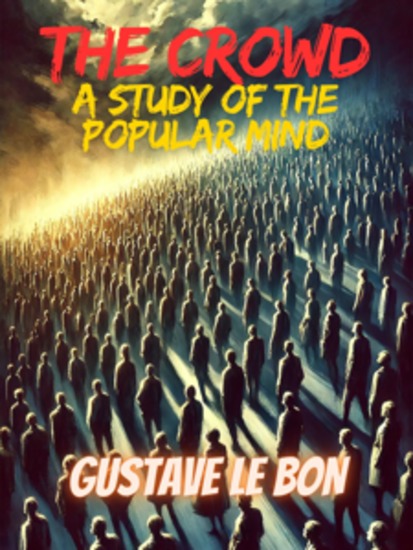
The Crowd - cover

The Crowd

Gustave Le Bon

Maison d'édition: David De Angelis

  • 0
  • 0
  • 0

Synopsis

Published in 1895, it anticipated the instrumental use of crowds and the era of great dictatorships with extraordinary foresight. It influenced Freud, Theodore Roosevelt, Mussolini and De Gaulle. It paved the way for the emergence of a new discipline, social psychology, becoming a fundamental text in the sociology of communication. Crowds are a destructive force, lacking an overall vision, undisciplined. This makes them easily orientable and impressionable. The prestige and charisma of the leader, thanks to the repetitive use of a few simple slogans, not argued, is able to access their primitive collective unconscious and therefore to maneuver them. In the collective soul, the intellectual attitudes of men, and consequently their individuality, are annulled.
Disponible depuis: 04/03/2025.

D'autres livres qui pourraient vous intéresser

  • Gesturing - A Selection from the John Updike Audio Collection - cover

    Gesturing - A Selection from the...

    John Updike

    • 0
    • 0
    • 0
    The extraordinarily evocative stories depict the generation born in a small-town America during the Depression and growing up in a world where the old sexual morality was turned around and material comforts were easily had. Yet, as these stories reflect so accurately, life was still unsettling, and Updike chronicles telling moments both joyful and painful. The texts are taken from his recent omnibus, The Early Stories, 1953-1975. 
    In describing how he wrote these stories in a small, rented, smoke-filled office in Ipswitch, Massachusetts, he says, ""I felt that I was packaging something as delicately pervasive as smoke, one box after another, in that room, where my only duty was to describe reality as it had come to me -- to give the mundane its beautiful due.""
    Voir livre
  • Before The Big Bang - The Origin of Our Universe from the Multiverse - cover

    Before The Big Bang - The Origin...

    Laura Mersini-Houghton

    • 0
    • 0
    • 0
    A revolutionary new account of our universe’s creation—and a breathtaking exploration of the landscape from which we sprang—from one of the world’s most celebrated cosmologists 
    What came before the Big Bang, and what exists outside of the universe it created? Until recently, scientists could only guess at what lay past the edge of space-time. However, as pioneering theoretical physicist Laura Mersini-Houghton explains, new scientific tools are now giving us the ability to peer beyond the limits of our universe and to test our theories about what is there. And what we are finding is upending everything we thought we knew about the cosmos and our place in it. 
    Mersini-Houghton is no stranger to boundaries—or to pushing through them. As a child growing up in Communist Albania, she discovered a universe beyond her walled-off world through the study of math and science, and through music. As a female cosmologist in a male-dominated field, she transcended the limits that society and her profession tried to place on her. And as a trailblazing researcher, she helped to revolutionize the study of our universe by revealing that, far from living in a cosmic Albania, with a world that ends at its borders, we are part of a larger family of universes—a multiverse—that holds wonders we are only beginning to unlock. Mersini-Houghton’s groundbreaking research suggests that we sit in a quantum landscape whose peaks and valleys hide a multitude of other universes, and even hold the secret to the origins of existence itself. Recent evidence has revealed the signatures of such sibling universes in our own night sky, confirming Mersini-Houghton’s theoretical work and offering humbling evidence that our universe is just one member of an unending cosmic family. 
    The incredible scientific saga of one woman’s mind-expanding journey through the multiverse, Before the Big Bang will reshape our understanding of humanity’s place in the unfathomable vastness of the cosmos. 
    Supplemental enhancement PDF accompanies the audiobook.
    Voir livre
  • Hayden - Brave - cover

    Hayden - Brave

    Keith Hayden

    • 0
    • 0
    • 0
    Betrayed and Forsaken: A US Air Force Veteran's Strength through Adversity - A Military Memoir 
    Keith Hayden was 16 years old when terrorists crashed planes into the World Trade Center. 
    4 months later, his father died before his eyes. 
    These two pivotal events marked the origins of his military career with the United States Air Force. 
    A dangerous adventure that would propel him from desert sands to sandy beaches. For this officer turned Special Agent fate takes many forms. 
    Betrayed in the mountains, forsaken under flashing lights, murder in Japan, investigated in paradise -- twists and trouble followed him. 
    Now, in his own his words, discover how he remained true to himself and brave, no matter the situation. 
    Experience this first-hand account of a U.S. military veteran's experience during the peak of the Iraq-Afghanistan War era. 
    Told through reflective prose and over a decade of authentic journal entries written by the author, Hayden: Brave is a MUST READ for members of the U.S. military community and military documentary fans.
    Voir livre
  • Fireside Reading of The Prophet - cover

    Fireside Reading of The Prophet

    Kahlil Gibran

    • 0
    • 0
    • 0
    Experiencing a story read out loud is one of the oldest forms of entertainment there is. Fireside Reading is a way to slow down, reconnect with the timeless wisdom of great books and rediscover the simple pleasure of being read to. Join Gildart Jackson in front of a cozy fire as he reads The Prophet by Kahlil Gibran to you and your family.
    Voir livre
  • Railroad Robber Barons The: The Lives of the Magnates Who Dominated America’s Rail Industry in the 19th Century - cover

    Railroad Robber Barons The: The...

    Editors Charles River

    • 0
    • 0
    • 0
    The Gilded Age and the dawn of the 20th century are often remembered as an era full of monopolies, trusts, and economic giants in heavy industries like oil and steel. Men like Andrew Carnegie built empires like Carnegie Steel, and financiers like J.P. Morgan merged and consolidated them. The era also made names like Astor, Cooke, and Vanderbilt instantly recognizable across the globe. Over time, the unfathomable wealth generated by the businesses made the individuals on top incredibly rich, and that in turn led to immense criticism and an infamous epithet used to rail against them: robber barons.  
    	Dozens of men were called “robber barons”, and the industrial might wielded by some of these men in the late 19th century directly led to a public backlash and made President Teddy Roosevelt the “trust buster”, and there has since been countless regulations to attempt to avoid the types of monopolies found over 100 years ago. However, many 20th century historians and writers pushed back against the allegations hurled at the “robber barons” and even took issue with the name. Libertarian writer John Stossel argued, “They weren't robbers, because they didn't steal from anyone, and they weren't barons - they were born poor...” Ironically, one of America’s most famous robber barons, Andrew Carnegie, epitomized the American Dream, migrating with his poor family to America in the mid-19th century and rising to the top of the business world in his adopted country. And like Carnegie, railroad tycoon Cornelius Vanderbilt set a precedent of sorts with his philanthropy, most notably his gift to Vanderbilt University, which bears his name. Similarly, the West Coast's most famous railroad mogul became Leland Stanford, who also bequeathed a prestigious university after making it to the top of the industry.
    Voir livre
  • After the Funeral - From their pens to your ears genius in every story - cover

    After the Funeral - From their...

    Mary Butts

    • 0
    • 0
    • 0
    Mary Frances Butts was born on 13th December 1890 in Poole, Dorset. 
    Her early years were spent at Salterns, an 18th-century house overlooking Poole Harbour.  Sadly in 1905 her father died, and she was sent for boarding at St Leonard's school for girls in St Andrews. 
    Her mother remarried and, from 1909, Mary studied at Westfield College in London, and here, first became aware of her bisexual feelings.  She was sent down for organising a trip to Epsom races and only completed her degree in 1914 when she graduated from the London School of Economics.  By then Mary had become an admirer of the occultist Aleister Crowley and she was given a co-authorship credit on his ‘Magick (Book 4)’. 
    In 1916, she began the diary which would now detail her future life and be a constant reference point for her observations and her absorbing experiences. 
    During World War I, she was doing social work for the London County Council in Hackney Wick, and involved in a lesbian relationship.  Life changed after meeting the modernist poet, John Rodker and they married in 1918. 
    In 1921 she spent 3 months at Aleister Crowley's Abbey of Thelema in Sicily; she found the practices dreadful and also acquired a drug habit.  Mary now spent time writing in Dorset, including her celebrated book of short stories ‘Speed the Plough’ which saw fully develop her unique Modernist prose style. 
    Europe now beckoned and several years were spent in Paris befriending many artists and writing further extraordinary stories.   
    She was continually sought after by literary magazines and also published several short story collections as books. Although a Modernist writer she worked in other genres but is essentially only known for her short stories.  Mary was deeply committed to nature conservation and wrote several pamphlets attacking the growing pollution of the countryside. 
    In 1927, she divorced and the following year her novel ‘Armed with Madness’ was published.  A further marriage followed in 1930 and time was spent attempting to settle in London and Newcastle before setting up home on the western tip of Cornwall.  By 1934 the marriage had failed. 
    Mary Butts died on 5th March 1937, at the West Cornwall Hospital, Penzance, after an operation for a perforated gastric ulcer. She was 46.
    Voir livre