Begleiten Sie uns auf eine literarische Weltreise!
Buch zum Bücherregal hinzufügen
Grey
Einen neuen Kommentar schreiben Default profile 50px
Grey
Jetzt das ganze Buch im Abo oder die ersten Seiten gratis lesen!
All characters reduced
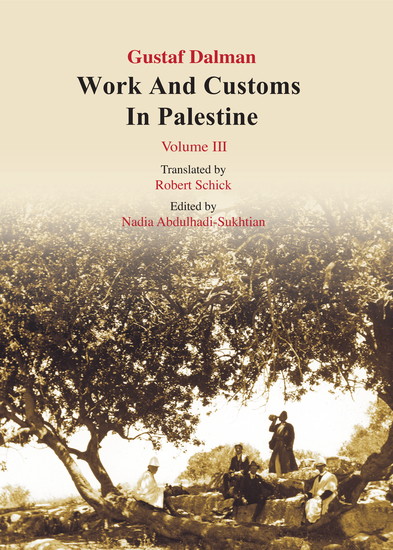
Works and Customs in Palestine Volume III - From Harvest to Flour Harvesting Threshing Winnowing Sifting Storing Grinding - cover

Works and Customs in Palestine Volume III - From Harvest to Flour Harvesting Threshing Winnowing Sifting Storing Grinding

Gustaf Dalman

Übersetzer Robert Schick

Verlag: Al Nasher Technical Services

  • 0
  • 0
  • 0

Beschreibung

Volume III, continues where Volume II left off, with the harvest up to the milling and storing of the flour. It starts with the harvest weather, the human work force, the various harvest tools, continues with the work on the threshing floor, the threshing tools, the production of flour and groats together with the tools used, as well as the different kinds of storage equipment.
Verfügbar seit: 16.05.2024.
Drucklänge: 476 Seiten.
Weitere Bücher, die Sie mögen werden

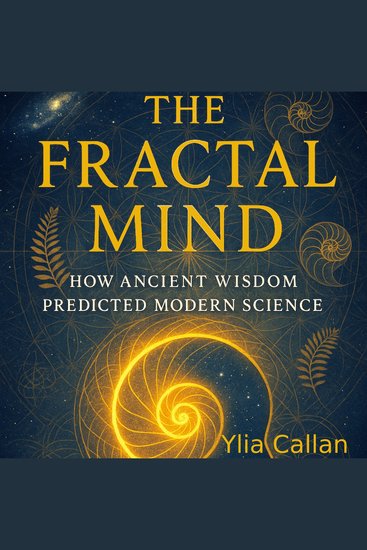
  • The Fractal Mind - How Ancient Wisdom Predicted Modern Science - cover

    The Fractal Mind - How Ancient...

    Ylia Callan

    • 0
    • 0
    • 0
    This audiobook is narrated by an AI Voice.   
    The Fractal Mind – How Ancient Wisdom Predicted Modern Science is a journey across time, thought, and imagination - exploring how humanity’s oldest myths, sacred symbols, and intuitive insights foreshadowed the very discoveries of modern science. 
    From the spiralling patterns of galaxies to the branching of rivers, trees, and neural networks, the universe is woven with fractal geometry - and the ancients seemed to know it. This audiobook uncovers how ancient cultures mirrored these cosmic patterns in story, art, ritual, and language, offering a wisdom that modern physics, biology, and information theory are only beginning to confirm. 
    Blending mythology, science, and philosophy, each chapter reveals hidden connections: how sacred geometry underlies life’s design, how cycles of time shape memory and prophecy, how dreams and symbols reflect the recursive patterns of reality, and how consciousness itself may be a living fractal of the cosmos. 
    This is not only a book about science and spirit - it is a mirror of the timeless human quest to understand our place in the infinite. The Fractal Mind invites listeners into a space where myth and mathematics meet, where story and science entwine, and where the deepest truths of nature resound with wonder. 
    If you have ever felt that the wisdom of the past holds keys to the mysteries of the future, this audiobook is for you.
    Zum Buch
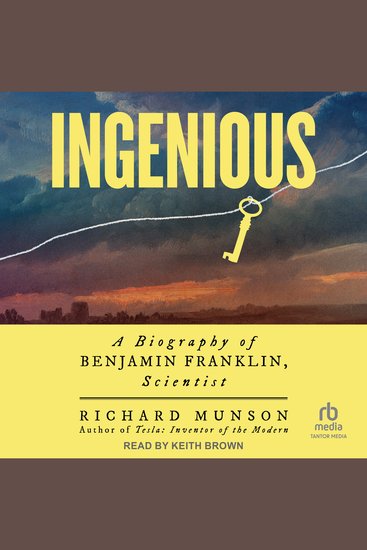
  • Ingenious - A Biography of Benjamin Franklin Scientist - cover

    Ingenious - A Biography of...

    Richard Munson

    • 0
    • 0
    • 0
    The dramatic story of an ingenious man who explained nature and created a country. 


    Benjamin Franklin was one of the preeminent scientists of his time. Driven by curiosity, he conducted cutting-edge research on electricity, heat, ocean currents, weather patterns, chemical bonds, and plants. But today, Franklin is remembered more for his political prowess and diplomatic achievements than his scientific creativity. 


    In this incisive and rich account of Benjamin Franklin's life and career, Richard Munson recovers this vital part of Franklin's story, reveals his modern relevance, and offers a compelling portrait of a shrewd experimenter, clever innovator, and visionary physicist whose fame opened doors to negotiate French support and funding for American independence. 


    Munson's riveting narrative explores how science underpins Franklin's entire story—from tradesman to inventor to nation-founder—and argues that Franklin's political life cannot be understood without giving proper credit to his scientific accomplishments.
    Zum Buch
  • The Era of Liberation - 1862-1894 - cover

    The Era of Liberation - 1862-1894

    Louis Kossuth, Abraham Lincoln,...

    • 0
    • 0
    • 0
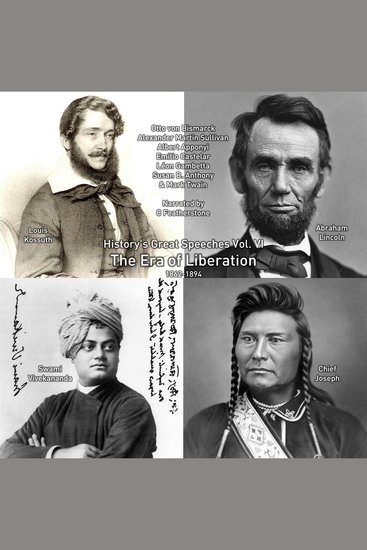
    The late 19th Century was a time of liberation. After the collapse of empires, people of all creeds demanded their equality.We begin with two speeches that represent the old order, by Bismarck. Between the two speeches he went from being Prussia’s last Minister President to being the Germany’s first Chancellor. A statesman in the oldest mold, he argues for nationalist dominance against forces temporal and religious.The counter is given by Sullivan, who excoriates the British government for the Zulu war, asking why the country supported wars of aggression in foreign lands.From there, we move to the liberation of nations and peoples. Louis Kossuth embodied Hungary’s struggle against imperial oppression, Castelar argues for a Spanish republic, and Gambetta for the education of the peasantry in France. Across Europe, a tide rose demanding the government serve the people rather than use them.In America, Lincoln defined the struggle between the Union and Confederacy as the start of universal emancipation and freedom for all men. In contrast, Chief Joseph’s speech drips with pathos, as he lays down his spear forever, desperate to find what is left of his massacred and desolate peoples in the wilderness. After the Civil War ends, Susan Anthony’s speech demands that women should have the vote, as guaranteed in the constitution for all citizens.A series of speeches by Swami Vivekananda follow, given at the first World’s Parliament of Religions. These speeches brought Buddhism and Hinduism into the Anglosphere, and began a trend of searching for spiritual liberation alongside the more material demands of the time.We finish on a lighter tone, as Mark Twain bemoans the decay of the art of lying. In an age of such seriousness, the tall tale fell out of fashion, and the simple joy of telling a fisherman’s tale was lost.
    Zum Buch
  • Russian Made Easy - Beginner - Volume 2 of 3 - cover

    Russian Made Easy - Beginner -...

    Lingo Wave

    • 0
    • 0
    • 0
    We broke our new series on learning Russian down into different learning stages. Start with the "Lower Beginner" books followed by the "Beginner" and "Upper Beginner" books. Next, progress to the "Intermediate" series, then test and reinforce your knowledge with the "Conversations" series. 
    This audiobook is divided into units. While it provides different learning patterns and accommodates various needs, this audiobook focuses on helping you improve your ability to understand, speak, and memorise Russian.  
    In Unit 1 you will hear Russian decoded with each syllable spoken very slowly and clearly with repetition. Immediately before each sentence is spoken, you will hear the translation, so you will always understand what is being said. 
    Unit 2 focuses solely on increasing your listening ability, which will improve your abilities to engage in dialogue with a native Russian speaker. This chapter requires you to listen very carefully to nuances in the language. 
    By Unit 3 you will already notice progress in your abilities to speak and understand Russian. The spoken translation is followed by two repetitions in Russian at a completely natural speed. While you are learning to process naturally spoken Russian, Units 3 and 4 will help you memorise new vocabulary and full sentences. 
    In Unit 5 you can test yourself on how much you have learned. If you are having difficulties, we suggest you revisit the listening, speaking, or memorisation section of Units 1, 2 3 or 4, according to what you need more help with. 
    Topics covered in this book: 
    1. Asking about family 
    2. Asking about relationship status 
    3. Expressing frequency 
    4. Talking about spare time activities and hobbies 
    5. Using quantifiers/determiners 
    6. Talking about preference 
    7. Talking about abilities 
    8. Talking about location of places 
    9. Describing appearance 
    10. Talking about personality 
    ...
    Zum Buch
  • Humans: A Brief History of How We F*cked It All Up - cover

    Humans: A Brief History of How...

    Anonym

    • 0
    • 0
    • 0
    Modern humans have come a long way in the seventy thousand years they’ve walked the earth. Art, science, culture, trade—on the evolutionary food chain, we’re true winners. But it hasn’t always been smooth sailing, and sometimes—just occasionally—we’ve managed to truly f*ck things up.Weaving together history, science, politics and pop culture, Humans offers a panoramic exploration of humankind in all its glory, or lack thereof. From Lucy, our first ancestor, who fell out of a tree and died, to General Zhou Shou of China, who stored gunpowder in his palace before a lantern festival, to the Austrian army attacking itself one drunken night, to the most spectacular fails of the present day, Humans reveals how even the most mundane mistakes can shift the course of civilization as we know it. Lively, wry and brimming with brilliant insight, this unique compendium offers a fresh take on world history and is one of the most entertaining reads of the year.
    Zum Buch
  • A Rare Recording of Physicist Richard Feynman Explaining Scientific Method - cover

    A Rare Recording of Physicist...

    Richard Feynman

    • 0
    • 0
    • 0
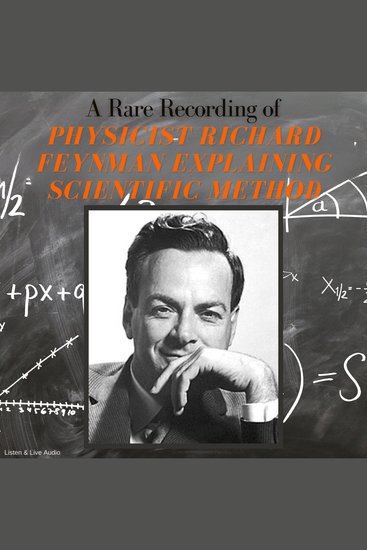
    Richard Phillips Feynman (May 11, 1918 - February 15, 1988) was an American theoretical physicist, known for his work in the path integral formulation of quantum mechanics, the theory of quantum electrodynamics, and the physics of the superfluidity of supercooled liquid helium. In 1965, Feynman received the Nobel Prize in Physics jointly with Julian Schwinger and Shin'ichirō Tomonaga.
    Zum Buch