Join us on a literary world trip!
Add this book to bookshelf
Grey
Write a new comment Default profile 50px
Grey
Subscribe to read the full book or read the first pages for free!
All characters reduced
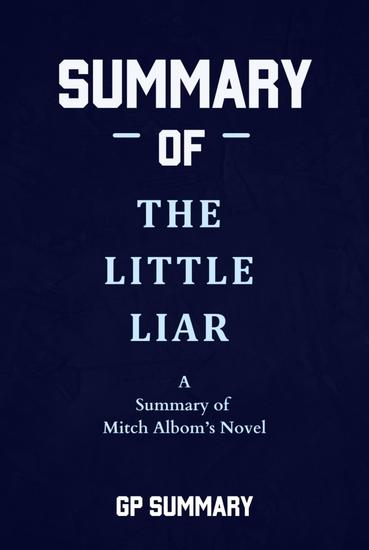
Summary of The Little Liar a novel by Mitch Albom - cover

Summary of The Little Liar a novel by Mitch Albom

GP SUMMARY

Publisher: BookRix

  • 0
  • 0
  • 0

Summary

DISCLAIMER
This book does not in any capacity mean to replace the original book but to serve as a vast summary of the original book.
Summary of The Little Liar a novel by Mitch Albom
IN THIS SUMMARIZED BOOK, YOU WILL GET:


- - Chapter astute outline of the main contents.
- - Fast & simple understanding of the content analysis.
- - Exceptionally summarized content that you may skip in the original book 
Mitch Albom's The Little Liar is a powerful novel set during the Holocaust, focusing on the lives of three survivors. Nico Krispis, an innocent boy, is offered a chance to save his family by convincing Jewish residents to board trains to new homes. However, when the final train arrives, Nico discovers he helped send his family to Auschwitz. The novel explores honesty, survival, revenge, and devotion, and is narrated by the voice of Truth itself. It is a timeless story about the harm caused by deceit and the power of love to redeem us.
Available since: 11/15/2023.
Print length: 71 pages.

Other books that might interest you

  • Thoughts for the Times of War and Death - cover

    Thoughts for the Times of War...

    Sigmund Freud

    • 0
    • 0
    • 0
    In this insightful essay Sigmund Freud delves into the psychological roots of war, the nature of human aggression, and the profound impact of death on society.
    
    Written during the tumultuous years of World War I, Freud explores how conflict shapes the psyche and why humanity is drawn to violence despite the consequences.
    Show book
  • Donald Writes No More - The Life of Donald Goines the Godfather of Street Lit - cover

    Donald Writes No More - The Life...

    Eddie Stone

    • 0
    • 0
    • 0
    For the fiftieth anniversary of his murder, this gritty, engrossing, definitive biography of the legendary Black writer Donald Goines—the Godfather of Urban Street Lit and "one of hip hop's greatest inspirations" (The Source Magazine)—is back. 


    Addict, thief, pimp, pusher, player—and most notably, groundbreaking writer. Donald Goines was all of these. 


    As a kid, Donald Goines was the product of a middle-class family. After high school, he joined the Air Force—and discovered the heroin that would rule the remainder of his life. On the streets, he turned to writing when he was straight enough to keep at it. He used the language of the streets and he wrote of its people. Goines's success was immediate and exciting. But eventually those same streets claimed him. He was murdered as he sat writing a new book. Yet his legacy continues, as a revolutionary in the literary world and also in music, with major hip-hop artists including 50 Cent, Nas, and Jay-Z all crediting Goines's novels as influences. Here is his complete story.
    Show book
  • On Life After Death - cover

    On Life After Death

    Carl Jung

    • 0
    • 0
    • 0
    C. G. Jung, (Carl Gustav Jung) was a Swiss psychiatrist and psychotherapist who founded analytical psychology. Jung proposed and developed the concepts of extraversion and introversion archetypes, as well as the collective unconscious. His work has been influential in psychiatry and in the study of religion, philosophy, archeology, anthropology, literature, and related fields. He was a prolific writer, many of whose works were not published until after his death. 
    The central concept of analytical psychology is individuation—the psychological process of integrating the opposites, including the conscious with the unconscious, while still maintaining their relative autonomy. Jung considered individuation to be the central process of human development. 
    Jung created some of the best known psychological concepts, including the archetype, the collective unconscious, the complex, and synchronicity. The Myers-Briggs Type Indicator (MBTI), a popular psychometric instrument, has been developed from Jung's theory of psychological types. 
    Though he was a practising clinician and considered himself to be a scientist, much of his life's work was spent exploring tangential areas such as Eastern and Western philosophy, alchemy, astrology, and sociology, as well as literature and the arts. Jung's interest in philosophy and the occult led many to view him as a mystic, although his ambition was to be seen as a man of science. His influence on popular psychology, the psychologization of religion, spirituality, and the New Age movement has been immense.
    Show book
  • Speaking Up without Freaking Out 3rd ed - 50 Techniques for Confident and Compelling Presenting - cover

    Speaking Up without Freaking Out...

    Matt Abrahams

    • 0
    • 0
    • 0
    The Speaking Up without Freaking Out audio book by Matt Abrahams (host of the award-winning Think Fast Talk Smart podcast) contains over 50 anxiety management techniques that are based on scientifically supported theory and evidence that will help you become a more confident and compelling communicator regardless of where you present -- on stage, in a meeting, or virtually. 
    Confident and compelling presenting involves a complicated mix of physiological and psychological factors. In the 3rd edition, this audio book provides specific guidance and opportunities to practice developing the skills you will need to feel more comfortable speaking in front of others in an engaging way. 
    This book is divided into seven chapters: 
    Chapter 1 describes speaking anxiety, how it shows itself, its negative effects, and how you can appear less nervous. 
    Chapter 2 describes the main theories about why people feel anxious when speaking and, importantly, offers you several specific techniques to reduce speaking anxiety and bolster your confidence. 
    Chapter 3 details how you can use your nonverbal presence and voice to not only appear more confident, but also feel more confident. 
    Chapter 4 how focusing on your audience’s needs and connecting your content to them can reduce your anxiety and make your presentations more compelling. 
    Chapter 5 provides techniques and guidance on how to structure your presentations to better help you and your audience remember what you present. 
    Chapter 6 teaches how to resist and stop some self-defeating beliefs and behaviors that perpetuate and exacerbate anxiety. 
    Chapter 7 addresses how to put all this information to work for you by creating your own Anxiety-Management Plan.
    Show book
  • Cool - How Air Conditioning Changed Everything - cover

    Cool - How Air Conditioning...

    Salvatore Basile

    • 0
    • 0
    • 0
    "[A] history of air conditioning, chronicling the numerous gimmicks, failed attempts, con jobs, and eventual successes . . . a surprisingly interesting journey." —San Francisco Book Review 


    The air conditioner is often hailed as one of the modern world's greatest inventions—yet nearly as often blamed for global disaster. It has changed everything from architecture to people's food habits; saved countless lives, and caused countless deaths. First appearing in 1902, when Willis Carrier, an engineer barely out of college, developed the "Apparatus for Treating Air," everyone assumed it would instantly change the world. But the story of air conditioning and its rise to ubiquity is far from simple. 


    In Cool, Salvatore Basile tracks two fascinating stories: the struggle to perfect an effective cooling device, and the effort to convince people that they actually needed such a thing. With a cast of characters ranging from Leonardo da Vinci to Richard Nixon and Felix the Cat, Cool showcases the myriad reactions to air conditioning as it was developed and introduced to the world. Here is a unique perspective on a common convenience: how we came to rely on it today, and how it might change radically tomorrow.
    Show book
  • Held by a Thread - What's the Value of Art in Schools? - cover

    Held by a Thread - What's the...

    Anna Cutler

    • 0
    • 0
    • 0
    What was your experience of art in school? Was it all doilies, cheap paint, and crusty brushes? Or was it better than that but you still wondered why it seemed to be the runt of the educational litter. In this humorous, engaging, and thought-provoking book, Anna Cutler, a leading figure in art education, takes you on a journey through her personal experiences and reflections on the value of art in schools. By the end you’ll come to realise that the stakes are surprisingly high for the social, emotional, and intellectual development of our children. It is an impassioned plea to nourish, within and beyond schools, the one resource that will never run out: the human capacity to create.
     
    “Engagingly informal and on a take-it-or-leave-it basis, this wise and witty book can be absorbed quite effortlessly in one sitting. It leaves you with the sense that you’ve enjoyed one-on-one tuition from the favourite teacher you never had.”  
     
    Dr Shane Kinghorn, Manchester Metropolitan University.
     
    “I learned a great deal reading this book and laughed in all the right places. It is a powerful, persuasive ‘Call to Arts’.”
     
     Andrew McGuinness, author.
    Show book