Rejoignez-nous pour un voyage dans le monde des livres!
Ajouter ce livre à l'électronique
Grey
Ecrivez un nouveau commentaire Default profile 50px
Grey
Abonnez-vous pour lire le livre complet ou lisez les premières pages gratuitement!
All characters reduced
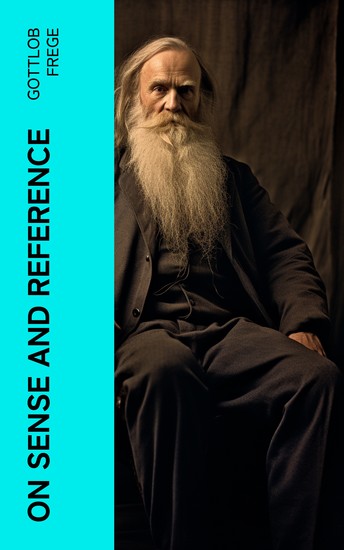
On Sense and Reference - cover

On Sense and Reference

Gottlob Frege

Traducteur Max Black

Maison d'édition: e-artnow

  • 0
  • 0
  • 0

Synopsis

In the philosophy of language, the difference between sense and reference was a concept of the German philosopher and mathematician Gottlob Frege in 1892. This idea, presented in this work, reflects the two ways he thought a singular term might have meaning.
Disponible depuis: 07/12/2023.
Longueur d'impression: 24 pages.
D'autres livres qui pourraient vous intéresser

  • Combing Through the White House - Hair and Its Shocking Impact on the Politics Private Lives and Legacies of the Presidents - cover

    Combing Through the White House...

    Theodore Pappas

    • 0
    • 0
    • 0
    Read by the author. 
    Discover a fascinating and novel look at the U.S. presidents, the first families, and American history—all through the lens of hair. With meticulous detail and engaging storytelling, encyclopedia editor Theodore Pappas combs through American history, teasing out long-forgotten and little-known ways that hair has influenced the presidency and the public and private lives, personal scandals, and tragedies of the men and women who have occupied the White House. 
    Go deep into the history of such topics as:Abraham Lincoln's famously ridiculed appearance and the surprising role hair played in both his presidency and assassinationJohn F. Kennedy's connection to James Bond and how hair factored into his vast image-making and infidelitiesThe lush tradition of collecting hair as a way of honoring leaders, remembering our loved ones, and preserving their memoriesScientific hair analysis and how DNA has been used to solve long-standing presidential mysteriesThe connection of hair to the lives, loves, scandals, and tragedies that shaped presidents, first ladies, and the nation at large 
      
    This unique window into the past shines entertaining new light on the decisions, relationships, and tragedies that have shaped the role of the president and the place of the U.S. in the world. Whether you're interested in presidential trivia or historical mysteries, Combing Through the White House personalizes the past through an element of life we can all relate to—hair—giving us new glimpses into our country and even ourselves. 
    The images can be found in the audiobook companion PDF download.
    Voir livre
  • The Highly Sensitive Person - cover

    The Highly Sensitive Person

    Nell Laurel

    • 0
    • 0
    • 0
    The Highly Sensitive Person: A Guide for the Highly Sensitive Person on How to Manage Emotional Overload, Anxiety and Stress and Live a Well-Balanced LifeBeing a highly sensitive person is not a mental illness. It is not a psychological condition or disorder. Because of his high sensitivity, a highly sensitive person simply finds it difficult to filter out or sift through stimuli. Only about 20% of the general population has sensory processing sensitivity. Given these statistics, if you are a highly sensitive person, do not be surprised if you feel out of place with most people. But with enough understanding of what this condition means, you will learn the strengths and weaknesses associated with this circumstance. In this audiobook, you will learn about HSP. You will get all the information that can help you understand and cope with the challenges unique to a highly sensitive person. It will provide practical and sensible advice you can apply in your daily life to resolve problems common to highly sensitive people. This audiobook will cover the following topics:- Emotions and How it Relates to HSP- Become Self-aware- More Tips for the Highly Sensitive Person- Tips on How to Manage Stress and Anxiety- And many more!To learn more, download your copy of this audiobook today!
    Voir livre
  • Joseph Roth: A short biography - 5 Minutes: Short on time – long on info! - cover

    Joseph Roth: A short biography -...

    5 Minutes, 5 Minute Biographies,...

    • 0
    • 0
    • 0
    Joseph Roth, literary genius and tragic figure: Life and work in a short biography! Everything you need to know, brief and concise. Infotainment, education and entertainment at its best!
    Voir livre
  • When I Consider Your Heavens - How Science and Philosophy Lead Us to God - cover

    When I Consider Your Heavens -...

    Antony Latham

    • 0
    • 0
    • 0
    In this thought-provoking book, Antony Latham shows how science and philosophy provide evidence for the existence of God. There was a beginning of the universe, which requires an explanation beyond itself. The exquisite fine-tuning of the physical laws necessary for life has all the hallmarks of design. Paleontology and biology show unmistakable signs of an intelligence behind life. Consciousness and free-will, inexplicable in purely physical terms, point to something beyond the material. The philosophy of beauty and morality leads us to an author of both. He argues that the universe is ‘open’—not simply the interaction of matter and energy, but a realm where miracles can happen. The evidence for the greatest miracle in history, the resurrection of Jesus, is carefully presented. 
    About the Author: 
    Antony Latham is a retired family doctor with nine years of experience working in hospitals in East Africa. He has authored books on Darwinism and the philosophy of mind, and holds a degree in Medical Law and Bioethics. Currently, he chairs the Scottish Council on Human Bioethics. He and his wife have four children and three grandchildren. They live in the Western Isles of Scotland, where he enjoys sailing and mountaineering.
    Voir livre
  • The History of England Volume 4 - The Reign of Queen Elizabeth I - cover

    The History of England Volume 4...

    David Hume

    • 0
    • 0
    • 0
    In Volume 4, Hume closes his account of ‘England Under the House of Tudor’ begun in Volume 3, and devotes it entirely to the reign of Queen Elizabeth I. It was not really expected that she would survive to accede to the monarchy; and it was certainly unexpected that she would rule for so long (1558-1603) while steadfastly declining to take a husband. All in all, her reign was a remarkable achievement. 
    Elizabeth had so much to contend with over the years. From the start, she had to oversee the reinstatement of the Protestant religion after the tumultuous reign of her sister, Mary. Then came the testing matter of Mary, Queen of Scots which dragged on for decades.  
    There were also numerous Catholic conspiracies (many threats to her personally), requiring close attention by her protective spymaster ministers William Cecil and Francis Walsingham.  
    Then there were the complex relationships with other leading European powers, France and Spain, culminating in the spectacular climax in 1588 when Sir Francis Drake (and the weather) routed the Spanish Armada. 
    Hume does not approach Elizabeth and her reign with the ‘unbounded panegyrics’ so often adopted by historians before him. He criticises them for ‘having been so extremely ignorant of the transactions of this reign as to extol her for a quality which, of all others, she was the least possessed of – a tender regard for the constitution, and a concern for the liberties and privileges of her people.’ This, Hume insists, was not quite Elizabeth. 
    Despite acknowledging her popularity, Hume is at pains in his History to present a more rounded portrait. ‘The prerogatives of this princess were scarcely ever disputed, and she therefore employed them without scruple: Her imperious temper, a circumstance in which she went far beyond her successors, rendered her exertions of power violent and frequent, and discovered the full extent of her authority.  
    However, he continues, ‘the great popularity, which she enjoyed proves that she did not infringe any established liberties of the people’. 
    In Volume 4, Hume shows himself to be a historian of character and clarity, but also demonstrates his scholarly integrity. In the controversial issue of the guilt or innocence of Mary, for example, he went back to original documents to support his opinion. This is why his History of England remains an informative and stimulating account in the 21st century.
    Voir livre
  • END OF HISTORY AND THE LAST MAN 10-Minute Summary THE - Has history come to an end? The boldest and most brilliant interpretation of humanity’s present and future history - cover

    END OF HISTORY AND THE LAST MAN...

    Francis Fukuyama

    • 0
    • 0
    • 0
    In The End of History and the Last Man, political scientist Francis Fukuyama presents one of the most provocative theses of the contemporary era: after the fall of the Berlin Wall and the collapse of the Soviet Union, liberal democracy not only emerged as the dominant political model, but also represents the culmination of humanity’s ideological evolution. 
    With clear prose and rigorous argumentation, Fukuyama draws on thinkers such as Hegel, Marx, and Nietzsche to develop an ambitious vision: if history is a struggle of ideas, then liberalism has triumphed over its rivals—fascism and communism—on political, economic, and moral grounds. From this perspective, humanity has reached its ultimate form of organization, at least structurally. 
    However, this claim is neither triumphalist nor naive. Fukuyama acknowledges the challenges that liberal democracies face: nationalism, religion, economic inequality, and especially the threat of the “last man,” a passive, conformist figure concerned solely with personal well-being. The author warns that although liberal ideology has prevailed, the human yearning for recognition, identity, and purpose remains alive. History may have ended, but human dilemmas persist. 
    This book offers not only a deep historical and philosophical reading but also challenges the reader with fundamental questions: What does it mean to be free? Can a society live without transcendent ideals? Are we condemned to comfort, or are we capable of reinventing our purpose? 
    Ideal for readers interested in politics, philosophy, contemporary history, and social theory, this work has become a classic of modern political thought. A brilliant, controversial, and deeply relevant text that invites reflection on humanity’s destiny in an age of uncertainty. 
       
     
    Voir livre