Rejoignez-nous pour un voyage dans le monde des livres!
Ajouter ce livre à l'électronique
Grey
Ecrivez un nouveau commentaire Default profile 50px
Grey
Abonnez-vous pour lire le livre complet ou lisez les premières pages gratuitement!
All characters reduced
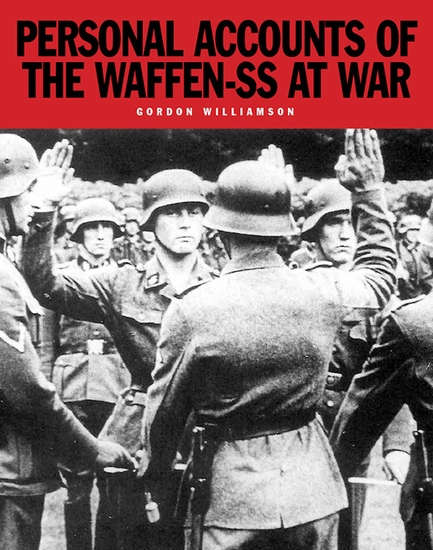
Personal Accounts of the Waffen-SS at War - cover

Personal Accounts of the Waffen-SS at War

Gordon Williamson

Maison d'édition: Amber Books Ltd

  • 0
  • 0
  • 0

Synopsis

No military organisation has fought as well against such overwhelming odds as the Waffen-SS, but few have earned such an infamous reputation in the process. Hitler’s elite proved itself in some of the most savage actions of World War II: the battle of Kharkov, the defence of the Demyansk Pocket and the Normandy landings. Certain units, however, also perpetrated atrocities against innocent civilians, while others were closely associated with the concentration camps. Personal Accounts of the Waffen-SS at War is the story of the men who wore the SS runes – told in their own words. Speaking candidly about their wartime service, former Waffen-SS soldiers of all ranks and nationalities talk about their training, indoctrination, combat on the Eastern Front, their commanders and political masters and the issue of atrocities. Illustrated with 150 rare black-and-white photographs, not only does Personal Accounts of the Waffen-SS at War address one of the most fascinating organisations within the Third Reich, but unlike much history it offers personal accounts from inside the Waffen-SS. This book will appeal to anyone interested in the history of World War II and the Third Reich.
Disponible depuis: 25/05/2023.
Longueur d'impression: 192 pages.
D'autres livres qui pourraient vous intéresser

  • Little Women Podcast: Love And Spiritual Transformation In Little Women - cover

    Little Women Podcast: Love And...

    Niina Niskanen

    • 0
    • 0
    • 0
    In her novels, Louisa May Alcott emphasises characters' spiritual transformation when they fall in love with one another. This happens to Laurie when he falls for Amy and to Jo when she falls for Friedrich. How did Louisa May Alcott and other transcendentalists view love? They saw love as something sacred, based on the idea that you build something bigger with your significant other. 
    Dive into the heart of Louisa May Alcott's "Little Women", where love is more than romance—it’s a journey of spiritual transformation. In this unique podcast episode, explore how Alcott portrays love as a profound force, one that shapes and elevates her characters’ lives. This transformative love touches Laurie as he falls for Amy, and Jo as she opens her heart to Friedrich, revealing Alcott’s deeper vision of love’s sacred essence.🌌 Key ThemesLove as Sacred: Discover how Alcott and transcendentalist thinkers saw love as a partnership in building something meaningful and larger than oneself.Character Growth: Follow Laurie and Jo’s transformations, showing how falling in love impacts their spirituality and personal growth.Transcendentalist Influence: Uncover the ways Alcott and her contemporaries believed love could transcend individual desires and unite two souls in a shared purpose.🎧 Why Listen? 
    If you've ever wondered how love can be both soulful and transformative, this episode offers fresh insights into how a classic novel redefines romantic relationships. Perfect for fans of literary analysis, Alcott's works, and anyone curious about the intersection of love, spirituality, and self-discovery. 
    This episode invites listeners to journey beyond the surface of romance and explore how love can lead to profound spiritual awakening.
    Voir livre
  • The Tiger from Poznań - cover

    The Tiger from Poznań

    Richard Siegert

    • 0
    • 0
    • 0
    In the Second World War, Poznan was a key river crossing and railway junction on the Polish-German border. When the alarm was given indicating the Red Army's approach in January 1945, the city's 80-100,000 German civilians were speedily evacuated, leaving a garrison of some 15,000 men, mostly poorly-armed infantry, to face the rigors of a siege conducted by a massively superior and ruthless enemy anxious to acquire this transport center, which was vital for the advance on Berlin. 


    This is the account of Eastern Front veteran Richard Siegert, the gunner and later commander of the defenders' sole Tiger tank. Since the death of the driver in a futile attempt to escape from a PoW camp in Russia just after the end of the war, Siegert is the only survivor of that crew able to pass its record on to posterity. His account details how the crew fought gallantly against impossible odds, even when the Tiger was immobilized and could only act as a stationary antitank gun post or pillbox during the last heroic days' fighting for the citadel.
    Voir livre
  • The Correlation-Causation Fallacy - Assuming Correlation Implies Causation - cover

    The Correlation-Causation...

    William Rands

    • 0
    • 0
    • 0
    The correlation-causation fallacy is a common error in reasoning where people mistakenly believe that because two events or variables are correlated, one must have caused the other. This fallacy is not only widespread but can have significant consequences in various aspects of life, including science, policy-making, and everyday decision-making. It stems from the human tendency to look for patterns and explanations, often leading us to draw conclusions from observed associations without carefully analyzing the underlying mechanisms at play. 
    At its core, the fallacy occurs when a correlation—meaning two variables move together in some way—is confused with a causal relationship, where one variable directly influences or causes changes in the other. Correlation does not imply causation, a principle that is fundamental to sound scientific reasoning and critical thinking. For example, if there is a correlation between the number of hours spent watching TV and the number of people eating unhealthy food, it would be erroneous to conclude that watching TV causes people to eat poorly. Other factors, such as time spent sitting idle or lifestyle choices, could be influencing both variables. The danger of assuming causation based on correlation is that it leads to misguided conclusions, decisions, and actions. 
    This fallacy can often be found in media reports, advertising, and even scientific studies. Headlines like "Studies show that eating chocolate improves memory!" or "Increased spending on education leads to higher student performance" may imply a direct causal relationship based on observed correlations, but they neglect to account for potential confounding variables or the possibility of coincidence. In more complex situations, the misinterpretation of correlations can lead to flawed public policies, ineffective interventions, and misplaced public fear or optimism.
    Voir livre
  • Founding an Empire - cover

    Founding an Empire

    Santiago Machain

    • 0
    • 0
    • 0
    From the wind-swept plains of Anshan to the terraced palaces of Persepolis, Founding an Empire follows how a cluster of royal ambitions became the ancient world’s most sophisticated superstate. Opening with Cyrus the Great’s audacious conquests and his radical politics of legitimacy—liberation, local autonomy, and measured mercy—the narrative moves through Cambyses II’s Egyptian campaign at the edge of the known world and into the turbulence of succession that nearly cracked the young empire. It culminates with Darius I’s disciplined counterrevolution: a reforming king who turned roads, taxes, languages, and law into a scalable system.
    Voir livre
  • Heartbreak: The Lenka Trilogy Part 1 - cover

    Heartbreak: The Lenka Trilogy...

    John Righten

    • 0
    • 0
    • 0
    1990. Lenka Brett, a smart but unworldly young, Irish teacher, volunteers to deliver aid when the world learns of the horrifying plight of children in Romanian orphanages. An English naval officer, Captain Simon Syrianus, volunteers to be her co-driver. Together, they join a convoy of humanitarian aid drivers known as the Rogues, the last hope for those in areas where official charities cannot enter. Lenka falls in love, but when the Rogues become the target of mercenaries, tragedy follows and she discovers her lover is not who he appeared to be.
    Voir livre
  • The Wannabe Fascists - A Guide to Understanding the Greatest Threat to Democracy - cover

    The Wannabe Fascists - A Guide...

    Federico Finchelstein

    • 0
    • 0
    • 0
    Meet today's almost fascists and learn the warning signs to intercept them on the road from populism to dictatorship. 


    With The Wannabe Fascists, historian Federico Finchelstein offers a precise explanation of why Trumpism and similar movements across the world belong to a new political breed, the last outcome of the combined histories of fascism and populism: the wannabe fascists. This new type of populist politician is typically a legally elected leader who, unlike previous populists who were eager to distance themselves from fascism, turns to totalitarian lies, racism, and illegal means to destroy democracy from within. 


    Drawing on almost three decades of research on the histories of fascism and populism around the world, this book lays out in clear language what the author calls the "four pillars of fascism"—xenophobia, propaganda, political violence, and ultimately dictatorship. Finchelstein carefully explains how and why wannabe fascists like Trump, Bolsonaro, and Modi embrace the first three pillars but don't quite succeed in dictatorship and total suppression of the popular vote. The Wannabe Fascists stresses the importance of preventing despots from reaching this tipping point and offers a clear warning for what's at stake.
    Voir livre