Rejoignez-nous pour un voyage dans le monde des livres!
Ajouter ce livre à l'électronique
Grey
Ecrivez un nouveau commentaire Default profile 50px
Grey
Abonnez-vous pour lire le livre complet ou lisez les premières pages gratuitement!
All characters reduced
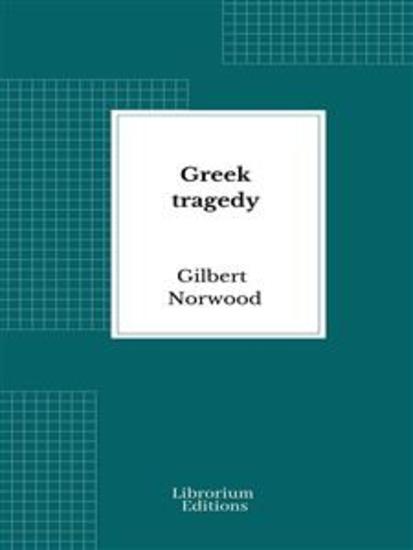
Greek tragedy - cover

Greek tragedy

Gilbert Norwood

Maison d'édition: Librorium Editions

  • 0
  • 0
  • 0

Synopsis

All the types of dramatic poetry known in Greece, tragic, satyric, and comic, originated in the worship of Dionysus, the deity of wild vegetation, fruits, and especially the vine. In his honour, at the opening of spring, were performed dithyrambs, hymns rendered by a chorus, who, dressed like satyrs, the legendary followers of Dionysus, presented by song and mimic dance stories from the adventurous life of the god while on earth. It is from these dithyrambs that tragedy and satyric drama both sprang. The celebrated Arion, who raised the dithyramb to a splendid art-form, did much incidentally to aid this development. His main achievement in this regard is the insertion of spoken lines in the course of the lyrical performance; it seems, further, that these verses consisted of a dialogue between the chorus and the chorus-leader, who mounted upon the sacrificial table. Such interludes, no doubt, referred to incidents in the sacred story, and the early name for an actor (ὑποκριτής, “one who answers”) suggests that members of the chorus asked their leader to explain features in the ritual or the narrative.
Disponible depuis: 21/08/2024.

D'autres livres qui pourraient vous intéresser

  • The Wife Who Didn't Eat - cover

    The Wife Who Didn't Eat

    Thersa Matsuura

    • 0
    • 0
    • 0
    A farmer in old Japan prays to the gods for a wife, someone who is kind, beautiful, and hardworking. What would be even better is if she didn’t eat at all, saving him both money and food. Imagine his surprise when just such a woman shows up at his house one night. But all is not perfect. The gods have quite the sense of humor, and the farmer soon learns what kind of monster he is living with. But is it too late?“The Wife Who Didn’t Eat” is author Thersa Matsuura’s retelling of a classic horror-tinged Japanese folktale, “Kwazu Nyobo”. Here she reads her version of the story followed by a short commentary with some of her research notes and thoughts on the tale. Both the short story and commentary come in at just under one hour. Thersa Matsuura is a published author of two short story collections, one nominated for a Bram Stoker Award. You can also find her on her podcast, Uncanny Japan, where she talks more about the more obscure parts of Japanese culture. Reviews: “Very soothing, educational and entertaining. Love this deep dive into Japanese culture. Not to mention just the right amount of Spooky.”            By Spooks76“High production value and haunting storytelling helps shed light onto Japanese folklore. Teresa is clear, concise and highlights stories that might otherwise never be heard by Western ears. Highly recommend!”         By Jameswhojamesyu
    Voir livre
  • India - History of Events Causes and Consequences - cover

    India - History of Events Causes...

    Kelly Mass

    • 0
    • 0
    • 0
    Yes! You’ve come across a combo of 3 titles, all about different topics related to the history of India. Take a look at these topics and then decide for yourself. I’m sure this is something you could be intrigued by. 
    Title 1: Kashmir 
    Kashmir is the Indian subcontinent's northern most geographical area. It is quite different from the rest of India. And till the mid-nineteenth century, "Kashmir" only described the Kashmir Valley, which lies between the Great Mountain Ranges and the Pir Panjal Variety. 
    The Kashmir area ended up being a crucial center of Hinduism and later Buddhism in the first centuries, while Kashmir Shaivism developed later, in the ninth century. This is why so many people attribute significant spiritual meaning to the area. It is no wonder, therefore, that some travelers go to this specific area for spiritual purposes. 
    Title 2: The Maurya Empire 
    The Maurya Empire was a South Asian Iron Age historic empire centered in Magadha, created by Chandragupta Maurya in the year 322 before Christ and lasting till 185 before Christ in a loose-knit way. The conquest of the Indo-Gangetic Plain focused the Maurya Empire, and Pataliputra functioned as its capital city (modern-day Patna). Beyond this royal core, the empire's geographical reach was limited by the dedication of army leaders who ruled the armed cities that dot the landscape. 
    Title 3: The Punjab 
    Punjab could be mainly in Pakistan at this moment, but the Punjabi people live and have resided in India also. As disputes emerged between the Indians and Pakistani, the border has moved from one area to another. Still, the Punjabi society is probably a vital aspect of India's history. 
    Punjab is a geopolitical, cultural, and historic area in South Asia, situated in the northern area of the Indian subcontinent and incorporating parts of Pakistan and India. The area's limitations are ill-defined and based upon historic accounts.
    Voir livre
  • Nok Civilization - The Mysterious Sculptor of Terracotta and West Africa's Early Culture - cover

    Nok Civilization - The...

    Rolf Hedger

    • 0
    • 0
    • 0
    The Nok civilization is one of the most fascinating and mysterious ancient cultures of West Africa. It flourished between approximately 1500 BCE and 500 CE, making it one of the earliest known complex societies in sub-Saharan Africa. The Nok people are best known for their remarkable terracotta sculptures, which provide valuable insights into their artistry, beliefs, and way of life. Despite their historical significance, much about the Nok civilization remains unknown, leaving archaeologists and historians to piece together their story from scattered artifacts and excavation sites. 
    The first discovery of Nok artifacts occurred in 1928, when British archaeologist Bernard Fagg came across a series of terracotta figurines in central Nigeria. These artifacts, found near the village of Nok, revealed an advanced artistic style that was distinct from any previously known African culture. The sculptures depicted human figures with intricate hairstyles, elaborate jewelry, and expressive facial features, suggesting a highly developed artistic tradition. This discovery marked the beginning of a deeper exploration into the Nok civilization, leading to further excavations that uncovered tools, pottery, and evidence of early ironworking. 
    One of the most significant aspects of Nok’s discovery was its role in the history of metallurgy in Africa. Archaeological findings suggest that the Nok people were among the earliest in West Africa to practice iron smelting, a technological advancement that contributed to agricultural development and societal growth. The presence of iron tools indicates that they engaged in farming, hunting, and trade, supporting the idea that Nok society was well-organized and economically active.
    Voir livre
  • Nature and Virtue Themed Exercises for Relaxation and Concentration: Guided Imagery Visualisations and Drawing Tasks - cover

    Nature and Virtue Themed...

    Maria Murto, Päivi Halmekoski,...

    • 0
    • 0
    • 0
    This book includes nature and virtue themed guided imagery and visualisations. The exercises involve sitting, lying down, standing, or walking. There are also coloured pencil drawing tasks, which include nature observation and colouring virtues. The audiobook has the same exercises as the 2nd edition of the printed book. The instructions in the beginning of the book are shortened in the audiobook. 
    Narrator: Rebecca Clamp (British female voice). 
    Recorded by Hans Wessels. 
    Cover image, an opening oak bud: Yadana Tun. 
    Contents: 
    1. Nature and Virtue Themed Exercises for Relaxation and Concentration 
    2. Drawing Exercises 
    3. Ancient Forest 
    4. By the Seashore 
    5. Mountains 
    6. In a Meadow 
    7. Inside an Oak Grove 
    8. At a Lake 
    9. In an Alpine Meadow 
    10. In a Garden 
    11. Thankfulness 
    12. Serenity 
    13. Wonder 
    14. Peacefulness 
    15. Courage 
    16. Determination 
    17. Kindness 
    18. Patience 
    19. Confidence 
    20. In Nature 
    21. Slow Walk 
    22. Times of Day 
    23. Drawing Times of Day 
    24. Three Words 
    25. Colours of Virtues 
    26. Colours in Nature 
    27. Forms in Nature 
    28. Observing Nature with Coloured Pencils 
    29. Observing the Transformation from a Bud to Leaves 
    30. Creating Your Own Colouring Pages Out of Autumn Leaves
    Voir livre
  • Evocation - Evoke The Power of Inter-Dimensional Beings and Summon Spirits - Yes You Can Series - cover

    Evocation - Evoke The Power of...

    Maria D'Andrea

    • 0
    • 0
    • 0
    TOP RATED PSYCHIC REVEALS HOW TO EVOKE THE MOST POWERFUL OF POSITIVE SPIRITS AND COMPEL THEM TO DO YOUR BIDDING! 
    HUNGARIAN BORN MARIA D'ANDREA SAYS YOU CAN GAIN RICHES, HONOR AND TRANQUILITY WITH THE USE OF VARIOUS PENTACLES, ALL OF WHICH ARE FULLY ILLUSTRATED IN THIS UNIQUE STUDY GUIDE. 
    If you are considering an occult approach to life's difficulties, this easy to read, step-by-step tutorial will teach you how to summon deities, angels, archangels, or any sort of inter-dimensional being, as well as the protocols for conversing with whatever entity arrives at your command. Maria's methods give you 100 percent control of the situation as you delve into what the sages of old have termed "ceremonial magick." 
    However, not only does Maria teach how to bring spirits into your presence, she also teaches proper cleansing and banishing techniques to help the student in the aftermath of the spirits' visit. You cannot be taken over or "possessed" if you follow Maria's instructions to the letter. 
    Indeed! If you approach contacting the various benevolent spirits who await your summoning with the proper caution and respect for ritual, you may get the kind of personal help you've needed for years but could never find elsewhere in the "real" world. What mortals cannot do for themselves, spirits will do for them. Maria's "Evocation" is here to aid in your contact and dealings with the "Other Side." 
    Spells you will find in this book include: 
    •Summon the Archangel Metetron to connect to the divine for information or healing. 
    •Gain riches, honor and tranquility by the skillful use of various pentacles, all of which are fully illustrated in the book. 
    •Use the pentacles of Venus to draw romance into your life or to safeguard and jump-start love relationships you’re in already.
    Voir livre
  • Talleyrand: The Life and Legacy of France’s Most Influential Diplomat - cover

    Talleyrand: The Life and Legacy...

    Editors Charles River

    • 0
    • 0
    • 0
    “Politics is the systematic cultivation of hatred.” - Talleyrand 
    	While Metternich is most associated with the Congress of Vienna, France, despite its turbulence, had its own influential representative there: Charles Maurice de Talleyrand-Périgord. Known simply as Talleyrand, his name ultimately became associated with crafty, manipulative personal and political maneuvering, even in a country that suffered no shortage of such diplomats and ministers in its history. 
    	As an adult, Talleyrand lived through the most tumultuous years of French history. In a period of little more than 40 years, France passed through five very different periods of rule, but despite the chaos these rapid changes brought, Talleyrand served in important roles in each successive new regime and, through a combination of charm, guile, intelligence, ability, and duplicity, played a leading role in undermining and destroying each. 
    	Under the Ancien Régime, the social and political system by which France had been ruled since the Middle Ages, Talleyrand became a bishop. When the French Revolution tore the nation apart, Talleyrand betrayed both the church and the French Monarchy and became Foreign Minister for the Directory, the governing committee of the French First Republic. In 1799, he betrayed the Republic by helping to organize the coup d'état that would see Napoleon Bonaparte become the absolute dictator of France. 
    	Talleyrand became extremely rich and very powerful under Napoleon, until he wearied of his new leader and betrayed him by selling secrets to his enemies. Talleyrand was one of the key people involved in the plot to remove Napoleon from power and pave the way for the Bourbon Restoration that brought Louis XVIII to the French throne in 1814. He was also a significant factor in the undermining of that regime and its replacement in 1830 during another revolution by a new constitutional monarchy.
    Voir livre