Join us on a literary world trip!
Add this book to bookshelf
Grey
Write a new comment Default profile 50px
Grey
Subscribe to read the full book or read the first pages for free!
All characters reduced
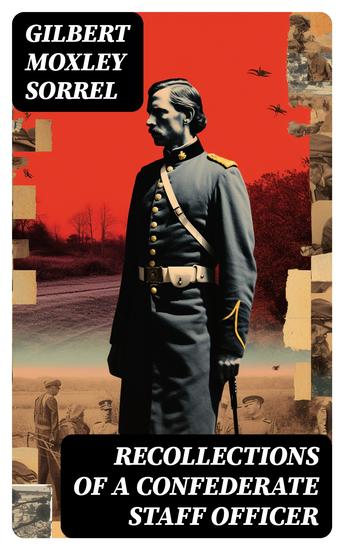
Recollections of a Confederate Staff Officer - Civil War Memories Series - cover

Recollections of a Confederate Staff Officer - Civil War Memories Series

Gilbert Moxley Sorrel

Publisher: DigiCat

  • 0
  • 0
  • 0

Summary

In "Recollections of a Confederate Staff Officer," Gilbert Moxley Sorrel offers a poignant and dynamic recounting of his experiences during the American Civil War. Written with a blend of personal reflection and historical analysis, Sorrel's narrative captures the trials and tribulations of a Confederate officer serving under the renowned General James Longstreet. The memoir is marked by a vivid literary style that combines narrative prose with rich imagery, allowing readers to immerse themselves in the complexities of war, loyalty, and leadership amid the pervasive chaos of battle. Sorrel's account is not just a soldier's tale; it is a poignant exploration of the moral dilemmas faced by commanders and soldiers alike, set against the backdrop of a fractured nation grappling with its identity. Gilbert Moxley Sorrel, born in 1838 in Georgia, was deeply influenced by the cultural milieu of the South and his family's military legacy. His insights as a staff officer stem from years spent navigating the intricacies of military life and the relationships forged in the crucible of conflict. Sorrel's literary voice reflects a synthesis of personal experience and broader historical context, making his observations both intimate and universally relevant. Readers interested in military history or the personal stories that shaped the American Civil War will find "Recollections of a Confederate Staff Officer" to be an indispensable resource. Sorrel not only illuminates the ethos of the Confederate cause but also delves into the broader themes of honor, sacrifice, and the brutal realities of war. This memoir stands as a testament to the human spirit, making it a compelling read for scholars and general audiences alike.
Available since: 11/09/2023.
Print length: 237 pages.

Other books that might interest you

  • Science Of Everyday Decisions The: How Small Choices Shape Our Lives - cover

    Science Of Everyday Decisions...

    Sybex Books

    • 0
    • 0
    • 0
    Have you ever wondered why you choose one thing over another? Why certain habits stick while others fade? Or how the countless small decisions you make every day—what to eat, where to go, or whom to talk to—shape the trajectory of your life? 
    The Science of Everyday Decisions: How Small Choices Shape Our Lives delves into the fascinating interplay of psychology, neuroscience, and behavioral economics to uncover the mechanisms behind our decision-making processes. This book reveals the subtle forces—both internal and external—that guide our actions, often without us even realizing it. 
    Explore how split-second choices and habitual behaviors define our relationships, careers, health, and happiness. Learn how biases, emotions, and context influence our judgments and why understanding these factors can help us make smarter, more deliberate decisions. 
    Through engaging anecdotes, groundbreaking research, and actionable strategies, this book offers tools to:Recognize and overcome decision-making traps.Build healthier habits and break unproductive cycles.Make confident choices in the face of uncertainty.Understand the ripple effect of small decisions on long-term outcomes. 
    Whether you're deciding what to prioritize at work, how to approach personal relationships, or simply choosing what to have for dinner, The Science of Everyday Decisions will empower you to take control of your life by mastering the art and science of decision-making
    Show book
  • Conspiracies Coincidences Or Clues? - A Fun Guide To Finding The Truth - cover

    Conspiracies Coincidences Or...

    Damon Gilbert

    • 0
    • 0
    • 0
    Dive into a riveting exploration of conspiracy theories, hidden historical events, and little-known facts that challenge the narratives we’ve been taught. Written by a layman author with a knack for uncovering truth, this book delivers profound insights through clear, relatable prose—free from the trappings of intellectual superiority. From shadowy government cover-ups to forgotten moments that shaped our world, each chapter unravels mysteries with curiosity and candor. Whether it’s questioning official accounts of pivotal events or shedding light on obscure, game-changing incidents, the author connects the dots with a fresh perspective. Perfect for readers who crave truth without jargon, this book invites you to question assumptions and explore the past with new eyes. Engaging, thought-provoking, and accessible, it’s a journey into the unknown that empowers every reader to think critically and discover the stories history tried to bury. Prepare to be captivated by revelations that resonate long after the final page.
    Show book
  • The Anarchist Handbook - cover

    The Anarchist Handbook

    Michael Malice

    • 0
    • 0
    • 0
    Anarchism has been both a vision of a peaceful, cooperative society—and an ideology of revolutionary terror. Since the term itself—anarchism—is a negation, there is a great deal of disagreement on what the positive alternative would look like. The black flag comes in many colors.The Anarchist Handbook is an opportunity for all these many varied voices to speak for themselves, from across the decades. These were human beings who saw things differently from their fellow men. They fought and they loved. They lived and they died. They disagreed on much, but they all shared one vision: Freedom.
    Show book
  • Summary of Bradley Hope & Justin Scheck’s Blood and Oil - cover

    Summary of Bradley Hope & Justin...

    Falcon Press

    • 0
    • 0
    • 0
    Buy now to get the main key ideas from Bradley Hope & Justin Scheck’s Blood and Oil 
      
    Mohammed bin Salman Al Saud, Saudi Arabia’s crown prince and de facto ruler, is one of the most influential political figures in the world, yet much about him remains mysterious, even to those who are impressed by his groundbreaking economic and social decisions and unprecedented reforms.  
    In Blood and Oil (2020), journalists Bradley Hope and Justin Scheck immerse readers into the twisted world of the Saudi dynasty. They explore the political and foreign agenda of the 36-year-old ruler, who, despite claiming openness and modernity, uses coercion and deadly means to silence dissidents and impose fear. They tackle Saudi Arabia’s strategic relations with the US and its regional allies, as well as its moves against its arch-enemy Iran.
    Show book
  • Victorian People - A Reassessment of Persons and Themes 1851–1867 - cover

    Victorian People - A...

    Asa Briggs

    • 0
    • 0
    • 0
    This text looks at the people, ideas and events between the Great Exhibition of 1851 and the Second Reform Act of 1867. From "John Arthur Roebuck and the Crimean War", and "Samuel Smiles and the Gospel of Work" to "Thomas Hughes and the Public Schools" and "Benjanmin Disraeli and the Leap in the Dark", Asa Briggs provides an assessment of Victorian achievements; and in doing so conjures up an enviable picture of the progress and independence of the last century. "For expounding this theme, this interaction of event and personality, Mr. Briggs is abundantly and happily endowed. He is always readable, often amusing, never facetious. He is widely read and widely interested. He has a sound historic judgment, and an unfailing sense for what is significant in the historic sequence and what is merely topical. . . . Above all, he is in sympathy with the age of which he is writing."—Times Literary Supplement
    Show book
  • Aftermath of World War II The: The Political Legal and Technological Ramifications of History’s Deadliest Conflict - cover

    Aftermath of World War II The:...

    Charles River Editors

    • 0
    • 0
    • 0
    At the end of World War II, the world was faced with some sobering statistics. With over 50,000,000 deaths when both military and civilian losses had been accounted for, the death toll was devastating, and for many of those who lived in countries that had been ravaged by war, hunger and financial strain had become parts of daily life. Furthermore, beyond the physical damage was the growing knowledge of the atrocities that had been committed both before and during the war. In fact, the Allies were discussing how to dole out justice for Axis war crimes as early as 1943, and once the war was over, it was time for the nations to turn their attention towards determining the proper punishments.  
    	In the wake of the war, the European continent was devastated, and the conflict left the Soviet Union and the United States as uncontested superpowers. This ushered in over 45 years of Cold War, and a political alignment of Western democracies against the Communist Soviet bloc that produced conflicts pitting allies on each sides fighting, even as the American and Soviet militaries never engaged each other. Though it never truly got “hot” between the two superpowers directly, the Cold War was a tense era until the dissolution of the USSR, and nothing symbolized the split more than the division of Berlin.  
    	If anyone wondered whether the Cold War would dominate geopolitics, any hopes that it wouldn’t were dashed by the Soviets’ blockade of West Berlin in April 1948, ostensibly to protest the currency being used in West Berlin but unquestionably aiming to extend their control over Germany’s capital. By cutting off all access via roads, rail, and water, the Soviets hoped to force the Allies out, and at the same time, Stalin’s action would force a tense showdown that would test their mettle.
    Show book