Begleiten Sie uns auf eine literarische Weltreise!
Buch zum Bücherregal hinzufügen
Grey
Einen neuen Kommentar schreiben Default profile 50px
Grey
Jetzt das ganze Buch im Abo oder die ersten Seiten gratis lesen!
All characters reduced
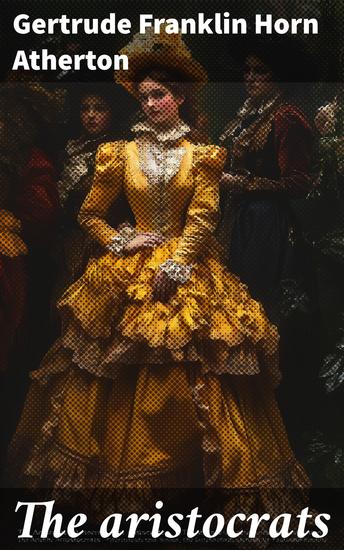
The aristocrats - Impressions of the Lady Helen Pole during her sojourn in the Great North Woods - cover

The aristocrats - Impressions of the Lady Helen Pole during her sojourn in the Great North Woods

Gertrude Franklin Horn Atherton

Verlag: Good Press

  • 0
  • 0
  • 0

Beschreibung

In "The Aristocrats," Gertrude Franklin Horn Atherton delves into the intricate dynamics of upper-class society in late 19th-century California. Atherton's literary style is characterized by incisive psychological insights, vivid characterizations, and a biting social critique that reflects the tensions of a changing America. The novel presents a duality of tradition and modernity, as the story navigates the lives of the wealthy elite grappling with their fading relevance amidst the rise of new societal norms. Atherton's keen perception of social mores makes this work a critical commentary on class disparities and the evolving notion of identity during a pivotal era in American history. Atherton, a prominent figure of the early 20th century, was significantly influenced by her own experiences as a woman in California's early literary and social circles. Having witnessed the disparities between various social strata, she crafted "The Aristocrats" to encapsulate the struggles, ambitions, and follies of her contemporaries. Her deep understanding of human nature and societal expectations informs the narrative, making her characters both relatable and complex. This novel is highly recommended for readers interested in social commentary and character-driven narratives. Atherton's exploration of aristocracy offers a nuanced perspective that resonates with ongoing discussions about class and identity. With its rich prose and engaging plot, "The Aristocrats" stands as a remarkable achievement in American literature.
Verfügbar seit: 02.03.2025.
Drucklänge: 200 Seiten.

Weitere Bücher, die Sie mögen werden

  • Before the Law - From their pens to your ears genius in every story - cover

    Before the Law - From their pens...

    Franz Kafka

    • 0
    • 0
    • 0
    Franz Kafka was born on 3rd July 1883 in Prague, then in Bohemia, the eldest of 6, into a middle-class Jewish family. 
    Life for the young Kafka and his passion for literature was often made an ordeal by his over-bearing and domineering entrepreneur of a father.   
    In 1889 Kafka was sent to the Deutsche Knabenschule, an elementary school in Prague. His father would only allow him to be educated in German-speaking schools and even went so far as to limit visits to the synagogue to four a year. 
    In 1901 he graduated from the classics-oriented Altstädter Gymnasium. Kafka did well there and across a large range of subjects.  He now enrolled at the Charles Ferdinand University, to study chemistry, but quickly switched to law for which he obtained his degree in June 1906 and then performed the mandatory year of unpaid service as clerk at the civil and criminal courts. 
    A job at an Italian insurance company left him little time to write and after a year he took another job with the Worker's Accident Insurance Institute for the Kingdom of Bohemia where he stayed until ill health led to his resignation in 1922. 
    Although he saw work as a means to pay the bills and to allow him time to write, he received several promotions and was noted as a good employee. 
    By 1917 Kafka was suffering from tuberculosis, which required frequent periods of convalescence. Interspersed with this, were several intense affairs before he settled in Berlin with Dora Diamant, a 25-year-old kindergarten teacher who herself having left the ghetto now influenced Kafka's interest in the book of Jewish law, the Talmud. 
     
     
    Kafka’s on-going health was littered with problems. Apart from TB there were several other ailments, including migraines, insomnia, boils, depression, all usually brought on by excessive stresses and strains. He attempted to counteract all of this by naturopathic treatments, a vegetarian diet and consuming large quantities of unpasteurized milk. 
    His tuberculosis still worsened. He returned to Prague, where he died on 3rd June 1924. He was 40.
    Zum Buch
  • For the Blood is the Life - A renowned and influential early gothic vampire tale set in Italy - cover

    For the Blood is the Life - A...

    F. Marion Crawford

    • 0
    • 0
    • 0
    Francis Marion Crawford was born on August 2nd, 1854 at Bagni di Lucca, Italy. An only son and a nephew to Julia Ward Howe, the American poet and writer of ‘The Battle Hymn of the Republic’.  
     
    His education began at St Paul's School, Concord, New Hampshire, then to Cambridge University; University of Heidelberg; and the University of Rome.  
     
    In 1879 Crawford went to India, to study Sanskrit and then edited The Indian Herald. In 1881 he returned to America to continue his Sanskrit studies at Harvard University. 
     
    At this time in Boston he lived at his Aunt Julia house and in the company of his Uncle, Sam Ward. His family was concerned about his employment prospects.  After a singing career as a baritone was ruled out, he was encouraged to write.  
     
    In December 1882 his first novel, ‘Mr Isaacs’, was an immediate hit which was amplified by ‘Dr Claudius’ in 1883.  
     
    In October 1884 he married Elizabeth Berdan. They went on to have two sons and two daughters. 
     
    Encouraged by his excellent start to a literary career he returned to Italy with Elizabeth to make a permanent home, principally in Sant' Agnello, where he bought the Villa Renzi that then became Villa Crawford.  
     
    In the late 1890s, he began to write his historical works: ‘Ave Roma Immortalis’ (1898), ‘Rulers of the South’ (1900) and ‘Gleanings from Venetian History’ (1905). The Saracinesca series is perhaps his best work. ‘Saracinesca’ was followed by ‘Sant’ Ilario’ in 1889, ‘Don Orsino’ in 1892 and ‘Corleone’ in 1897, that being the first major treatment of the Mafia in literature.  
     
    Francis Marion Crawford died at Sorrento on Good Friday 1909 at Villa Crawford of a heart attack.  
     
    Set in Italy, ‘For Blood is the Life’ draws us into a world usually beyond our senses.  With Crawford’s pen the uneasy, horrific world of vampires is now upon us.
    Zum Buch
  • Kutenai Killing (Stonecroft Saga Book 12) - A Historical Western Novel - cover

    Kutenai Killing (Stonecroft Saga...

    B.N. Rundell

    • 0
    • 0
    • 0
    IN A LAND OF PROVEN WARRIORS AND BITTER ENEMIES, THE OUTCOME OF ANY BATTLE IS NEVER CERTAIN AND MORE OFTEN…DEADLY. 
    The bloody waters at the lake’s edge told of the destruction of the Kutenai village. Dead bodies were strewn about, smoke curled from burning lodges, and the war cries of screaming Blackfoot warriors followed the war party from the scene of death and destruction. 
    It started as a rivalry between two war leaders of the Piikani Blackfoot. Friends since their youth, they both wanted the same woman and were on a quest for honors and loot. One chose to attack the Salish but met more than expected. The second, known as White Eagle, chose to go after the Kutenai and blood flowed. His easy victory over one village drove him to go for a second village, but he had not known of the wrath and vengeance of a dreaded enemy of the Blackfoot known as Spirit Bear. 
    Together with his battle-hardened friend, Black Buffalo, these two were determined to become the personification of vengeance as they pursued the blood-thirsty and vengeful Blackfoot war party.
    Zum Buch
  • Great Gatsby The (Annotated) - cover

    Great Gatsby The (Annotated)

    F. Scott Fitzgerald

    • 0
    • 0
    • 0
    The Great Gatsby is a 1925 novel by American writer F. Scott Fitzgerald. Set in the Jazz Age on Long Island, near New York City, the novel depicts first-person narrator Nick Carraway's interactions with mysterious millionaire Jay Gatsby and Gatsby's obsession to reunite with his former lover, Daisy Buchanan. 
    The novel was inspired by a youthful romance Fitzgerald had with socialite Ginevra King, and the riotous parties he attended on Long Island's North Shore in 1922. Following a move to the French Riviera, Fitzgerald completed a rough draft of the novel in 1924. He submitted it to editor Maxwell Perkins, who persuaded Fitzgerald to revise the work over the following winter. After making revisions, Fitzgerald was satisfied with the text, but remained ambivalent about the book's title and considered several alternatives. Painter Francis Cugat's cover art greatly impressed Fitzgerald, and he incorporated aspects of it into the novel. 
    After its publication by Scribner's in April 1925, The Great Gatsby received generally favorable reviews, though some literary critics believed it did not equal Fitzgerald's previous efforts. Compared to his earlier novels, Gatsby was a commercial disappointment, selling fewer than 20,000 copies by October, and Fitzgerald's hopes of a monetary windfall from the novel were unrealized.  
    Gatsby continues to attract popular and scholarly attention. Contemporary scholars emphasize the novel's treatment of social class, inherited versus self-made wealth, race, and environmentalism, and its cynical attitude towards the American dream. One persistent item of criticism is an allegation of antisemitic stereotyping. The Great Gatsby is widely considered to be a literary masterwork and a contender for the title of the Great American Novel. 
    -Wikipedia
    Zum Buch
  • Lady Susan - cover

    Lady Susan

    Jane Austen

    • 0
    • 0
    • 0
    Lady Susan is a short epistolary novel by Jane Austen, possibly written in 1794 but not published until 1871. This early complete work, which the author never submitted for publication, describes the schemes of the title character.
    Lady Susan Vernon, a beautiful and charming recent widow, visits her brother- and sister-in-law, Charles and Catherine Vernon, with little advance notice at Churchill, their country residence. Catherine is far from pleased, as Lady Susan had tried to prevent her marriage to Charles and her unwanted guest has been described to her as "the most accomplished coquette in England". Among Lady Susan's conquests is the married Mr. Manwaring.
    Zum Buch
  • The Romance of Tristan and Iseult - cover

    The Romance of Tristan and Iseult

    Joseph Bédier

    • 0
    • 0
    • 0
    The Romance of Tristan and Yseut 
    Step into a timeless tale of forbidden love, honor, and destiny with The Romance of Tristan and Yseut. This legendary story, at the heart of Western literature, has captivated audiences for centuries, inspiring countless works of art, music, and literature. 
    Follow Tristan, the valiant Cornish knight, and Yseut, the enchanting Irish princess, as they are bound together by fate and a magical love potion. Their passion defies the laws of heaven and earth, igniting a love so profound it transcends betrayal, duty, and even death itself. 
    Joseph Bédier masterfully weaves medieval sources into a seamless, eloquent narrative, bringing this iconic legend to life in rich detail. This audiobook immerses you in a world of chivalry, adventure, and the tragic beauty of a love destined to endure beyond the confines of time. 
    Narrated with clarity and emotion by an advanced AI voice, this rendition preserves the essence of the classic while offering a fresh and modern listening experience. 
    Are you ready to embark on this unforgettable journey of love and sacrifice? Press play and let the magic of The Romance of Tristan and Yseut sweep you away.
    Zum Buch