Rejoignez-nous pour un voyage dans le monde des livres!
Ajouter ce livre à l'électronique
Grey
Ecrivez un nouveau commentaire Default profile 50px
Grey
Abonnez-vous pour lire le livre complet ou lisez les premières pages gratuitement!
All characters reduced
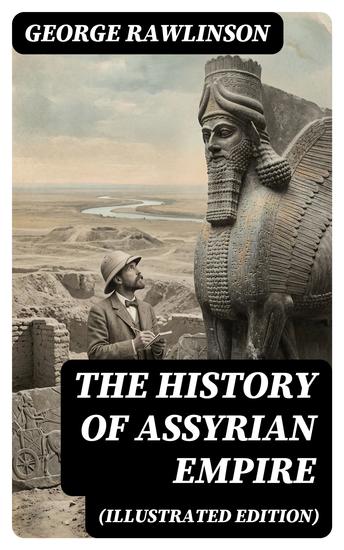
The History of Assyrian Empire (Illustrated Edition) - Enriched edition - cover

The History of Assyrian Empire (Illustrated Edition) - Enriched edition

George Rawlinson

Maison d'édition: DigiCat

  • 0
  • 0
  • 0

Synopsis

In "The History of Assyrian Empire (Illustrated Edition)", George Rawlinson presents a meticulous exploration of the Assyrian civilization, its rise to prominence, and its eventual decline. Written in a scholarly yet accessible prose style, this book is enriched with illustrations that visually enhance readers' understanding of the ancient empire's grandeur and complexity. Rawlinson interweaves archaeological findings, historical texts, and contemporary scholarly debates, situating the Assyrian Empire within the broader context of Mesopotamian history, thus making it not only informative but also profoundly engaging for both scholars and lay readers alike. George Rawlinson, a renowned historian and Assyriologist of the 19th century, drew upon his extensive knowledge of ancient languages and archaeology to craft this authoritative work. His deep passion for ancient history likely stemmed from his own studies in the East and his encounters with the rich legacies of ancient civilizations. Being part of the first generation of Western scholars to systematically study Assyrian cuneiform inscriptions, Rawlinson's insights and interpretations are invaluable to our understanding of not only Assyria but also the broader historical narratives of the Near East. This Illustrated Edition of "The History of Assyrian Empire" is highly recommended for anyone interested in ancient history, archaeology, or the development of early civilizations. Rawlinson's scholarship combined with the visual enhancements provide a unique window into the glory and intricacies of the Assyrian Empire, making it a must-read for students, historians, and enthusiasts alike.

In this enriched edition, we have carefully created added value for your reading experience:
- A succinct Introduction situates the work's timeless appeal and themes.
- The Synopsis outlines the central plot, highlighting key developments without spoiling critical twists.
- A detailed Historical Context immerses you in the era's events and influences that shaped the writing.
- A thorough Analysis dissects symbols, motifs, and character arcs to unearth underlying meanings.
- Reflection questions prompt you to engage personally with the work's messages, connecting them to modern life.
- Hand‐picked Memorable Quotes shine a spotlight on moments of literary brilliance.
- Interactive footnotes clarify unusual references, historical allusions, and archaic phrases for an effortless, more informed read.
Disponible depuis: 13/11/2022.
Longueur d'impression: 352 pages.

D'autres livres qui pourraient vous intéresser

  • Early History of Montenegro The: The History of the Region from Antiquity to Autonomy - cover

    Early History of Montenegro The:...

    Editors Charles River

    • 0
    • 0
    • 0
    Much has been written about Western intervention during the breakup of Yugoslavia, and whether it made matters worse, prevented worse atrocities, or was simply ineffective. In early 1992, however, what was clear was that Europe was hopelessly divided over the best course of action to take towards Yugoslavia, and after several years of fighting, the Bosnian War was one of the most violent conflagrations in Europe since the end of World War II. 
    That war had been the byproduct of centuries of tensions in the Balkans, and an attempt in the wake of World War I to redraw the political boundaries of Europe and the Middle East. That included forming the Kingdom of Yugoslavia, initially known as the Kingdom of Serbs, Croats and Slovenes, a particularly fragile enterprise, and there was almost constant tension between the majority Serbs and the other Yugoslav nationalities, especially the Croats. As a result, the Kingdom was a land of political assassinations, underground terrorist organizations, and ethnic animosities. In 1929, King Alexander I suspended democracy and ruled as a dictator until he himself was assassinated in 1934. 
    Depending on the source, many authors have focused on different catalysts for Yugoslavia’s demise, but Vesna Drapac may have succinctly summed the situation up when he wrote that by the end, the state “lacked a reason to exist.” There is certainly something in this sentiment, but the disintegration came at an enormous cost. 
    Given what happened in Yugoslavia, it should be little surprise the area that eventually became the modern nation of Montenegro has had a turbulent history for millennia, with shifting borders, different degrees of autonomy, and various conflicts occurring within it.
    Voir livre
  • Islamic Empires of India The: The History of the Muslim Dynasties that Ruled India Before the British - cover

    Islamic Empires of India The:...

    Editors Charles River

    • 0
    • 0
    • 0
    India has been the location of many different empires throughout its long history. The Indus Valley Civilization was home to one of the world’s first civilizations more than 5,000 years ago, and despite India’s tradition of cultural and political pluralism, several rulers attempted to place the entire Sub-Continent under the rule of one dynasty or government with a dominant religion. Most of these would-be rulers were far from successful, although a few came close, setting the template for later conquerors. 
    The religion of Islam had entered India centuries earlier through merchants and missionaries, but, in the 10th century, warrior bands of Muslims began establishing themselves permanently in what is today Pakistan. From their permanent strongholds, these Muslim warriors of Turkish descent raided northern India, eventually capturing the city of Delhi and establishing what would become the Delhi Sultanate.  
    The Delhi Sultanate was comprised of five dynasties that expanded their borders, and Islam, at sword point, but also through diplomacy and trade. The Delhi Sultanate became known as a state that welcomed the expertise of foreigners, no matter their religion, and promoted the welfare of its citizens through a host of social programs. Eventually, the Delhi Sultanate grafted ideas and inspiration from India’s pre-Islamic past with those of Islam to create a state that was quite unique and powerful. 
    The Mughals, a group with Turkish and Mongolian roots, used gunpowder weapons to sweep into northern India, topple the existing Islamic dynasty in Delhi, and eventually subject most of India to their rule. The term “gunpowder empire” was originally coined by Russian scholar V. V. Bartold and popularized by American historians William McNeil and Marshall Hodgson in the mid-20th century to describe the Islamic Ottoman, Safavid, and Mughal empires, which they claimed came to power through gunpowder.
    Voir livre
  • The Five Secrets of James Bond - cover

    The Five Secrets of James Bond

    Aliocha Wald Lasowski

    • 0
    • 0
    • 0
    To unravel the mysteries of his majesty's faithful secret agent, Alyosha Wald Lasowski uses the best techniques of current decoding. From gender studies to postcolonial thought, from popular culture to geopolitics, the author lays bare the mysteries encodedin the twenty-five Bond films. Lasowski even goes so far as to invent the “philoscopic approach,” which lays bare what seems invisible on the screen.
    From Doctor No in 1962 to No Time to Die in 2021, The Five Secrets of James Bond brings an unusual approach that shows the most famous secret agent in a different light.
    Voir livre
  • The First Landing - cover

    The First Landing

    Santiago Machain

    • 0
    • 0
    • 0
    When a fleet of Norse ships braves the stormy Atlantic and lands on the wild shores of Vinland, a new chapter in history begins. Led by Leif Erikson, the settlers must confront the challenges of an unknown land, forge uneasy alliances with the indigenous Skraeling peoples, and navigate the tensions of their own traditions and ambitions. As the seasons turn, the Norse community faces hardship, hope, and the birth of a new society—one shaped by courage, cooperation, and the enduring spirit of adventure. The First Landing is a sweeping tale of survival, cultural encounter, and the seeds of a colony that could change the fate of two worlds.
    Voir livre
  • Russia - History Facts and Biographies of Russian Leaders Tsars and Royalty - cover

    Russia - History Facts and...

    Kelly Mass

    • 0
    • 0
    • 0
    This is a bundle of several books in 1, which are: 
    Ivan the Terrible - Ivan IV Vasilyevich, referred to as Ivan the Terrible in English, was the Grand Prince of Moscow from 1533 to 1547 and the very first Moscow ruler to announce himself Tsar of Russia from 1547 to 1584. Ivan was the first ruler of Moscow after the city's flexibility. 
    Leon Trotsky - Leon Trotsky was a Ukrainian-Russian Marxist revolutionary, political thinker, and political leader who lived from November the 7th, in the year 1879 till August the 21st 1940. He developed a variation of Marxism referred to as Trotskyism after being a communist ideologically. 
    Catherine the Great - Catherine II (born Sophie of Anhalt-Zerbst; May the 2nd 1729-- November the 17th 1796, typically called Catherine the Great, ruled as Empress of Russia from 1762 to 1796, making her the nation's longest-serving female ruler. Following the assassination of her spouse and 2nd cousin, Peter III, she rose to power. Russia grew bigger, its civilization was rejuvenated, and it was acknowledged as one of Europe's great powers during her reign. 
    Peter the Great - From May the 7th, in 1682 till his death in 1725, Peter the Great or Pyotr Alekséyevich governed the Tsardom of Russia and ultimately the Russian Empire, collectively ruling before 1696 with his older half-brother, Ivan V. He got ports on the Azov and Baltic Seas through a series of triumphant disputes, creating the structure for the Imperial Russian Navy, ending undisputed Swedish control in the Baltic, and launching the Tsardom's development into a much larger empire. 
    Grigori Rasputin - Rasputin, Grigori Yefimovich, was a Russian mystic and self-declared holy man who befriended the family of Nicholas II, Russia's last emperor, and accomplished massive power in late Imperial Russia.
    Voir livre
  • The Freedom of Letting Go - Finding Health and Happiness Through Forgiveness - cover

    The Freedom of Letting Go -...

    Steven Lucas

    • 0
    • 0
    • 0
    "The Freedom of Letting Go: Finding Health and Happiness Through Forgiveness" by Steven Lucas explores the transformative power of forgiveness. Drawing from research and real-life examples, Lucas demonstrates how letting go of grudges and embracing forgiveness can lead to improved mental and physical health, healthier relationships, and greater resilience. Through a practical four-step process, he offers readers a roadmap for cultivating forgiveness in their lives, along with exercises to integrate forgiveness into daily practice. This compassionate and insightful book serves as a guide for personal growth, healing, and emotional freedom.
    Voir livre