Begleiten Sie uns auf eine literarische Weltreise!
Buch zum Bücherregal hinzufügen
Grey
Einen neuen Kommentar schreiben Default profile 50px
Grey
Jetzt das ganze Buch im Abo oder die ersten Seiten gratis lesen!
All characters reduced
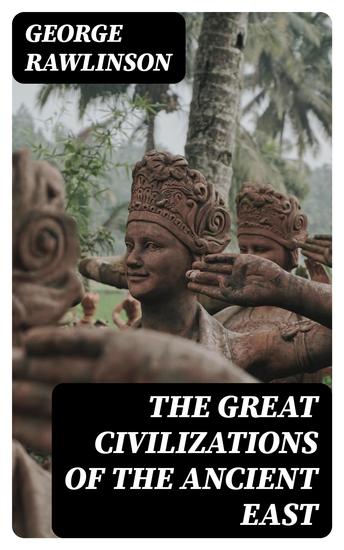
The Great Civilizations of the Ancient East - Egypt Phoenicia The Kings of Israel and Judah Babylon Parthia Chaldea Assyria Media Persia… - cover

The Great Civilizations of the Ancient East - Egypt Phoenicia The Kings of Israel and Judah Babylon Parthia Chaldea Assyria Media Persia…

George Rawlinson

Verlag: DigiCat

  • 0
  • 0
  • 0

Beschreibung

In "The Great Civilizations of the Ancient East," George Rawlinson embarks on an extensive exploration of the rich tapestry of early Eastern civilizations, including Mesopotamia, Persia, and Egypt. Written in an engaging yet scholarly style, the book weaves together extensive historical analysis with vivid descriptions of cultural and societal developments. Rawlinson employs a comparative framework, examining the interplay between these civilizations, while grounding his narrative in primary sources and archaeological findings that provide a robust contextual backdrop. The work stands as a significant contribution to the field of ancient history, reflecting the author's deep knowledge and appreciation of the complexities of early human societies. George Rawlinson, a distinguished scholar and contemporary of the Victorian era, was renowned for his expertise in ancient languages and cultures. His academic pursuits, including the translation of cuneiform inscriptions, deeply influenced his understanding of the Eastern world. Rawlinson's passion for history is evident in his meticulous research and thoughtful synthesis of information, driven by a desire to illuminate the interconnectedness of ancient societies and their legacies. This book is highly recommended for readers seeking a comprehensive and insightful understanding of the foundations of civilization in the East. Whether you are a history enthusiast or a student of anthropology, Rawlinson's work offers valuable perspectives on the complexities of human development, making it an essential addition to your library.
Verfügbar seit: 13.11.2022.
Drucklänge: 3099 Seiten.

Weitere Bücher, die Sie mögen werden

  • Da Vinci Code by Dan Brown The (Book Analysis) - Detailed Summary Analysis and Reading Guide - cover

    Da Vinci Code by Dan Brown The...

    Bright Summaries

    • 0
    • 0
    • 0
    Unlock the more straightforward side of The Da Vinci Code with this concise and insightful summary and analysis!This engaging summary presents an analysis of The Da Vinci Code by Dan Brown, a global bestseller that has been the object of many controversies. In this esoteric thriller, readers follow Robert Langdon, a university professor, as he unravels the course of history to unveil the mystery of the Holy Grail, in a gripping chase that leads him from secret societies to religious conspiracies. It has faced great controversy due to its religious references and has been denounced by many Christians as an attack on Catholicism. Nonetheless, it is a global literary phenomenon and has been translated into 44 languages as well as being adapted for the big screen. Brown's novels are all thrillers in which the action plays out over 24-hours, making for an excited and fast-paced read. Find out everything you need to know about The Da Vinci Code in a fraction of the time!This in-depth and informative reading guide brings you: • A complete plot summary • Character studies • Key themes and symbols • Questions for further reflectionWhy choose BrightSummaries.com?Available in print and digital format, our publications are designed to accompany you in your reading journey. The clear and concise style makes for easy understanding, providing the perfect opportunity to improve your literary knowledge in no time.See the very best of literature in a whole new light with BrightSummaries.com!
    Zum Buch
  • 17 Hours to More Clarity Courage and Confidence - A Repeatable Roadmap of Intermittent Fasting Meditating and Creating - cover

    17 Hours to More Clarity Courage...

    Bradley Charbonneau

    • 0
    • 0
    • 0
    Looking to "change your life"?What about "change your day"?Let's aim for more clarity, courage, and confidence by tomorrow at 9 am.Not your whole life.Just one single day. 
    Let me take you on a tiny journey of one night and one morning, from 4 pm to 9 am. Here's Who I Am Not: Intermittent Fasting Ph.D.Meditation guru from NepalNew York Times bestselling authorHere's Who I Am: ClearCourageousConfident 
    If your goals are those first three, I'm probably not your guy.  
    If you'd like more clarity, courage, and confidence by 9 am tomorrow, let's go on a tiny trip.  
    If you've been stuck trying to change your life, let's break that down to a period of just 17 hours, from 4 pm to 9 am, and let's focus on improving your clarity, courage, and confidence even just a tiny bit.  
    Once you feel the power, the joy, the bliss of a Tiny Win, you'll know you can do it again and again. Listen to 17 Hours today!
    Zum Buch
  • Giftedness - How to Help Smart Children Focus and Handle Sensitivity (3 in 1 Combo) - cover

    Giftedness - How to Help Smart...

    Angela Wayning

    • 0
    • 1
    • 0
    Take advantage of this three-book bundle, which gives you a better deal than if you were to just buy one of them. The book contains the following titles: 
    Title 1: Gifted children often have a hard time staying focused on one thing, unless it’s something they are passionate about. Then they are hyper-focused. This and other problems can be address when talking to teachers, as well as the fact that some gifted kids seem to underachieve for various reasons. The best ways to motivate your gifted children are here, as well as tactics to deal with bullies, which often target more sensitive and intelligent children. Bullying is one of the last topics addressed in this guide: How to talk about it with the teacher, how to avoid becoming a target more quickly, and how to make it go away. 
    Title 2: In this brief guide to giftedness, we will assess and critically examine the results of IQ-tests and their significance. We will also look at the homework problems many gifted children face, with their particular set of grey matter, and why schools often fail to meet the needs of those same children, because let’s face it: The schools often have no clue what to do with them, how to challenge them properly, or how to adapt a program to their constant drive to explore, discover, and be more creative. 
    Title 3: Most gifted children are intelligent because their senses are sharp and intense, and this can result in strong feelings of self-reflection and dramas over nothing. Sometimes, they may say that things that are easy, are actually hard, or they are unwilling to push through with certain things. So, how do you deal with that? In this book, we’ll talk about that, as well as some of the prevention efforts to make sure your highly intelligent child won’t become the victim of bullying. We’ll also touch on the question of whether you should homeschool your child or not, something that many parents struggle with.
    Zum Buch
  • Circassians The: The Turbulent History of the Ethnic Group in the North Caucasus - cover

    Circassians The: The Turbulent...

    Editors Charles River

    • 0
    • 0
    • 0
     Circassia could be broadly split into a western and eastern region. Eastern Circassia was inhabited by Kabardians who mainly spoke Kabardian while Western Circassia was made up of Adyghe, who spoke the eponymously-named Adyghe. As a result, discussions about the Circassians tend to split the geography of Circassia into two portions: Eastern Circassia, or Kabardia, and Western Circassia, or Adyghe. Geographically, Kabardia was situated in the middle segment of the Caucasian peninsula, with steppes to the north, and higher mountains to the south. The two key rivers in the Circassia region are the Kuban River, originating near Mount Elbrus in the Caucasus Mountains and flowing from south to north into the Sea of Azov, and the Terek River, originating in the Mtskheta-Mtianeti region of Georgia and flowing from west to east into the Caspian Sea. The Sunzha is another of the major rivers that dissects the region and acts as a tributary of the Terek. These waterways would provide strategic points in the long Russo-Circassian wars. The Caucasus region itself contains a repository of raw materials important in history (and today), including petroleum, natural gas, copper, manganese and tungsten. It also has fertile soil capable of growing wheat, barley, corn, sunflower, and many fruits and vegetables. It is unsurprising, therefore, that outsiders have coveted the region. 
    	 The Circassian people were never united as a single political bloc, which provided a core problem for their survival as larger powers, outsiders and invaders were able to exploit differences. They were invaded on many occasions during their history in the pre-modern period, including by the Mongols and the Khazars.
    Zum Buch
  • Embracing (Rather Than Fixing) Our Authentic Selves - cover

    Embracing (Rather Than Fixing)...

    JD David Bedrick

    • 0
    • 0
    • 0
    We are a society of armchair psychologists, who are constantly self-diagnosing. There are scores of books and television programs that suggest ways for us to reprogram and rid ourselves of disturbing feelings and behavior patterns. Bedrick is deepening the dialogue about the role and practice of psychology in today’s society. Much of mainstream or “pop” psychology give us plenty of labels, but does it go deep enough to motivate us to truly change destructive patterns? David Bedrick gives us a new vision of psychology where people are seen not as either functional or dysfunctional. It’s a psychology where awareness and dialogue are more important than labels. 
    Mainstream psychology often misses the range of diversity in people and tries to “normalize” them into a sea of sameness. In Process Oriented Psychology, for example, there are no 7 steps to a cure. This branch of psychology acknowledges that everyone is different. Bedrick is an awareness follower and says, “I’m using my awareness in watching all the communication a person gives me, much of which is not verbal.” He follows what they are showing him until the client reveals their own cure or medicine. He gives many exciting examples in this dynamic dialogue. (hosted by Justine Willis Toms)
    Zum Buch
  • Mechanized Death: The History and Legacy of the First Machine Guns Used in War - cover

    Mechanized Death: The History...

    Editors Charles River

    • 0
    • 0
    • 0
    Soon after dawn on July 1, 1916, British and Commonwealth troops climbed out of damp, muddy trenches in the Somme valley and began to advance across no-man’s land towards German positions. This was the biggest Anglo-French attack of the First World War to date, and British commanders were confident that their troops would quickly push the Germans back out of France and perhaps even begin a drive into Germany itself. The tactics they used in planning this battle had changed little since the Napoleonic Wars. After an artillery bombardment, a mass of infantry would move forward to overwhelm the defenses and then three cavalry divisions would exploit the breakthrough and drive deep into German-held territory. 
    	The British commander, Field Marshal Douglas Haig, was certain that this battle would lead to a decisive victory. The Germans had been worn down by fighting on other parts of the Western Front in 1915 and the British attacking force was one of the largest bodies of men at arms ever sent on the attack. However, by the time that night fell on that day, 57,000 British troops had become casualties, including more than 19,000 killed, the highest number of British casualties in a single day of combat.  
    	What Haig (and most other military commanders on all sides during World War I failed to grasp was that infantry tactics in use for more than a thousand years were no longer viable. That was simply because sending massed infantry formations to attack prepared enemy defensive positions could no longer succeed in the face of machine guns, which could pour a devastating stream of fire on any exposed troops. Sending troops over open ground to attack a defense that incorporated many linked machine gun positions was simply suicidal, and the outcome was carnage on an industrial scale as more and larger attacks during World War I simply caused even larger numbers of casualties.
    Zum Buch