Begleiten Sie uns auf eine literarische Weltreise!
Buch zum Bücherregal hinzufügen
Grey
Einen neuen Kommentar schreiben Default profile 50px
Grey
Jetzt das ganze Buch im Abo oder die ersten Seiten gratis lesen!
All characters reduced
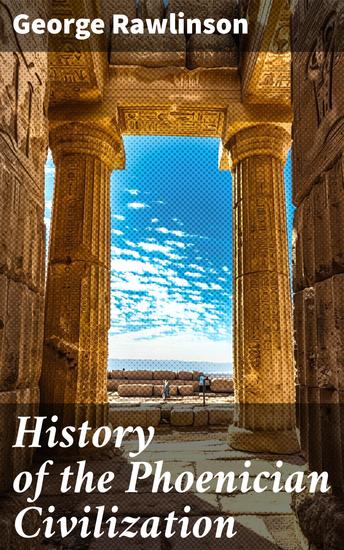
History of the Phoenician Civilization - Exploring the Legacy of Phoenician Trade and Navigation - cover

History of the Phoenician Civilization - Exploring the Legacy of Phoenician Trade and Navigation

George Rawlinson

Verlag: Good Press

  • 0
  • 0
  • 0

Beschreibung

George Rawlinson's "History of the Phoenician Civilization" offers an exhaustive exploration of the intricate socio-political structures, trade networks, and cultural contributions of the ancient Phoenicians. The text employs a rigorous scholarly style, rich with detailed analysis and historical context, drawing from both archaeological findings and classical sources. Rawlinson's writing transcends mere narration, engaging readers with vivid depictions of key events and figures, while situating the Phoenicians within the broader landscape of Mediterranean history. As a 19th-century historian and Assyriologist, George Rawlinson was profoundly influenced by his rigorous classical education and his role as one of the first to translate cuneiform inscriptions from ancient Mesopotamia. His fascination with ancient civilizations likely stemmed from this background, as he intertwines comparative analysis of Phoenician culture with insights into its interactions with neighboring societies, such as the Greeks and Egyptians. Rawlinson's expertise underscores the validity and depth of his historical interpretations, making them invaluable to both scholars and enthusiasts of ancient history. I wholeheartedly recommend "History of the Phoenician Civilization" to anyone intrigued by the complexities of ancient cultures and their legacies. Rawlinson's meticulous work shines a light on the often-overlooked achievements of the Phoenicians, providing a compelling narrative that enriches our understanding of their enduring impact on western civilization.
Verfügbar seit: 17.11.2023.
Drucklänge: 389 Seiten.

Weitere Bücher, die Sie mögen werden

  • No Country for Old Age - America's War on Aging from Valley Forge to Silicon Valley - cover

    No Country for Old Age -...

    Mischa Honeck

    • 0
    • 0
    • 0
    Since the birth of their nation, Americans have acted on the belief that theirs was a land of youth, a place destined to offer a fresh start to an aging world. No Country for Old Age tells this story from the founding period to our present moment, but not without exposing its darker side: rejuvenation has often bred grand expectations that end in division and despair. 


    Mischa Honeck reveals how Americans of diverse backgrounds have sought not only to feel and look younger but also to breathe new life into their communities. Whether marching under the banners of science, public health, sexual liberation, physical fitness, nation-building, or world peace, these youth seekers have tended to paint their ventures in utopian colors. However, from the founders to today's Silicon Valley elites, anti-aging ventures have repeatedly magnified social inequalities, often projecting visions of society that have been unmistakably classist, racist, misogynist, and ageist. Today we are experiencing rejuvenation's Janus-faced legacy: As transhumanists rhapsodize about cyber-enhancing human bodies, ghastly pandemics, old-age poverty, and shrinking life expectancies are poised to become the new normal for many twenty-first-century Americans.
    Zum Buch
  • 1922 Irish Civil War - cover

    1922 Irish Civil War

    Legends of War

    • 0
    • 0
    • 0
    In late June 1922, growing animosity between Pro and Anti-Treaty factions erupted into armed conflict in the center of Dublin. For the next ten months, the Irish Free State was wracked by a bitter, bloody, and brutal civil war between those who sought to protect the new government and those who wished to destroy it. This is the story of the Irish Civil War, its origins, and its consequences.
    Zum Buch
  • The Happy Writer - Get More Ideas Write More Words and Find More Joy from First Draft to Publication and Beyond - cover

    The Happy Writer - Get More...

    Marissa Meyer

    • 0
    • 0
    • 0
    This program is read by the author.From #1 New York Times bestselling author and the creator and host of the popular podcast, The Happy Writer, comes the ultimate guide to writing with less stress and more JOY.If you aren’t suffering, you aren’t creating. Right? Wrong! Writing can and should be joyful, fulfilling… even fun! Applicable to writers in all genres and disciplines—from screenwriters to novelists, journalists to picture book authors, aspiring to many-times published—The Happy Writer is a heartfelt and optimistic guide that will show you the way to a happier writing journey.Part craft guide, part writing coach, and part cheerleader, this book offers useful advice on a slew of common writing and publishing ailments, such as how to end procrastination, how to build a social media platform that reflects your personality, how to get your imagination to overflow with new ideas, how to listen to your intuition when receiving a critique on your work, how to overcome impostor syndrome, what to do when you’re stuck in the query trenches, and so much more.No matter where a writer might be on their creative journey, Meyer encourages them to tap into their own personal sources of joy and to celebrate every milestone, all while confronting challenges (writer’s block! rejection! burnout!) with a reservoir of resources for every temperament, budget, and career.Known in writers’ circles as a generous mentor, Meyer shares stories from her own writing path to help every writer discover the ultimate joys of living their best writing life.A Macmillan Audio production from Feiwel & Friends.
    Zum Buch
  • Raided by the Gladiators (Gay Historical Erotica) - cover

    Raided by the Gladiators (Gay...

    Archer Vale

    • 0
    • 0
    • 0
    In the Colosseum, there’s a weapon more powerful than a sword or a spear. It’s brought me to my knees. 
    I let a strange man into my home. He claims to be a physician from Alexandria. He claims to know the secret to godlike sexual performance. 
    But the treatment he prescribed…it’s shocking. 
    If I follow his instructions, I’ll lose everything. My status…my wealth…my dignity…I’ll be trading it away for this sexual blessing. 
    And he says there are risks involved. 
    I might get addicted. 
    --- 
    CONTAINS EXPLICIT GAY SEXUAL CONTENT. 
    For exclusive stories, visit www.ArcherVale.com.
    Zum Buch
  • Freedom's Battle - cover

    Freedom's Battle

    Mohandas K. Gandhi

    • 0
    • 0
    • 0
    "Freedom's Battle" is an influential essay written by Mahatma Gandhi in 1922 during the Indian independence movement. In this thought-provoking piece, Gandhi reflects on the principles of nonviolent resistance and civil disobedience as a means to challenge and overcome oppressive systems. 
     
    The essay begins with Gandhi acknowledging the critical juncture at which the fight for freedom stands. He passionately articulates the necessity of the struggle for independence and the moral imperative for individuals to resist unjust laws and policies. 
     
    Gandhi introduces the concept of Satyagraha, emphasizing the power of truth and nonviolence. He argues that nonviolent resistance is not a strategy of the weak but a potent force that requires great courage and strength of character. He believes that nonviolence is not a submission to injustice but a proactive, assertive force that can transform both the oppressor and the oppressed. 
     
    Throughout the essay, Gandhi explores the moral duty of individuals to engage in civil disobedience when faced with unjust laws. He contends that obedience to an unjust law is in itself a form of violence, and breaking such laws nonviolently becomes a powerful instrument for societal change. 
     
    Gandhi also touches on the idea of self-suffering as a means of resistance. He advocates for willingly enduring the consequences of civil disobedience as a way to awaken the conscience of the oppressor and the society at large. 
    "Freedom's Battle" is a call to action, urging individuals to recognize their agency in the struggle for freedom and justice. It remains a significant work that encapsulates Gandhi's philosophy of nonviolence and its application in the pursuit of social and political change. The essay serves as a timeless inspiration for movements advocating civil rights, justice, and freedom around the world.
    Zum Buch
  • Four Dissertations - A Natural History of Religion Of the Passions Of Tragedy Of the Standard of Taste - cover

    Four Dissertations - A Natural...

    David Hume

    • 0
    • 0
    • 0
    David Hume (1711-1776) remains one of the most stimulating and entertaining writers in the English essay tradition. Though primarily known for long-form writings, he was adept at taking one subject and looking at it in a more concise but accessible manner. 
    Hume devoted his life to study – across a wide range of his personal interests, reflecting his background in philosophy, history, economics, and many other subjects. This can be clearly seen in Four Dissertations (1757) and the topics he chose to consider. 
     
    Of these, The Natural History of Religion is the most well-known and widely quoted. Hume’s views, shaped by empiricism and scepticism, enables him to offer a perspective unusual for his age, though naturally it is embedded in the prevailing view ‘The whole frame of nature bespeaks an intelligent author’. Nevertheless, this does not restrict his thinking as he examines the psychological and sociological factors that shape religious sentiment. 
     
    The other three Dissertations are no less fascinating. Fittingly, in Of The Passions, Hume delves into the complex realm of human emotions. Investigating the nature of desire, love, fear, and more, he presents a wide-ranging study of how passions influence our actions and shape our experiences. 
     
    Of Tragedy, explores the aesthetics of dramatic art. Hume looks into the power of tragedy to elicit a passionate response and provoke contemplation. He examines the mechanisms by which tragedies captivate audiences and evoke a range of sentiments, shedding light on the profound impact of art on human consciousness. 
     
    In Of the Standard of Taste, Hume takes the viewpoint of the beholder, rather than the object. Declaring ‘We are apt to call barbarous whatever departs widely from our own taste and apprehension,’ he proposes that two elements, sentiment and critical faculty form a major part in decisions on taste. For “Beauty is no quality in things themselves: It exists merely in the mind which contemplates them; and each mind perceives a different beauty.” But such a subjective view cannot deny a certain consensus on beauty, which leads Hume to examine the matter of aesthetics in the light of judgements of established critics. 
     
    This recording concludes with Hume’s two short autobiographies, written at different times in his life and with differing characteristics. The first, A Kind of Life (1734) is a letter written to a doctor and the second, My Own Life (1776) was written shortly before his death.
    Zum Buch