Begleiten Sie uns auf eine literarische Weltreise!
Buch zum Bücherregal hinzufügen
Grey
Einen neuen Kommentar schreiben Default profile 50px
Grey
Jetzt das ganze Buch im Abo oder die ersten Seiten gratis lesen!
All characters reduced
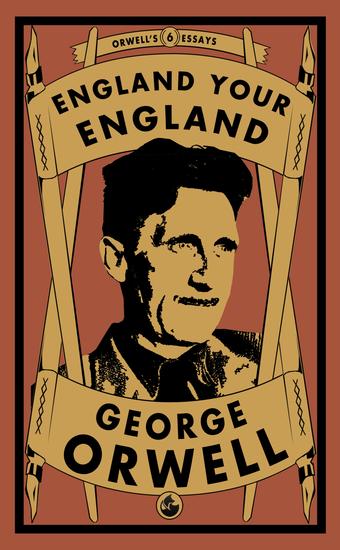
England Your England - cover

Entschuldigung, dieses Buch ist in Ihrem Land nicht verfügbar.

England Your England

George Orwell

Verlag: Renard Press

  • 0
  • 0
  • 0

Beschreibung

George Orwell set out 'to make political writing into an art', and to a wide extent this aim shaped the future of English literature – his descriptions of authoritarian regimes helped to form a new vocabulary that is fundamental to understanding totalitarianism. While 1984 and Animal Farm are amongst the most popular classic novels in the English language, this new series of Orwell's essays seeks to bring a wider selection of his writing on politics and literature to a new readership.
Fearing that England was about to be wiped from the face of the earth by the Nazi bombers flying overhead, Orwell put pen to paper and set out to make a record of English culture. England Your England, the sixth in the Orwell's Essays series, is this record, and is an important tableau of the nation's history, and demonstrates a resolute refusal to bow to the threatening forces of Fascism.
Verfügbar seit: 23.02.2022.
Drucklänge: 96 Seiten.
Weitere Bücher, die Sie mögen werden

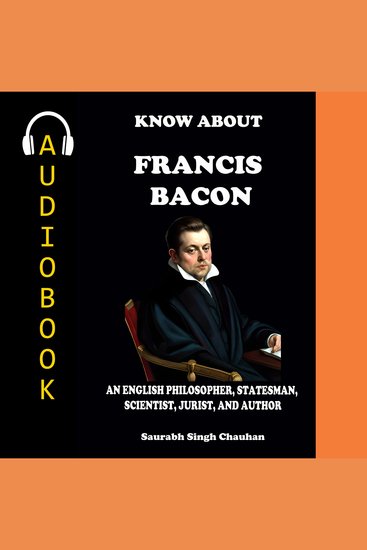
  • Know about "francis bacon" - an english philosopher statesman scientist jurist and author - cover

    Know about "francis bacon" - an...

    Saurabh Singh Chauhan

    • 0
    • 0
    • 0
    This is small copy of the introduction of the book: Francis Bacon (1561-1626) was an English philosopher, statesman, scientist, jurist, and author. He is considered to be one of the most influential figures in the Scientific Revolution. Bacon's work helped to lay the foundation for modern science by promoting the use of inductive reasoning and experimental observation. 
    Bacon was born into a prominent family in London. His father, Sir Nicholas Bacon, was the Lord Keeper of the Great Seal under Queen Elizabeth I. Bacon's mother, Anne Cooke Bacon, was a learned woman who taught him Latin and Greek at a young age. 
    Bacon received a classical education at Trinity College, Cambridge. After graduating from Cambridge, he studied law at Gray's Inn. Bacon was admitted to the bar in 1582 and quickly rose through the ranks of the legal profession. 
    In 1584, Bacon was elected to Parliament. He served in Parliament for over 20 years and was a vocal advocate for reform. Bacon also served in a number of government positions, including Solicitor General, Attorney General, and Lord Chancellor.
    Zum Buch
  • Odd Woman Out - cover

    Odd Woman Out

    Melanie Chartoff

    • 0
    • 0
    • 0
    Trying to crawl inside the television set to get her parents' attention, but blocked by the tubes and wires, she went the long way around to get herself seen onscreen. 
    In thirty-five stand alone essays and stories comprising a very late in life love story, a person who feels fictitious learns to become real from the roles she plays. Chartoff exposes her artistry and love blunders in her hilarious, heartbreaking, and hopeful memoir Odd Woman Out. 
    From her 1950s childhood in a suburb she describes as an "abusement park" to performing Molière on Broadway, to voicing characters on the popular Rugrats cartoon series, Melanie Chartoff was anxious "out of character," preferring any imaginary world to her real one. Obsessed with exploring her talent, fame came as a destabilizing byproduct. Suppressing a spiritual breakdown while co-starring on a late-night comedy show, Chartoff grew alienated. Given a private audience with a guru, she finally hears her inner voice, '70s soul singer Barry White, crooning, "Get out, baby!" All the while, she's courted by men with homing pigeons and Priuses, idealized by guys who want the girl du jour from TV to be their baby rearer or kidney donor. 
    Go backstage on Broadway, behind the scenes on network television, and inside the complicated psyche of a performer struggling in the role of a complete human. ITrying to crawl inside the television set to get her parents' attention, but blocked by the tubes and wires, she went the long way around to get herself seen onscreen. 
    In 35 stand alone essays and stories comprising a better-late-than -never love story, a person who feels fictitious learns to become real from the roles she plays. Chartoff exposes her artistry and love blunders in her hilarious, heartbreaking, and hopeful memoir Odd Woman Out.
    Zum Buch
  • The Magic Shop - cover

    The Magic Shop

    H. G. Wells

    • 0
    • 0
    • 0
    Out for a walk in London one day, Gip and his father happen upon a magic shop. At Gip's urging, the two go in — and things grow more and more curious by the minute. Counters, store fixtures, and mirrors seem to move around the room, and the shopkeeper is most mysterious of all. Gip is thrilled by all he sees, and his father is at first amused, but when things become stranger and sinister father is no longer sure where reality ends and illusion begins.
    Zum Buch
  • Ordinary Wonder Tales - cover

    Ordinary Wonder Tales

    Emily Urquhart

    • 0
    • 0
    • 0
    A journalist and folklorist explores the truths that underlie the stories we imagine—and reveals the magic in the everyday. 
    “I’ve always felt that the term fairy tale doesn’t quite capture the essence of these stories,” writes Emily Urquhart. “I prefer the term wonder tale, which is Irish in origin, for its suggestion of awe coupled with narrative. In a way, this is most of our stories.” In this startlingly original essay collection, Urquhart reveals the truths that underlie our imaginings: what we see in our heads when we read, how the sight of a ghost can heal, how the entrance to the underworld can be glimpsed in an oil painting or a winter storm—or the onset of a loved one’s dementia. In essays on death and dying, pregnancy and prenatal genetics, radioactivity, chimeras, cottagers, and plague, Ordinary Wonder Tales reveals the essential truth: if you let yourself look closely, there is magic in the everyday.
    Zum Buch
  • Final Vows - Murder Madness and Twisted Justice in California - cover

    Final Vows - Murder Madness and...

    Karen Kingsbury

    • 0
    • 0
    • 0
    A New York Times bestselling author and former Los Angeles Times reporter chronicles the marriage between a Christian woman and an ex-con that ends in murder. 


    When Carol Montecalvo began writing to a man in prison through a program at her church, she considered it her Christian duty. But the letters soon became her lifeline, something she actually looked forward to sending and receiving. She fell in love with the man behind the letters and just before Dan was released, they wed in the prison chapel. Their marriage lasted nine years, until the fateful night when Dan stoically called 911 to report his wife's murder. 


    With a half-million dollar insurance policy riding on his wife's death, and a string of adulterous affairs in his past, Dan is the most obvious suspect. But is this former felon really guilty? Or could he actually be a grieving widower, in the wrong place at the wrong time? 


    In this powerful true crime account of the gruesome murder and sensational trial that followed, New York Times bestselling author Karen Kingsbury weaves an emotional story that leaves listeners guessing until the final, harrowing conclusion.
    Zum Buch
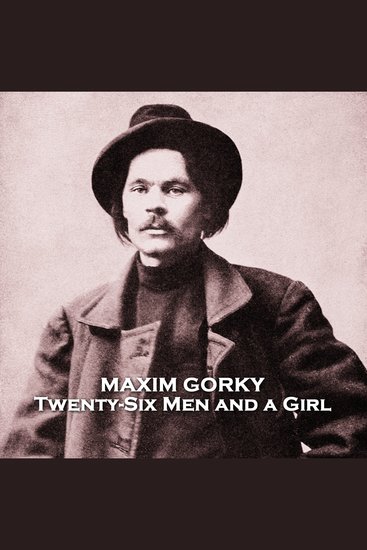
  • Twenty-Six Men and a Girl - From their pens to your ears genius in every story - cover

    Twenty-Six Men and a Girl - From...

    Maxim Gorky

    • 0
    • 0
    • 0
    Alexei Maximovich Peshkov was born on 28th March 1868, in Nizhny Novgorod, Russia. 
    Better known as Maxim Gorky he was orphaned at 11 and ran away from home at 12.  At 19 he had already attempted suicide and thereafter travelled, by foot, across the Russian Empire for 5 years. 
    His first book ‘Essays & Stories’ in 1898 was a sensation and so began a long career as an author of short stories, novels and plays.  Gorky saw writing as a moral and political act that would help to change the unjust world around him.  He was an ardent early advocate of the emerging Marxist movement and publicly opposed the Tsarist regime leading several times to his arrest.  
    In 1904 he began his own theatre but the censor banned every play and Gorky was forced to abandon the project. 
    But Gorky was a financially successful author, editor, and playwright and gave monies to political parties as well as for civil rights and social reform.  The brutal shooting of workers, which set in motion the Revolution of 1905, pushed Gorky more decisively toward radical solutions.  
    In 1906 he went to the United States to raise funds for the Bolsheviks. Those experiences including a scandal over travelling with his lover and not his wife deepened his contempt for the ‘bourgeois soul.’ 
    Gorky now moved to Capri in Italy, both for health reasons and to escape the increasingly repressive times in Russia.  
    An amnesty for the 300th anniversary of the Romanov dynasty saw him return to Russia in 1914. His politics remained close to the Bolshevik cause.  But soon, after the 1918 revolution, his essays referred to Lenin as a tyrant for his senseless arrests and repression.  He was soon appealing to the outside world for food aid after the catastrophic crop failure. 
    In October 1921 Gorky returned to Italy, now in Fascist hands, and settled in Sorrento until 1932.  His health worsened with the onset of tuberculosis. 
    He wrote several successful books there but now decided to find an understanding with the communist regime. Stalin invited him home and his return was hailed as a major propaganda victory.  He was decorated with the Order of Lenin, and a province, a park, and various streets re-named in his honour. 
    But he had his faults too.  In 1933, Gorky co-edited a book on the White Sea-Baltic Canal and denied even a single prisoner died during its construction, but thousands had. As well, knowing that some Nazis were homosexual, a phrase was attributed to him that said ‘exterminate all homosexuals and fascism will vanish’.  Although he was himself was quoting another he was decidedly homophobic. 
    With the increase of Stalinist repression in 1935 Gorky was placed under unannounced house arrest. 
    Maxim Gorky died on the 18th June 1936 from pneumonia.  He was 68. 
    Stalin and Molotov were among those who carried Gorky's urn of ashes at his funeral.
    Zum Buch