Rejoignez-nous pour un voyage dans le monde des livres!
Ajouter ce livre à l'électronique
Grey
Ecrivez un nouveau commentaire Default profile 50px
Grey
Abonnez-vous pour lire le livre complet ou lisez les premières pages gratuitement!
All characters reduced
Romola - cover

Romola

George Eliot

Maison d'édition: Pharos Books

  • 0
  • 0
  • 0

Synopsis

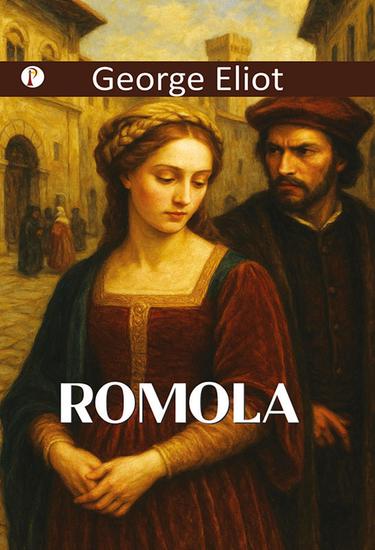
Set in Renaissance Florence at the time of political and religious upheaval, this historical novel follows Romola, the intelligent and idealistic daughter of a scholar, whose life is transformed by love, betrayal, and moral awakening. George Eliot recreates a city torn between Medici rule, republican experiment, and the fiery preaching of Savonarola. Romola's marriage to the charming yet weak Tito Melema draws her into a web of ambition and deceit, while her own conscience pushes her toward service and sacrifice. The novel combines rich historical detail with Eliot's characteristic psychological insight, exploring themes of duty, faith, and the cost of integrity. It speaks to readers who enjoy complex characters, political drama, and thoughtful reflections on how individuals can act ethically in turbulent times. Romola stands as a major achievement in historical fiction and a fascinating expansion of Eliot's concern with moral choice.
Disponible depuis: 01/11/2026.
Longueur d'impression: 793 pages.
D'autres livres qui pourraient vous intéresser

  • William Shakespeare as He Lived - An Historical Tale - cover

    William Shakespeare as He Lived...

    Henry Curling

    • 0
    • 0
    • 0
    Complete and unabridged, with 57 full-page plates by William Hogarth, Thomas Gainsborough and Joseph Wright of Derby. Shakespeare's life imagined in detail - Stratford, the deer-stealing, the London theaters and the court. Curling wrote it in the middle of the nineteenth century, when little of Shakespeare's life was documented, and filled the gaps with confident invention. This edition is bound with a gallery of 57 plates after Gainsborough, Copley, Wright of Derby and others, chiefly wooded landscapes with herders, cattle and figures.
    Voir livre
  • The Adventurous Simplicissimus - Being the Description of the Life of a Strange Vagabond named Melchior Sternfels von Fuchshaim - cover

    The Adventurous Simplicissimus -...

    Hans Jakob Christoph von...

    • 0
    • 0
    • 0
    Complete and unabridged, with 54 full-page plates by Edvard Munch, Hans Werl and Adam Elsheimer. A boy is driven off his farm by soldiers in the Thirty Years War, becomes a fool, a soldier, a highwayman and a hermit, and survives the ruin of Germany. Grimmelshausen fought in that war himself; this is the first great German novel and the plainest account anyone left of what those thirty years did. Fifty-four plates span Holbein to Munch, from siege and battle scenes to allegories of war, matching the Thirty Years War that fills these pages.
    Voir livre
  • Lesley Castle - Full Cast Drama - cover

    Lesley Castle - Full Cast Drama

    Jane Austen

    • 0
    • 0
    • 0
    In the realm of classic literature, the name of Leslie Castle often occupies a quieter corner, overshadowed by the towering works of authors such as Jane Austen and Charlotte Brontë. However, in the rich tapestry of literary history, Leslie Castle by Anne Isabella Thackeray (later known as Mrs. Ritchie) stands as a charming and insightful novella that deserves recognition for its unique narrative style, character development, and themes that resonate with readers even today. 
     
    First published in 1864 under the pseudonym "Ivan Turgénieff," Leslie Castle presents a fascinating blend of satire and social commentary, wrapped in a narrative that unfolds through a series of letters. This epistolary form allows readers a direct glimpse into the hearts and minds of the characters, shedding light on their innermost thoughts and emotions. Through this intimate narrative technique, Thackeray masterfully paints the vivid personalities of her characters, bringing them to life with remarkable depth. 
     
    At the heart of Leslie Castle are two cousins, Lady Lesley and Lady Theodosia, who serve as the primary narrators. Through their letters, readers gain insight into their contrasting personalities and worldviews. Lady Lesley, the elder cousin, is a sensible and practical woman, often portrayed as the voice of reason. In contrast, Lady Theodosia, the younger and more impulsive of the two, embodies the romantic and whimsical spirit. The dynamic between these two characters offers an engaging exploration of the tension between pragmatism and romanticism, a theme that resonates across generations.
    Voir livre
  • Children of the Bush - cover

    Children of the Bush

    Henry Lawson

    • 0
    • 0
    • 0
    Children of the Bush is a classic collection of short stories by Henry Lawson, one of Australia's most celebrated writers. Set in the rugged Australian bush, the stories offer realistic and deeply human portrayals of rural life, capturing both its hardships and its quiet moments of resilience, humor, and hope. Drawing on his keen observation of everyday people, Lawson introduces readers to farmers, drovers, laborers, families, and travelers who struggle against isolation, poverty, drought, and the unforgiving landscape. His straightforward yet evocative storytelling highlights themes of endurance, mateship, compassion, and the strength of ordinary individuals facing extraordinary challenges.
    Voir livre
  • Old Comrades - cover

    Old Comrades

    Agnes Giberne

    • 0
    • 0
    • 0
    Old Comrades by Agnes Giberne is a thoughtful work centered on friendship, loyalty, shared memories, and the experiences that connect people over time. Through its characters and narrative, the book explores the strength of companionship and the lasting influence of relationships formed during important stages of life. Themes of courage, duty, kindness, and personal responsibility add depth to the story. Giberne's engaging style makes the work appealing to readers who enjoy classic literature and stories focused on human character. It offers an interesting reflection on friendship, personal growth, and the enduring bonds that remain meaningful even as circumstances and lives change.
    Voir livre
  • The Mouse - From their pens to your ears genius in every story - cover

    The Mouse - From their pens to...

    Saki Saki

    • 0
    • 0
    • 0
    Hector Hugh Munro, more familiarly known by his pen-name ‘Saki’ was born in what was then Akyab in British Burma on 18th December 1870. His father was an Inspector General for the Indian Imperial Police, and his mother the daughter of a Rear Admiral. 
    When he was 2 his mother died and he and his siblings were sent back to England to be raised by their grandmother and paternal maiden aunts in a strict, puritanical household near Barnstaple, Devon. Educated by governesses Saki used many of these women as character models for his later writing. 
    At 17 his father retried and returned to England and then embarked on a series of European travels with Saki and his siblings. 
    After a short stint working in Burma with the Indian Imperial Police Saki decided to move to London to make a living as a writer. Initially he wrote as a journalist for a number of newspapers and magazines before attempting an historical study, ‘The Rise of the Russian Empire’, whose real value lay in directing him to writing short stories instead, the first of which, ‘Dogged’, he published in 1899. 
    From here it was a short stab of the pen to writing political satire before in 1902 he became the foreign correspondent for The Morning Post, first in the Balkans, then Russia, Paris and back to London in 1908, where 'the agreeable life of a man of letters with a brilliant reputation awaited him.'  
    Collections of his short stories full of witty, mischievous and often macabre stories that satirized Edwardian society and two novels now appeared in the years up to the Great War.  At its’ outbreak he was 43 but managed to join as an ordinary trooper. More than once he returned to the battlefield when officially too sick or injured.  
    On 14th November 1916 Hector Hugh Munro was sheltering in crater during the Battle of the Ancre, when he was shot and killed by a German sniper. According to several sources, his last words were "Put that bloody cigarette out!"
    Voir livre