Join us on a literary world trip!
Add this book to bookshelf
Grey
Write a new comment Default profile 50px
Grey
Subscribe to read the full book or read the first pages for free!
All characters reduced
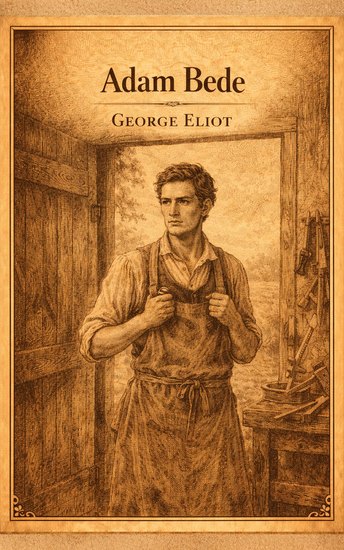
Adam Bede - cover

Adam Bede

George Eliot

Publisher: CLXBX

  • 0
  • 0
  • 0

Summary

Set in the pastoral countryside of late 18th-century England, Adam Bede is a powerful and deeply human novel that explores love, morality, betrayal, and redemption. As George Eliot's first published novel, it established her as one of the greatest writers of Victorian literature, celebrated for her psychological depth and compassionate realism.

At the heart of the story is Adam Bede, a hardworking and principled carpenter admired for his integrity and strength of character. Adam believes firmly in honesty, duty, and moral responsibility, values that guide every aspect of his life. Yet beneath his steady exterior lies a passionate heart, particularly when it comes to matters of love.

Adam finds himself deeply in love with the beautiful and charming Hetty Sorrel, a young dairymaid whose vanity and desire for a more glamorous life lead her into a secret and dangerous relationship with the dashing young squire, Arthur Donnithorne. While Arthur's charm masks his moral weakness, Hetty's youthful naivety blinds her to the serious consequences of her choices. As their ill-fated romance unfolds, the novel builds toward a heartbreaking crisis that tests every character's conscience and reshapes their destinies.

In contrast to Hetty's fragile vanity stands Dinah Morris, a gentle and devout Methodist preacher whose quiet strength and spiritual compassion form the moral center of the story. Through Dinah, Eliot explores themes of faith, forgiveness, and the possibility of redemption even in the face of grave wrongdoing.

Adam Bede is much more than a tale of romantic entanglement. George Eliot paints a vivid portrait of rural community life, filled with richly drawn characters whose struggles reflect universal human dilemmas. The novel examines the tension between desire and duty, appearance and reality, and justice and mercy. Eliot's profound insight into human nature reveals how small choices can carry immense consequences, and how compassion can coexist with accountability.

With its emotional intensity, moral complexity, and beautifully detailed setting, Adam Bede remains a timeless exploration of the human heart. It is a moving story of love tested by weakness, of suffering transformed by understanding, and of the enduring power of empathy in a flawed world.
Available since: 02/22/2026.
Print length: 724 pages.

Other books that might interest you

  • Maybe Esther - A Family Story - cover

    Maybe Esther - A Family Story

    Anonymous

    • 0
    • 0
    • 0
    An inventive, unique, and extraordinarily moving literary debut that pieces together the fascinating story of one woman’s family across twentieth-century Russia, Ukraine, Poland, and Germany. 
    Katja Petrowskaja wanted to create a kind of family tree, charting relatives who had scattered across multiple countries and continents. Her idea blossomed into this striking and highly original work of narrative nonfiction, an account of her search for meaning within the stories of her ancestors. 
    In a series of short meditations, Petrowskaja delves into family legends, introducing a remarkable cast of characters: Judas Stern, her great-uncle, who shot a German diplomatic attaché in 1932 and was sentenced to death; her grandfather Semyon, who went underground with a new name during the Bolshevik Revolution in Russia, forever splitting their branch of the family from the rest; her grandmother Rosa, who ran an orphanage in the Urals for deaf-mute Jewish children; her Ukrainian grandfather Vasily, who disappeared during World War II and reappeared without explanation forty-one years later—and settled back into the family as if he’d never been gone; and her great-grandmother, whose name may have been Esther, who alone remained in Kiev and was killed by the Nazis. 
    How do you talk about what you can’t know, how do you bring the past to life? To answer this complex question, Petrowskaja visits the scenes of these events, reflecting on a fragmented and traumatized century and bringing to light family figures who threaten to drift into obscurity. A true search for the past reminiscent of Jonathan Safran Foer’s Everything Is Illuminated, Daniel Mendelsohn’s The Lost, and Michael Chabon’s Moonglow, Maybe Esther is a poignant, haunting investigation of the effects of history on one family.
    Show book
  • Stories About Spies Who AREN'T James Bond - The name that first comes to mind isn't always the best - cover

    Stories About Spies Who AREN'T...

    John Buchan, Ambrose Bierce,...

    • 0
    • 0
    • 0
    Spies come in all shapes and sizes but all of the spies in this volume are decidedly not like the urbane British agent James Bond, who regularly saves the world.  These spies are on a missionand whether that’s saving their own lives, or the lives of many others imperilled by their Nation’s foes.
    Show book
  • Sweet Darusya - A Tale Of Two Villages - cover

    Sweet Darusya - A Tale Of Two...

    Maria Matios

    • 0
    • 0
    • 0
    'To my mind Maria Matios's Sweet Darusya is the best contemporary Ukrainian novel written since Ukrainian Independence in 1991. It reveals a family saga that is much more dynamic than classical sagas and at the same time is much more touching and engaging. It is an emotional history of Ukraine with a very well researched and vivid historical background that gives the reader the opportunity to understand not only the characters and their drama, but the entire drama of the country/countries in which they lived without leaving their village.' –Andrei Kurkov 


    'Maria Matios with her novel Sweet Darusya has boldly and strongly tossed political caution and public taboos to the wind—and at her own risk has taken us on a cruel journey into our bloody, and no less cruel, historical hell, into the abyss, where it is terrifying to peer.' –Pavlo Zahrebelny 


    'Ecstatic reactions, many awards, and the large number of readers are tied to its vivid, rich, but almost never sweet language, thanks to which the old world of a Ukrainian village blooms and begins a new life.' –Uli Hufen, Westdeutscher Rundfunk / Germany
    Show book
  • House of Matches - Grant Cartwright - cover

    House of Matches - Grant Cartwright

    Ro Artland

    • 0
    • 0
    • 0
    In House of Matches (2024) the poet fashions and gives life to diverse voices of refugees, immigrants, exiles, as well as victims of war, human trafficking, and pandemic. Collectively, in their stories of struggles, losses, and triumphs, the voices evoke the dramatically intense world of our decade - a world compared in the title poem to a "house of matches".
    Show book
  • Cascades of Time: Book summary & analysis - cover

    Cascades of Time: Book summary &...

    Margot Langley

    • 0
    • 0
    • 0
    This content is an independent and unofficial summary created for informational and educational purposes only. It is not affiliated with, authorized, approved, licensed, or endorsed by the original author or publisher. All rights to the original work belong to its respective copyright holders. This summary is not intended to substitute the original book, but to offer a concise overview and interpretation of its main ideas. 
    Cascades of Time is a mesmerizing journey through memory, fate, and the hidden threads that bind past and future. When a brilliant but reclusive historian stumbles upon a forgotten artifact capable of bending time, she is swept into a cascade of shifting realities—each revealing a different version of her life, her choices, and the world around her. As timelines collide and echoes of ancient civilizations resurface, she must navigate a labyrinth of secrets, sacrifice, and truth to preserve what truly matters. Poetic, thought-provoking, and emotionally resonant, Cascades of Time is a spellbinding tale for listeners who crave science-tinged fantasy, introspective adventure, and stories where time itself becomes the greatest mystery of all.
    Show book
  • Forgotten Authors The - Volume 4 - Jane Findlater to George Griffiths - cover

    Forgotten Authors The - Volume 4...

    Richard Marsh

    • 0
    • 0
    • 0
    Throughout the long centuries of human history is the want, and the need, to share information, to exchange ideas and for that knowledge and experience, for curiosity and learning, to be the basis of a civil society. 
    In literature the ambition is much narrower.  In order to be known, to be popular, you had to be published.  And for that people had to know you existed and your ideas worth reading.  Obviously for most of humanity’s time people couldn’t read and texts couldn’t be published in any great number. 
    In the 15th Century Gutenberg’s printing press began the revolution to address the second and by the 19th century had gathered pace with startling speed and mass distribution.  Education for the many was brought in to help people understand more of their world and, with new skills, how to have a better place within it.  Now, if the powers that owned the presses and means of distribution agreed an audience would now be able to avail themselves of your ideas, your printed words.  
    Sadly, in the thirst for the new, the recent and the past fell from sight, relegated to dark corners and dusty shelves.   
    But the printed word is rarely without someone, somewhere busying themselves through piles of papers and books rediscovering what a good story is, whatever its age. 
    Sadly, in the thirst for the new, the recent and the past fell from sight, relegated to dark corners and dusty shelves.    
    But the printed word is rarely without someone, somewhere busying themselves through piles of papers and books rediscovering what a good story is, whatever its age. 
    In this volume we offer up a small selection of those talents whose time has now come again.
    Show book