Rejoignez-nous pour un voyage dans le monde des livres!
Ajouter ce livre à l'électronique
Grey
Ecrivez un nouveau commentaire Default profile 50px
Grey
Abonnez-vous pour lire le livre complet ou lisez les premières pages gratuitement!
All characters reduced
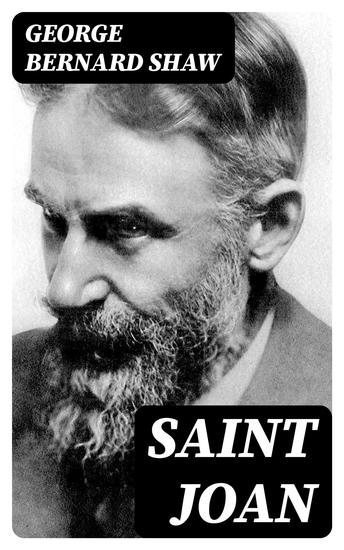
Saint Joan - cover

Saint Joan

George Bernard Shaw

Maison d'édition: DigiCat

  • 0
  • 0
  • 0

Synopsis

In his thought-provoking play "Saint Joan," George Bernard Shaw masterfully weaves a narrative that explores the life and trials of Joan of Arc, a peasant girl who rises to become a national hero and martyr for France. Shaw employs a blend of wit and philosophical discourse, characterized by his characteristic sharp dialogue, to grapple with themes of nationalism, faith, and individuality. Set against the backdrop of the Hundred Years' War, the play transcends mere historical retelling, inviting audiences to contemplate the complexity of human motives and the societal forces that shape legend from life. George Bernard Shaw, a prominent figure in early 20th-century literature and theatre, was deeply influenced by his socialist beliefs and his fascination with the interplay between morality and societal norms. His admiration for Joan of Arc as a symbol of courageous defiance against oppressive authority reflects Shaw's broader critique of conventional institutions and ideologies. This dynamic perspective renders Shaw's portrayal of Joan not just as a religious figure but as a revolutionary thinker, challenging the established order of her time. "Saint Joan" is an enduring work that captivates the reader and theatre-goer alike, offering profound insights into the nature of heroism and the conflict between personal conviction and societal expectations. This play is essential for those seeking to understand the complexities of moral authority and the timeless struggle for individual agency, making it a compelling read for students, scholars, and lovers of classic literature.
Disponible depuis: 15/09/2022.
Longueur d'impression: 137 pages.
D'autres livres qui pourraient vous intéresser

  • Tintern Abbey - Glorious poem evoking the beauty of a church monument - cover

    Tintern Abbey - Glorious poem...

    William Wordsworth

    • 0
    • 0
    • 0
    William Wordsworth was born on 7 April, 1770 in Cockermouth, in Cumbria, northwest England.  
    Wordsworth spent his early years in his beloved Lake District often with his sister, Dorothy. The English lakes could terrify as well as nurture, and as Wordsworth would write “I grew up fostered alike by beauty and by fear,” 
    After being schooled at Hawkshead he went to St. John’s College, Cambridge but not liking the competitive nature of the place idled his way through saying he “was not for that hour, nor for that place.”  
    Whilst still at Cambridge he travelled to France.  He was immediately taken by the Revolutionary fervor and the confluence of a set of great ideals and rallying calls for the people of France. 
    In his early twenties he ventured again to France and fathered an illegitimate child. He would not see that daughter till she was 9 owing to the tensions and hostilities between England and France. 
    There now followed a period of three to four years that plagued Wordsworth with doubt.  He was now in his early thirties but had no profession, was rootless and virtually penniless.  
    Although his career was not on track he did manage to publish two volumes, both in 1793;  An Evening Walk and Descriptive Sketches. 
    This dark period ended in 1795. A legacy of £900 received from Raisley Calvert enabled Wordsworth to pursue a literary career in earnest.  
    In 1797 he became great friends with a fellow poet, Samuel Taylor Coleridge. They formed a partnership that would change both their lives and the course of English poetry. 
    Their aim was for a decisive break with the strictures of Neoclassical verse. In 1798 the ground breaking Lyrical Ballads was published. Wordsworth wrote in the preface “the spontaneous overflow of powerful feelings: it takes its origin from emotion recollected in tranquility.” Most of the poems were dramatic in form, designed to reveal the character of the speaker. Thus the poems set forth a new style, a new vocabulary, and new subjects for poetry. 
    Coleridge had also conceived of an enormous poem to be called “The Brook,” in which he proposed to treat all science, philosophy, and religion, but soon laid the burden of writing it to Wordsworth.  To test his powers for that endeavour, Wordsworth began writing the autobiographical poem that would absorb him for the next 40 years, and which was eventually published as The Prelude, or, Growth of a Poet’s Mind.  
    By the 1820s, the critical acclaim for Wordsworth was growing, but perhaps his best years of work were behind him. Nonetheless he continued to write and to revise previous works.  
    With the death is 1843 of his friend and Poet Laureate Robert Southey, Wordsworth was offered the position. He accepted despite saying he wouldn’t write any poetry as Poet Laureate. And indeed he didn’t. 
    Wordsworth died of pleurisy on 23 April 1850. He was buried in St Oswald’s church Grasmere.
    Voir livre
  • Poetry Says It Better - Poems to Help You Wake Up - cover

    Poetry Says It Better - Poems to...

    Ellen Burstyn

    • 0
    • 0
    • 0
    Read by Ellen Burstyn 
    The legendary Academy Award–winning actress reflects on her love affair with poetry and makes us believers. 
    In this beautiful book, Ellen Burstyn celebrates poetic magic and shares her favorite works. Now into her nineties, Ellen reveals she had an evangelical response to learning poetry even as a child and would memorize and recite the works of Edna St Millay to envelope herself in the poet’s deeper emotional landscape. As she continued her epic rise through film and theater—eventually winning an Oscar, a Tony, a BAFTA, and an Emmy—poetry gave voice to her experience as no other literary art form could. She never went anywhere without her curated “poetry pack.” No matter where she was in the world, while waiting on set, in rehearsal, on a train, or just relaxing, she found comfort in verse. 
    For nearly nine decades, poetry has led Ellen on a life of adventure, from a pilgrimage to Rumi’s birthplace to a friendship with Maya Angelou, during which the poet read her work in Ellen’s movie trailer, to selecting the poems to join her in love, in motherhood and in grief. 
    Featuring work by W.B. Yeats, Edna Vincent St. Millay, Rainer Maria Rilke, William Wordsworth, Edgar Allan Poe, William Ernest Henley, and others, Poetry Says It Better is a perfect daily companion for everyone looking to deepen and add meaning to their life experience. Throughout, Burstyn’s charming voice and luminous insights help readers meet her in this poetic celebration—soul to soul.
    Voir livre
  • Love's Labour's Lost - cover

    Love's Labour's Lost

    William Shakespeare

    • 0
    • 0
    • 0
    King Ferdinand and his three friends, Biron, Longaville, and Dumain, plan to study philosophy for the next three years. During their academic pursuits, they must vow to sleep only three hours a night and not let any woman within a mile of court. These strict rules will prevent any distractions from their work - but their promises are soon put to the test when a princess and her three companions arrive for a state visit.
    Voir livre
  • Perdido - cover

    Perdido

    Elaine Terranova

    • 0
    • 0
    • 0
    In Perdido, Elaine Terranova' s seventh collection, the poet ponders the predicament of loss— " I want the dead but I am beside / the living." But for Terranova, perdido does not mean loss merely. Like the music from which she borrows her term, these poems bound with resilience.
    Voir livre
  • The Time Machine: A Comedy - cover

    The Time Machine: A Comedy

    John Nicholson, Steven Canny

    • 0
    • 0
    • 0
    When the worlds of science-fiction and science-fact collide… extraordinary things can happen.
    Dave is the great-great grandson of H.G. Wells, author of the 1895 novella The Time Machine, a book that foretold (with suspicious accuracy) the future of the human species. What if the ideas in that book weren't entirely fiction? Right now, Dave and his friends Amy and Michael must set out on a journey through time… the journey of a lifetime!
    The Time Machine: A Comedy is (very loosely) adapted from H.G. Wells by Steven Canny and John Nicholson, whose previous adaptation of The Hound of the Baskervilles was a hit in the West End and subsequently for numerous companies worldwide. It was first produced in 2023 on a tour of the UK, before a run at Park Theatre, London, produced by Original Theatre and directed by Orla O'Loughlin.
    Fast-paced and wise-cracking, this riotous retelling zips from the nineteenth century to the end of the world, and (with any luck) back again. It will suit any theatre company looking for a time-bending adaptation of a well-loved story – and a surefire audience-pleaser.
    Voir livre
  • A Young Boy Named David Book 22 - cover

    A Young Boy Named David Book 22

    David M. Smith

    • 0
    • 0
    • 0
    The “Young Boy Named David” series is designed to help young people deal with difficult situations that are hard to talk about and adults reconnect to their disconnected childhood helping heal broken pasts. In Book 22, the very real and pressing issue of guns enters David's life. He learns a lesson about this that will definitely help our young ones growing up in this crazy world.
    Voir livre