Rejoignez-nous pour un voyage dans le monde des livres!
Ajouter ce livre à l'électronique
Grey
Ecrivez un nouveau commentaire Default profile 50px
Grey
Abonnez-vous pour lire le livre complet ou lisez les premières pages gratuitement!
All characters reduced
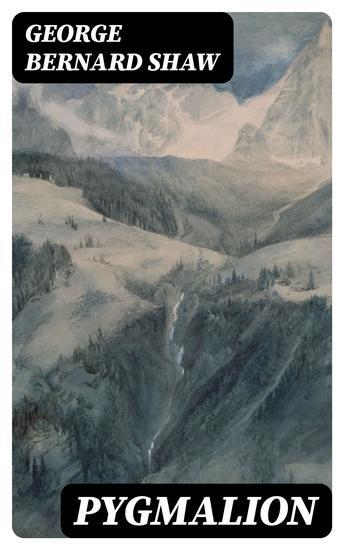
Pygmalion - cover

Pygmalion

George Bernard Shaw

Maison d'édition: DigiCat

  • 0
  • 0
  • 0

Synopsis

In George Bernard Shaw's iconic play "Pygmalion," the narrative explores themes of social class, identity, and transformation through the story of Eliza Doolittle, a flower girl with a strong Cockney accent, who is taken under the wing of phonetics professor Henry Higgins. Shaw's sharp wit and keen social commentary shine through in this comedic yet poignant exploration of language's power to shape one's societal standing. His use of realistic dialogue and vivid characterizations reflects the societal tensions of Edwardian England, making the play a seminal piece in both literature and theatrical history. George Bernard Shaw (1856-1950), a key figure in modernist literature, was deeply influenced by his own experiences with social inequality and his advocacy for women's rights. His background in music and journalism helped hone his talent for dialogue and character development. "Pygmalion" emerged during a period when class stratification was increasingly scrutinized, with Shaw aiming to challenge the conventions of societal norms and expectations through engaging characters and sharp repartee. This masterful play remains profoundly relevant today, inviting readers to reflect on the interplay between language and identity. Shaw's incisive critique of social constructs invites us to question our own biases, making "Pygmalion" not only a delightful read but also a thought-provoking exploration of human nature. It's a recommended addition to any literature enthusiast's collection.
Disponible depuis: 11/10/2022.
Longueur d'impression: 200 pages.

D'autres livres qui pourraient vous intéresser

  • 100 Great Catholic Poems - cover

    100 Great Catholic Poems

    Sally Read

    • 0
    • 0
    • 0
    Poetry is the language of Catholicism. From the songs of Scripture to the hymns of St. Thomas Aquinas, the Church has always used metaphor and image, meter and rhyme, and the music of language to illuminate and inculcate the faith.  Yet, when it comes to Catholic poetry itself, the song too often remains unsung. Many devout believers recoil from poetry, even when it is deeply Catholic. Many poetry lovers overlook Catholic poetry, even when it is truly great. And passionate readers are left with few resources from which to draw inspiration—even as the number of great Catholic poems continues to grow. This groundbreaking collection is designed to change that. Edited by acclaimed poet and author Sally Read, it includes a carefully curated collection of poetry with brief essays to introduce each selection; a detailed introduction and glossary of poetic terms; and a wide range of poetic voices—from giants like Dante and Shakespeare, to mystical saints like Hildegard of Bingen and John of the Cross, to modern masters like Gerard Manley Hopkins and Oscar Wilde, to contemporary female poets like Denise Levertov and Anne Porter. What emerges is truly universal: an unparalleled collection spanning twenty countries and twenty centuries. Whether Catholic or non-Catholic, a poetry skeptic or a poetry lover, readers will glean from these pages a deepened appreciation of the history of poetry, the life of the Church, and the powerful ways in which each strengthens the other. 
    Voir livre
  • Symbols Of Love - Authors English Audiobook Edition Read By Ireland - cover

    Symbols Of Love - Authors...

    Richard Peacock

    • 0
    • 0
    • 0
    This audiobook is narrated by an AI Voice.   
    Symbols Of Love: Author’s Audiobook Edition is a collection of modern poetry, short poetic stories and song lyrics.  This edition is slightly "darker" edition from the original "Symbols of Love" new books in print, this edition includes newly added material; additional poetry, as well as a short story called "Fracture", which was not included within the previously released print edition. All poetry & music was written by English American poet/artist Richard Peacock. Inside you will find out much more about the English, Irish & Finnish blood that flows deep within his veins.
    Voir livre
  • Almost Entirely - cover

    Almost Entirely

    Jennifer Wallace

    • 0
    • 0
    • 0
    Rooted in the grit of urban Baltimore and the forests of rural Massachusetts, these poems remind us that life' s tensions and polarities are energies we carry within ourselves.
    
    
    These are poems of witness and commentary, conversation and meditation. They offer moments of close looking, and of looking away; of loving, and of bungled attempts to be more loving. They call us to look long and hard— and generously — at our lives. Written with radiant honesty and fierce tenderness, they suggest a path of inner discovery where mystery awaits us in the ordinary.
    Voir livre
  • The Poetry of Sarojini Naidu - One of the finest modern global poets - cover

    The Poetry of Sarojini Naidu -...

    Sarojini Naidu

    • 0
    • 0
    • 0
    Sarojini Chattopadhyay was born into a Bengali family in Hyderabad, India on 13th February 1879, the eldest of the eight siblings. The family was well-respected in Hyderabad and were established artists. 
     
    Naidu passed her matriculation examination at the University of Madras and took a four-year break from her studies.  
     
    In 1895, H.E.H. the Nizam's Charitable Trust founded by the 6th Nizam, Mahbub Ali Khan, gave her the chance to study in England, first at King's College, London and later at Girton College, Cambridge.  
     
    Even in these early times she was a social activist.  It was whilst in England that she worked as a suffragist and was first drawn to the Indian National Congress' Hindu movement for India's independence from British Colonial rule.  
     
    She began writing at the age of twelve. Her play, ‘Maher Muneer’, written in Persian, impressed the Nawab of Hyderabad. It was an auspicious start. 
     
    Sarojini met Paidipati Govindarajulu Naidu, a physician, and after finishing her studies at age 19 married him. The couple would have five children.  Interestingly their families approved their marriage even though they were from different castes and society was not as tolerant as it might be today.  Additionally, Sarojini was from Bengal and Naidu from Andhra Pradesh and marriages between those from the north and south were frowned upon.  Happily, they overcame these problems and both marriage and careers thrived. 
     
    In 1905, her first collection of poems, ‘The Golden Threshold’ was published. 
     
    Naidu became a part of the Indian nationalist movement and was a follower of Mahatma Gandhi and his idea of swaraj (this was an India without its colonial administration systems).  Despite her growing political career she still found time to write and published several further volumes of poetry. Such was her eloquence that she became known as the ‘Nightingale of India’. 
    Sarojini was appointed the President of the Indian National Congress in 1925 and was a major influence and figure in the Independence movement.  
     
    Along with several other Congress leaders including Gandhi and Jawaharlal Nehru she was arrested for taking part in the 1930 Salt March.  Indeed Sarojini faced frequent arrest by the British Authorities and spent, in total, many months in prison. 
     
    Following India's independence from British rule in 1947, Sarojini was appointed as the governor of the present-day Uttar Pradesh in so doing she became India's first female governor. 
     
    Returning from work in New Delhi on 15th February, 1949 she was advised to rest by her doctors, and her official engagements were cancelled.  Her health deteriorated rapidly and on 1st March bloodletting was performed after she complained of severe headache.  
     
    Sarojini Naidu died of a cardiac arrest on 2nd March 1949.  She was 70.
    Voir livre
  • Leave Taking - cover

    Leave Taking

    Winsome Pinnock

    • 0
    • 1
    • 0
    'What doctor know about our illness? Just give you pills to sick you stomach and a doctor certificate. What they know about a black woman soul?'
    In North London, Del and Viv are soul-sick. Del doesn't want to be at home; staying out late – 3 p.m.-the-next-day late – is more her thing. Viv scours her schoolbooks trying to find a trace of herself between their lines.
    When Enid takes her daughters to the local obeah woman for some traditional Caribbean soul-healing, secrets are spilled. There's no turning back for Del, Viv and Enid as they negotiate the frictions between their countries and cultures.
    Two generations. Three incredible women. Winsome Pinnock's play Leave Taking is an epic story of what we leave behind in order to find home. It premiered in 1987, and was revived at the Bush Theatre, London, in 2018, in a production directed by the Bush's Artistic Director, Madani Younis.
    Winsome Pinnock has written numerous plays, including Talking in Tongues, for which she won the George Devine and Pearson Best New Play Awards.
    'The godmother of Black British playwrights' Guardian
    Voir livre
  • The Poetry of Aleister Crowley - Poems from the controversial black magic master of the counter culture - cover

    The Poetry of Aleister Crowley -...

    Aleister Crowley

    • 0
    • 0
    • 0
    Edward Alexander Crowley was born on 12th October 1875 to wealthy parents in Royal Leamington Spa in Warwickshire. 
     
    He was educated at Malvern College, Tonbridge School, Eastbourne College and finally Trinity College, Cambridge where he focused on his passions of mountaineering and poetry and published several volumes. 
     
    Life for Crowley was to abandon his parents’ Christian faith and instead to inject himself into Western esotericism.  In 1898, he joined the esoteric Hermetic Order of the Golden Dawn and was trained in ceremonial magic before studying both Hindu and Buddhist practices in India. 
     
    On his Egyptian honeymoon in 1904 he claimed contact with an entity―Aiwass―who gave him the sacred Book of the Law which served as the basis for the Thelema religion where he identified as its prophet.  During the Great War, which he spent in the United States, he claimed to be working for British Intelligence but by the 1920s he had decamped to pursue a libertine lifestyle in Sicily, and in the ensuing scandals was evicted by the Italian Government. 
     
    He divided the following two decades between France, Germany, and England, and the continuing promotion of Thelema. 
     
    During his life he gained widespread notoriety for his drug use, his bisexuality, and his alarming views on society.  In short, polite society frowned on his ways, his thoughts and his influence but to many others his stance had much of value.  Even after death he was a darling for the 60’s counterculture but his influence has since waned.   
     
    His literary works were both prolific and covered many topics.  In the early part of his career he published many poetry books, even plays, before his darker and more forceful works came to dominate his output. 
     
    Aleister Crowley died on 1st December 1947 at Hastings in England. He was 72. 
     
    1 - The Poetry of Aleister Crowley - An Introduction 
    2 - The Wizard Way by Aleister Crowley 
    3 - Hymn to Lucifer by Aleister Crowley 
    4 - The Pentagram by Aleister Crowley 
    5 - Hymn to Pan by Aleister Crowley 
    6 - A Birthday by Aleister Crowley 
    7 - The Quest by Aleister Crowley 
    8 - Boo to Buddha by Aleister Crowley 
    9 - All Night by Aleister Crowley 
    10 - Necrophilia by Aleister Crowley 
    11 - Mathilde by Aleister Crowley 
    12 - Ballade de la Jolie Marion by Aleister Crowley 
    13 - Rondels by Aleister Crowley 
    14 - Man's Hope by Aleister Crowley 
    15 - A Jealous Lover by Aleister Crowley 
    16 - Long Odds by Aleister Crowley 
    17 - Power by Aleister Crowley 
    18 - Optimist by Aleister Crowley 
    19 - Dumb by Aleister Crowley 
    20 - The Titanic by Aleister Crowley 
    21 - The Buddhist by Aleister Crowley 
    22 - The Mantra-Yoga by Aleister Crowley 
    23 - The Poet by Aleister Crowley
    Voir livre