Rejoignez-nous pour un voyage dans le monde des livres!
Ajouter ce livre à l'électronique
Grey
Ecrivez un nouveau commentaire Default profile 50px
Grey
Abonnez-vous pour lire le livre complet ou lisez les premières pages gratuitement!
All characters reduced
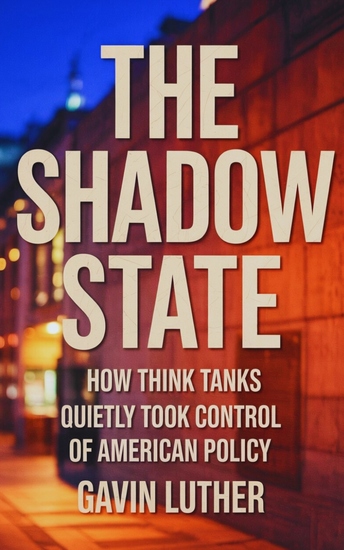
The Shadow State - How Think Tanks Quietly Took Control of American Policy - cover

The Shadow State - How Think Tanks Quietly Took Control of American Policy

Gavin Luther

Maison d'édition: Publishdrive

  • 0
  • 0
  • 0

Synopsis

Who really governs America?In The Shadow State, the answer lies not in Congress or the White House—but behind the scenes, in a vast and powerful web of think tanks, legal foundations, and donor-driven policy shops that shape the laws we live by without ever facing a single vote.From the Heritage Foundation’s blueprint for government overhaul to ALEC’s factory of copy-paste legislation, and from the Federalist Society’s judicial conquest to the media echo chambers rewriting truth itself, this groundbreaking investigation uncovers how unelected institutions have seized control of America's political infrastructure—subverting democracy while claiming to defend it.With surgical precision and deeply researched insight, The Shadow State reveals:How corporate and ideological interests quietly draft legislation before the public ever sees itWhy bipartisan politics are often just theater masking elite consensusHow public schools, courts, and newsrooms have become ideological battlegroundsThe disappearing influence of grassroots voices in an era of dark moneyAnd most urgently, what we can do to reclaim the republic before it's too lateA chilling exposé and a call to action, this book doesn’t just name the problem—it arms readers with the knowledge needed to challenge it. The Shadow State is a must-read for anyone who believes democracy should belong to the people—not the puppet masters in the background.
Disponible depuis: 30/03/2025.
Longueur d'impression: 233 pages.

D'autres livres qui pourraient vous intéresser

  • Democracy - A Guided Tour - cover

    Democracy - A Guided Tour

    Jason Brennan

    • 0
    • 0
    • 0
    In this short, accessible book, leading democratic theorist Jason Brennan guides listeners through the evolution of the concept of democracy and actual democratic practice over time to help them understand the foundations of this longstanding and yet newly fragile political system. 


    In his wide-ranging tour of the concept, Brennan will examine what democracy meant to the Greeks who first developed the concept before examining how it changed throughout European and later Western history. This will open up rich and perplexing questions. Over time, democracy shifted from being a fringe idea to the gold standard of political institutions: how did this change occur? How did the question of who counts as part of the ruling "people" change over time? As monarchies were replaced with democracies, what did theorists think the promises and perils of republican democracy were? How did actual democratic practice change the debates? What have we learned about how democracy functions—and in some cases, doesn't function—and what does this mean for future philosophical or empirical work? Brennan provides a curated, guided tour of the most important arguments for and against democracy, looking through the core values of stability, virtue, wisdom, freedom, and equality. The goal is to help listeners understand what is really at stake in democracy and its alternatives.
    Voir livre
  • Stakeknife's Dirty War - The Inside Story of Scappaticci the IRA's Nutting Squad and the British Spooks Who Ran the War - cover

    Stakeknife's Dirty War - The...

    Richard O'Rawe

    • 0
    • 0
    • 0
    Freddie Scappaticci was born in 1946 and raised in a deeply nationalist area of Belfast. When the Troubles broke out in 1969, he joined the Provisional IRA, where he quickly rose through the ranks, becoming commander of Belfast in 1984. 
     
    From the outside, Scappaticci appeared to be a dedicated volunteer, but inwardly, he had become disenchanted with the IRA and, in 1977, he started working for British intelligence. At the same time, he took up a leading role in a newly formed IRA Internal Security Unit (ISU), aka ‘The Nutting Squad’. He personally executed two suspected informers and condemned at least thirty-seven more to death. 
     
    Was he the serial killer that history portrays him? Undoubtedly. But it’s not that simple, because every time he passed the death penalty on an informer, he told his British intelligence handlers about the intended execution, giving them the opportunity to prevent the killing. 
     
    Did the tasking and co-ordinating group, the primary British intelligence organisation in Northern Ireland during the troubles, aid and abet the IRA in the mass-murder of British citizens? That is the question Richard O’Rawe poses in Stakeknife’s Dirty War. But O’Rawe goes further: he lays out a very compelling case that points to the TCGs running the IRA’s war from the mid-1980s to the 1994 ceasefire. Such was the British intelliegence penetration of the IRA, that Freddie Scappaticci, aka ‘Stakeknife’, was in control of all IRA operations in the Belfast Brigade area. This book will shock readers, and cause them to reevaluate everything they formerly held to be true about Stakeknife’s dirty war in Ireland.
    Voir livre
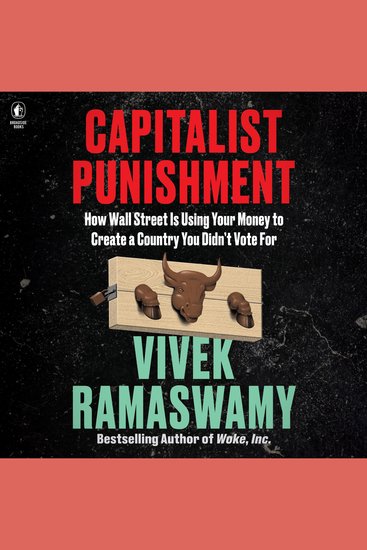
  • Capitalist Punishment - How Wall Street Is Using Your Money to Create a Country You Didn't Vote For - cover

    Capitalist Punishment - How Wall...

    Vivek Ramaswamy

    • 0
    • 0
    • 0
    A Wall Street cartel has quietly seized control of the American economy, and they are forcing governments and businesses to bow down to their political agenda—using your money to do it. 
    Three Wall Street firms have quietly amassed more money than Jeff Bezos, Elon Musk, Andrew Carnegie, and John Rockefeller combined. But the money isn’t even theirs. These asset managers have accumulated all their power through “passive funds,” as most investors no longer believe anyone can reliably pick stocks. Yet the Big Three have decided that they can reliably pick the right social policies instead. 
    As entrepreneur Vivek Ramaswamy reveals, the results are all bad—and working their way into every corner of the economy. They force US companies to adopt “racial equity audits” and “emissions caps” while supporting human rights atrocities in China. They coerce Western companies to produce less oil while shifting production to dirtier places like Russia. They allow companies like FTX to take victory laps on good management while collapsing like a house of cards. They charge high fees to mom-and-pop investors for so-called sustainable funds that are effectively identical to lower-fee index funds. 
    Worst of all, they’re celebrated as heroes—at least so far. Capitalist Punishment lifts the veil on the largest fiduciary breaches, antitrust abuses, and First Amendment violations of the twenty-first century, misdeeds that are hiding in plain sight.  
    This isn’t just a threat to capitalism. It’s a threat to democratic self-governance itself. Capitalist Punishment is an easy-to-follow educational tour de force for every participant in financial markets—which, to the surprise of most Americans, includes nearly every single one of them.
    Voir livre
  • My America - Langston Hughes on Democracy - cover

    My America - Langston Hughes on...

    Randal Maurice Jelks

    • 0
    • 0
    • 0
    Best known as the leader of the Harlem Renaissance, the celebrated poet and writer Langston Hughes believed in the power of art as resistance. What can we learn from his works today? 
    Randal M. Jelks delivers this revelatory portrait of the celebrated poet, essayist, playwright, and American artist Langston Hughes. My America traces Hughes's journey from a child captivated by the wonder of Kansas City to cosmopolitan witness in Paris, New York, Mexico City, and Madrid. We encounter Hughes as a young man discovering the pulse of modern life in a world on the verge of exploding metaphorically and literally. His experiences informed his work and his thinking on art, democracy, and activism. 
    Langston Hughes is one of the few American writers who consistently wrote about democracy from a joyous perspective, and My America explores how his works speak to the political anxieties and crises we face today. Jelks deftly examines the themes in Hughes's work, including creative expression, communal dignity, class struggle, and human suffering and what they mean for our inner well-being as democratic persons and political participants. 
    With care and no-holds-barred insight, My America removes the veneer of respectability often placed on Hughes's work and life to reveal his political adeptness. In a world threatened by fascism, Hughes's writing wasn't afforded the luxury of subtlety. He made a spiritual and political decision to stand on the side of the oppressed. He believed art should be practiced for the sake of justice. And democracy can be practiced with joy.
    Voir livre
  • The Cost of Conviction - How Our Deepest Values Lead Us Astray - cover

    The Cost of Conviction - How Our...

    Steven Sloman

    • 0
    • 0
    • 0
    When you are faced with a decision, do you consider the best outcome, or do you consider your deepest values about which actions are appropriate? The Cost of Conviction contrasts these two primary strategies for making decisions: consequentialism, the former, or prioritizing one's sacred values, the latter. Steven Sloman argues that, while both modes of decision making are necessary tools for a good decision maker, people err by deploying sacred values more often than they should, especially when it comes to sociopolitical issues. In this book, Sloman provides a new understanding of today's societal ills and grounds that understanding in science. 


    The book begins by covering the philosophical and conceptual background of the two decision-making strategies, then takes a deep dive into the psychology of decision making. Drawing on historical and current examples of the use of the two strategies, the author provides a thorough overview of the psychology of decision making, including work on judgment, conscious and unconscious decision-making processes, the roles of emotion, and even an analysis of habit and addiction. 


    With its unique emphasis on sacred values, The Cost of Conviction is an eye-opening must-listen for all decision makers, especially those who wish to understand judgment, social decision making, and leadership.
    Voir livre
  • Republicanism Explained - The Principles of Republican Government and Its Variants - cover

    Republicanism Explained - The...

    Arlo Holders

    • 0
    • 0
    • 0
    Republicanism is a political ideology that emphasizes the importance of a government where power rests in the hands of elected representatives, rather than a monarch or dictator. The essence of republicanism lies in the commitment to a system that prioritizes liberty, the rule of law, and the well-being of the public. Republicanism has roots in the ancient political thought of Greece and Rome, particularly through the Roman Republic, which provided the foundational ideas of civic participation and the limitation of power. It was in the Renaissance and Enlightenment periods that these principles were revived and further refined, giving rise to modern republicanism as we know it today. 
    The core tenet of republicanism is that government should be based on consent of the governed. Unlike monarchies, where power is inherited or imposed, republicanism promotes a system in which rulers are elected by the people to serve their interests. This concept of popular sovereignty—government’s authority coming from the consent of the people—distinguishes republicanism from both monarchy and democracy. In republican systems, rulers are expected to act in the best interest of society, balancing the needs of the individual with those of the community, while also safeguarding the common good. 
    A key feature of republicanism is its emphasis on the separation of powers. Drawing from Montesquieu’s influence, republican thought advocates for dividing government authority into branches—executive, legislative, and judicial—in order to prevent any one entity from becoming too powerful. This system of checks and balances ensures that power is distributed and that no single branch or individual can dominate or misuse their authority. This is vital to maintaining the liberty of individuals within a republican system.
    Voir livre