Rejoignez-nous pour un voyage dans le monde des livres!
Ajouter ce livre à l'électronique
Grey
Ecrivez un nouveau commentaire Default profile 50px
Grey
Abonnez-vous pour lire le livre complet ou lisez les premières pages gratuitement!
All characters reduced
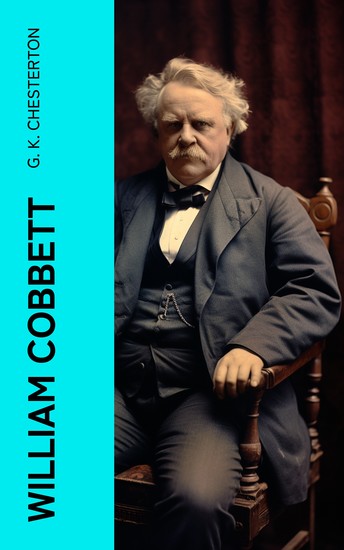
William Cobbett - cover

William Cobbett

G. K. Chesterton

Maison d'édition: e-artnow

  • 0
  • 0
  • 0

Synopsis

William Cobbett by G.K. Chesterton is the biography of an English pamphleteer, journalist, politician, and farmer born in Farnham, Surrey. He was one of an agrarian faction seeking to reform Parliament, abolish "rotten boroughs", restrain foreign activity, and raise wages to ease poverty among farm laborers and small landholders. Cobbett backed lower taxes, saving, reversing common enclosures, and resisting the 1821 gold standard.
Disponible depuis: 09/12/2023.
Longueur d'impression: 116 pages.
D'autres livres qui pourraient vous intéresser

  • Police-Encounters: Everything Black People Need To Know - cover

    Police-Encounters: Everything...

    Dr. Ezekiel Fierce Zeke

    • 0
    • 0
    • 0
    My Juris Doctorate Degree and expertise is in the study of criminal law and criminal procedure.As a Black Person, are you worried about police officers harming or killing you?Have you been in fear as a Black person by feeling that police are unfair, or that police mistreat, and brutalize Black People?Are you tired of not knowing how to act when encountering a police officer?If so, this book is for you.Here is just a fraction of what you will learn:• Why some Black People are getting harmed or killed by police• How to conduct yourself during a police-encounter• What a police officer’s authority is before, during, and after a police-encounter• How to teach your children and loved one’s how to conduct themselves during a police-encounter• Proof that the majority of Black people are not being mistreated during police-encounters• Proof that most white cops are not racist, nor are they out to harm or kill Black People* Proof that generally no cops white, black, or brown are out to harm or kill Black people* Plus, inside this book, you will learn how police officers are trained.And if that is not enough, you will learn the driving forces behind the unfortunate killings of Black People by cops.  For instance... some of the false rhetoric and the lies that are keeping tensions high between the police and Black People....how bystanders put themselves in harm’s way and can be charged with obstruction-of-justice by police ...proof that what you may believe is police brutality actually is not...and why there is absolutely no mass conspiracy by police officers or by police departments to harm or to kill Black people.This book will dispel many misconceptions and alleviate many fears.Even if you only applied the mere basics covered in this book, it is easily worth 1000x the cost of this book because it will keep you out of physical harm’s way and possibly save your life.Click "Buy Now" and grab your copy today!
    Voir livre
  • WWII Biographies - Monsters Martyrs and the Humans Behind the Headlines (2 in 1) - cover

    WWII Biographies - Monsters...

    Sage Winters

    • 0
    • 0
    • 0
    This book consists of two biographies, related to World War II: 
    Churchill's War - Winston Churchill is remembered as one of history’s most formidable leaders, a man whose unwavering resolve and stirring oratory inspired a beleaguered nation to withstand its darkest hour. Rising to prominence during one of humanity’s most perilous times, Churchill’s leadership during World War II not only shaped the fate of Britain but left an indelible mark on the global landscape. His life and career encapsulate the qualities of resilience, vision, and adaptability that are crucial during moments of profound crisis. Born into an aristocratic family in 1874, Churchill's early life was one of privilege, yet his path to greatness was anything but guaranteed. Despite academic struggles and initial failures, he demonstrated remarkable tenacity, carving out a career as a soldier, journalist, and eventually a politician. His varied experiences—whether charging on horseback in colonial campaigns or reporting from the frontlines—imbued him with a deep understanding of courage and strategy, traits that would serve him well in the years to come. However, he also had a dark side: The Bangledesh famine was partially or mostly to blame on his negligence. 
    Patton's Push - General George S. Patton was one of the most influential military leaders of the 20th century, his name forever linked with boldness, aggression, and relentless pursuit of victory. His legacy as a tactical genius in World War II is undisputed, particularly for his innovative strategies and dynamic leadership during key campaigns in Europe. Patton’s approach to warfare, characterized by rapid movement, audacity, and the application of psychological warfare, was a departure from traditional military doctrine and left an indelible mark on modern military tactics.
    Voir livre
  • Dr Heidigger's experiment - From their pens to your ears genius in every story - cover

    Dr Heidigger's experiment - From...

    Nathaniel Hawthorne

    • 0
    • 0
    • 0
    Nathaniel Hawthorne was born on 4th July 1804 in Salem, Massachusetts, a town synonymous with the earlier Salem Witch Trials. It was instrumental in Hawthorne’s later use of American Gothic and dark romanticism in his writing. 
    He was a mere four years old when his father died and his mother took him and his two sisters to live with her family and then on to their own home in Raymond, Maine. The young Hawthorne had a passion for fiction and poetry and voraciously read the works of Ann Radcliffe, Henry Fielding and Lord Byron.  
    He was sent to college at his maternal uncle’s insistence. During these years he met and befriended Henry Wadsworth Longfellow and future U S president Franklin Pierce. These friendships were lifelong and to have a crucial impact on his writings and career.  
    At college Hawthorne had made attempts at writing short stories and essays but without opportunities to publish. It was only in 1828 that he finally published his novel ‘Franshawe’ to little success and so he began work as editor for the American Magazine of Useful and Entertaining Knowledge.  
    Hawthorne’s short stories were first published in magazines but in 1837 were collected and published as ‘Twice-Told Tales’. A steady literary career still did not come his way and so he worked in a good position at Salem’s port and married the love of his life Sophia Peabody. They moved to live in ‘The Old Manse’ at Concord, Massachusetts.   
    Finally. in 1850 came spectacular literary and commercial success with ‘The Scarlet Letter’ followed by ‘The House of the Seven Gables’ the following year.  
    In 1852, Hawthorne published a biography of presidential candidate Franklin Pierce. After Pierce’s victory he was appointed consul in Liverpool, a position that offered prestige, money and fame. At the end of this appointment he returned several times to Europe before settling in Massachusetts and resuming writing and publication. 
    During the early 1860’s his health declined and on 19th May 1864 during a trip to Plymouth, New Hampshire. He was 59 and was buried in Sleepy Hollow Cemetery in Concord, Massachusetts.
    Voir livre
  • Jack Ruby - The Many Face's of Oswald's Assassin - cover

    Jack Ruby - The Many Face's of...

    Danny Fingeroth

    • 0
    • 0
    • 0
    Jack Ruby changed history with one bold, violent action: killing accused presidential assassin Lee Harvey Oswald on live TV two days after the November 22, 1963, murder of President John F. Kennedy. But who was Jack Ruby—and how did he come to be in that spot on that day? As we approach the sixtieth anniversaries of the murders of Kennedy and Oswald, Jack Ruby’s motives are as maddeningly ambiguous today as they were the day that he pulled the trigger. The fascinating yet frustrating thing about Ruby is that there is evidence to paint him as at least two different people. Much of his life story points to him as bumbling, vain, violent, and neurotic—a product of the grinding poverty of Chicago’s Jewish ghetto, a man barely able to make a living or sustain a relationship with anyone besides his dogs. By the same token, evidence exists of Jack Ruby as cagey and competent, perhaps not a mastermind, but a useful pawn of the Mob and of the police and the FBI—someone capable of running numerous legal, illegal, and semi-legal enterprises, of acting as a middleman in bribery schemes. Cultural historian Danny Fingeroth's research includes an in-depth interview with Rabbi Hillel Silverman, the clergyman who visited Ruby regularly in prison. His findings will catapult you into a trip through a house of historical mirrors. At its end, perhaps Jack Ruby’s assault on history will begin to make sense. And perhaps we will understand how Oswald’s assassin led us to the world we live in today.
    Voir livre
  • A Man of Bad Reputation - The Murder of John Stephens and the Contested Landscape of North Carolina Reconstruction - cover

    A Man of Bad Reputation - The...

    Drew A. Swanson

    • 0
    • 0
    • 0
    Five years after the Civil War, North Carolina Republican state senator John W. Stephens was found murdered inside the Caswell County Courthouse. Stephens fought for the rights of freedpeople, and his killing by the Ku Klux Klan ultimately led to insurrection, Governor William W. Holden's impeachment, and the early unwinding of Reconstruction in North Carolina. In recounting Stephens's murder, the subsequent investigation and court proceedings, and the long-delayed confessions that revealed what actually happened at the courthouse in 1870, Drew A. Swanson tells a story of race, politics, and social power shaped by violence and profit. The struggle for dominance in Reconstruction-era rural North Carolina, Swanson argues, was an economic and ecological transformation. Arson, beating, and murder became tools to control people and landscapes, and the ramifications of this violence continued long afterward. The failure to prosecute anyone for decades after John Stephens's assassination left behind a vacuum, as each side shaped its own memory of Stephens and his murder. 


    The malleability of and contested storytelling around Stephens's legacy presents a window into the struggle to control the future of the South.
    Voir livre
  • A Voice from the Pit - From their pens to your ears genius in every story - cover

    A Voice from the Pit - From...

    Bernard Capes

    • 0
    • 0
    • 0
    Bernard Edward Joseph Capes was born on the 30th August 1854 in London.  He was one of 11 children. 
    His early work was as a journalist and this developed into writing many short stories for the periodicals of the time including Blackwood's, Cassell's, Cornhill Magazine, Illustrated London News, Macmillan's Magazine, Mall Magazine, Pearson's Magazine, The Idler, and The Queen. 
    It took him many years to decide that writing full-time could be a sustainable career path.  His initial success came with ‘The Mill of Silence’.  As well as being published it garnered second prize at a competition sponsored by the Chicago Record.  He exceeded that by winning it the following year with ‘The Lake of Wine’.   
    Capes quickly became both prolific and popular.  As well as his stories and articles for the periodicals he wrote around 40 volumes across novels, poetry, history as well as romance and mystery novels. 
    Bernard Capes died on 2nd November 1918 in the flu epidemic.
    Voir livre