Rejoignez-nous pour un voyage dans le monde des livres!
Ajouter ce livre à l'électronique
Grey
Ecrivez un nouveau commentaire Default profile 50px
Grey
Abonnez-vous pour lire le livre complet ou lisez les premières pages gratuitement!
All characters reduced
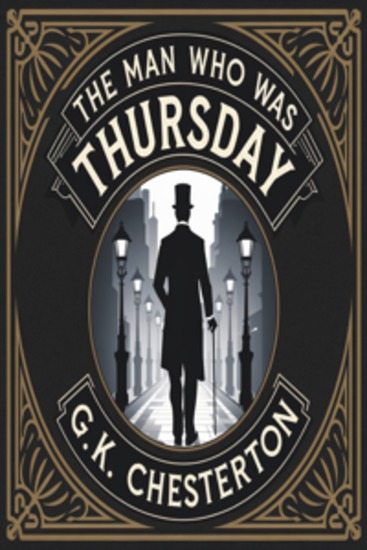
The Man Who Was Thursday (illustrated) - cover

The Man Who Was Thursday (illustrated)

G. K. Chesterton

Maison d'édition: Swish

  • 0
  • 0
  • 0

Synopsis

The Man Who Was Thursday" by G.K. Chesterton is a thrilling blend of mystery, philosophy, and adventure. Published in 1908, this literary masterpiece follows Gabriel Syme, a poet-turned-detective, as he infiltrates a secret council of anarchists, each named after a day of the week. Beneath its gripping plot lies a profound exploration of chaos, order, and the human condition. With its witty prose, unexpected twists, and enduring themes, Chesterton’s "Nightmare" remains a timeless classic that challenges the imagination and intellect.Perfect for readers who love thought-provoking fiction, intriguing characters, and philosophical undertones.
Disponible depuis: 14/12/2024.
D'autres livres qui pourraient vous intéresser

  • The Cricket on the Hearth The Lost Christmas Classic - Stories For Everyone - cover

    The Cricket on the Hearth The...

    Charles Dickens

    • 0
    • 0
    • 0
    The Cricket on the Heart is a novella by Charles Dickens, published by Bradbury and Evans, and released 20 December 1845. Dickens began writing the book in October 1845 and finished it by December. Like all of Dickens’s Christmas books, it was published in book form, not as a serial. Dickens described the novel as “quiet and domestic innocent and pretty.” It is subdivided into chapters called “Chirps”, similar to the “Quarters” of The Chimes or the “Staves” of A Christmas Carol. It is the third of Dickens’s five Christmas books, preceded by A Christmas Carol (1843) and The Chimes (1844), and followed by The Battle of Life (1846) and The Haunted Man and the Ghost’s Bargain (1848).
    Voir livre
  • Notes From Underground - cover

    Notes From Underground

    Fyodor Dostoyevsky

    • 0
    • 0
    • 0
    "Notes from Underground" (sometimes translated as "Notes from the Underground" or "Letters from the Underworld") is a novella by Fyodor Dostoyevsky, first published in 1864. It is often considered one of the first existentialist novels. The work is divided into two parts: the first is a rambling monologue by an unnamed narrator, often referred to as the "underground man", who is a retired civil servant living in St. Petersburg. This monologue is a bitter critique of utopianism, rational egoism, and utilitarianism. The second part of the novella, titled "Apropos of the Wet Snow", recounts episodes from the narrator's life that exemplify his philosophical arguments.
    Voir livre
  • Space Frontiers - cover

    Space Frontiers

    Michael D'Ambrosio

    • 0
    • 0
    • 0
    Will Saris, a recent graduate of the Space Fleet Academy, teams up with the owner of a supply depot and a princess to get revenge on a barbaric alien king and recover the mythical Eye of Icarus, which foretells future events through five Seers. Will’s nack for tactical strategies leads his crew on the Luna C and his new friends to a double life as space raiders and Fleet personnel.Will’s life becomes more complicated when he falls in love with Shanna, whom he rescues from the alien king’s prison. He learns that they have both descended from royal bloodlines and bestows additional responsibilities that they aren’t prepared for. Their romance becomes an inspiration for others in their quest for peace.
    Voir livre
  • The Adventure of Wisteria Lodge - cover

    The Adventure of Wisteria Lodge

    Arthur Conan Doyle

    • 0
    • 0
    • 0
    The Adventure of Wisteria Lodge is one of the fifty-six Sherlock Holmes short stories written by Arthur Conan Doyle. One of eight stories in the volume His Last Bow, it is a lengthy, two-part story consisting of "The Singular Experience of Mr. John Scott Eccles" and "The Tiger of San Pedro", which on original publication in The Strand bore the collective title of "A Reminiscence of Mr. Sherlock Holmes".Holmes is visited by a perturbed proper English gentleman, John Scott Eccles, who wishes to discuss something "grotesque". No sooner has he arrived at 221B Baker Street than Inspector Gregson also shows up, along with Inspector Baynes of the Surrey Constabulary. They wish a statement from Eccles about the murder near Esher last night. A note in the dead man's pocket indicates that Eccles said that he would be at the victim's house that night.Eccles is shocked to hear of Aloysius Garcia's beating death. Yes, he spent the night at Wisteria Lodge, Garcia's rented house, but when he woke up in the morning, he found that Garcia and his servants had all disappeared. He was alone in an empty house. He last remembers seeing Garcia at about one o'clock in the morning when he came to Eccles's room to ask if he had rung...Famous works of the author Arthur Conan Doyle: A Study in Scarlet, The Sign of the Four, The Adventures of Sherlock Holmes, The Memoirs of Sherlock Holmes, The Hound of the Baskervilles, The Return of Sherlock Holmes, The Valley of Fear, His Last Bow, The Case-Book of Sherlock Holmes, Stories of Sherlock Holmes, The Lost World.
    Voir livre
  • Highest Education The (Unabridged) - cover

    Highest Education The (Unabridged)

    Booker T. Washington

    • 0
    • 0
    • 0
    Booker Taliaferro Washington (April 5, 1856 - November 14, 1915) was an American educator, author, orator, and adviser to several presidents of the United States. Between 1890 and 1915, Washington was the dominant leader in the African American community and of the contemporary black elite. Washington was from the last generation of black American leaders born into slavery and became the leading voice of the former slaves and their descendants. They were newly oppressed in the South by disenfranchisement and the Jim Crow discriminatory laws enacted in the post-Reconstruction Southern states in the late 19th and early 20th centuries.
    THE HIGHEST EDUCATION: It may seem to some of you that I am continually talking to you about education-the right kind of education, how to get an education, and such kindred subjects-but surely no subject could be more pertinent, since the object for which you all are here is to get an education; and if you are to do this, you wish to get the best kind possible.
    Voir livre
  • A Dialogue Among Clever People - From their pens to your ears genius in every story - cover

    A Dialogue Among Clever People -...

    Leo Tolstoy

    • 0
    • 0
    • 0
    Leo Tolstoy was born in 1828 in the Russian province of Tula to a wealthy noble family. As a child, he had private tutors but he showed little interest in any formal education. When he went to the University of Kazan in 1843 to study oriental languages and law, he left without completing his courses.  Life now was relaxed and idle but with some writing also taking place.  Gambling debts forced an abrupt change of path and he joined the army to fight in the Crimean War.  He was commended for his bravery and promoted but was appalled at the brutality and loss of life.  He recorded these and other earlier experiences in his diaries which formed the basis of several of his works. 
    In 1852 ‘Childhood’ was published to immediate success and was followed by ‘Boyhood’ and ‘Youth’. 
    His experience in the army and the horrors he witnessed resulted in ‘The Cossacks’ in 1862 and the trilogy ‘Sevastopol Tales’. After the war he travelled around Europe, visiting London and Paris and meeting such luminaries as Victor Hugo and Charles Darwin.  
    It was now that Tolstoy began his masterpiece, ‘War and Peace’. Published in 1869 it was an epic work that changed literature. He quickly followed this with ‘Anna Karenina’.  
    These successes made Tolstoy rich and helped him accomplish many of his dreams but also brought problems as he grappled with his faith and the lot of the oppressed poor. These revolutionary views became so popular that the authorities now kept him under surveillance.  
    He led a life of asceticism and vegetarianism and put his socialist ideals into practice by establishing numerous schools for the poor and food programmes. He also believed in giving away his wealth, which caused much discord with his wife.  
    His writing continued to bring forth classics such as ‘The Death of Ivan Ilyich’ and many brilliant and incisive short stories such as ‘How Much Land Does A Man Need’.  
    In 1901 Tolstoy was excommunicated from the Church and controversially deselected for the Nobel Prize for Literature. 
    Whilst undertaking a pilgrimage by train in October 1910 with his daughter Aleksandra he caught pneumonia in the nearby town of Astapovo.  Leo Tolstoy died on November 9th, 1910, he was 82.
    Voir livre