Begleiten Sie uns auf eine literarische Weltreise!
Buch zum Bücherregal hinzufügen
Grey
Einen neuen Kommentar schreiben Default profile 50px
Grey
Jetzt das ganze Buch im Abo oder die ersten Seiten gratis lesen!
All characters reduced
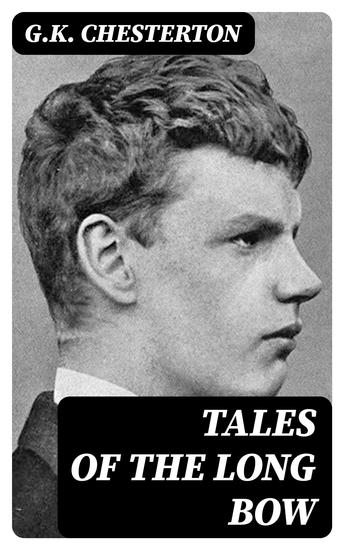
Tales of the Long Bow - cover

Tales of the Long Bow

G. K. Chesterton

Verlag: DigiCat

  • 0
  • 0
  • 0

Beschreibung

In "Tales of the Long Bow," G.K. Chesterton weaves a series of whimsical yet profound stories that center around the legendary bowman and symbol of English folklore. Through his characteristic wit and playful narrative style, Chesterton embarks on a nuanced exploration of themes such as bravery, chivalry, and the complexities of human nature. The tales are punctuated with a rich tapestry of dialogue and vivid imagery, reminiscent of Medieval literature, yet imbued with a modern sensibility that challenges societal norms and philosophical conventions of his time. Chesterton, a prominent figure in the early 20th-century literary scene, was known for his sharp intellect, profound faith, and social commentary, all of which found expression in his writing. His experiences as a journalist, combined with his keen interest in the moral implications of contemporary life, informed his storytelling approach—rendering these tales rich in allegory and social critique. "Tales of the Long Bow" reflects his deep admiration for the English landscape and its cultural heritage, revealing the author's desire to reconnect readers with their historical roots. This collection of tales is a must-read for those who appreciate a blend of humor, philosophy, and introspection. It invites readers to ponder the timeless virtues of honor, courage, and wit, all while enjoying Chesterton's signature narrative charm. Whether you are a longtime fan or new to his work, these tales will engage both the heart and mind, making them essential for any literary enthusiast.
Verfügbar seit: 22.11.2022.
Drucklänge: 150 Seiten.

Weitere Bücher, die Sie mögen werden

  • Autoportrait - cover

    Autoportrait

    Jesse Ball

    • 0
    • 0
    • 0
    Jesse Ball has produced fourteen acclaimed works of deeply empathetic absurdism in poetry and fiction. Now, he offers listeners his first memoir, one that showcases his "humane curiosity" (James Wood) and invites the listener into a raw and personal account of love, grief, and memory. Inspired by the memoir Édouard Levé put to paper shortly before his death, Autoportrait is an extraordinarily frank and intimate work from one of America's most brilliant young authors. 


    The subtle power of Ball's voice conjures the richness of everyday life. In each chapter, half-remembered moments are woven together with the joys and triumphs—and the mistakes and humiliations, too—that somehow tell us who we are, why we are here. Held at the same height as tragic accounts of illness or death are moments of startling beauty, banality, or humor: "I wake in the morning, I sit, I walk long distances. If there is somewhere to swim, I may swim. If I have a bicycle, I will ride it, especially to meet someone. There is no more preparing for me to do, other than preparing for death, and I do that by laughing. Not laughing at death, of course. Laughing at myself." 


    An extraordinary memoir that reminds us what is possible, Autoportrait will leave you feeling utterly invigorated, inspired, and a little afraid.
    Zum Buch
  • Evil Genius or Model Citizen? - cover

    Evil Genius or Model Citizen?

    Elmer Nusshausen

    • 0
    • 0
    • 0
    Is the town eccentric an EVIL GENIUS or MODEL CITIZEN?Rumors about his past include adventures overseas, Interpol, money laundering, gun running, international terrorism, witnesses disappearing without a trace, artificial intelligence, publishing empire, private jets, luxury hotels, hot women, sex research, an underground complex hidden behind a mausoleum hand-carved into a limestone cliff, and weaponization of humor.Elmer’s team of investigators includes  Fred the infiltrator, Tucker the investigative journalist, Donald the executive, Dick the private detective, and James the retired intelligence officer.This book is based on actual people and events!
    Zum Buch
  • Top 10 Poets The - The 18th Century - Five poems each from best poets born in the 18th century - cover

    Top 10 Poets The - The 18th...

    William Wordsworth, William...

    • 0
    • 0
    • 0
    Throughout the long centuries of human history is the want, and the need, to share information, to exchange ideas and for that knowledge and experience, for curiosity and learning, to be the basis of a civil society. 
    In literature the ambition is much narrower.  In order to be known, to be popular, you had to be published.  And for that people had to know you existed and your ideas worth reading.  Obviously for most of humanity’s time people couldn’t read and texts couldn’t be published in any great number. 
    In the 15th Century Gutenberg’s printing press began the revolution to address the second and by the 19th century had gathered pace with startling speed and mass distribution.  Education for the many was brought in to help people understand more of their world and, with new skills, how to have a better place within it.  Now, if the powers that owned the presses and means of distribution agreed an audience would now be able to avail themselves of your ideas, your printed words.  
    Sadly, in the thirst for the new, the recent and the past fell from sight, relegated to dark corners and dusty shelves.    
    But the printed word is rarely without someone, somewhere busying themselves through piles of papers and books rediscovering what a good story is, whatever its age. 
    In this volume we offer up a small selection of talents from the literary landscape of the 18th Century and its authors whose time has now come again.
    Zum Buch
  • Why Read - Selected Writings 2001–2021 - cover

    Why Read - Selected Writings...

    Will Self

    • 0
    • 0
    • 0
    From the Booker–shortlisted author of Umbrella, a world-girdling collection of writings inspired by a life lived in and for literature 
     
    From one of the most unusual and distinctive writers working today, Will Self’s Why Read is a cornucopia of thoughtful and brilliantly witty essays on writing and literature. 
     
    Self takes us with him: from the foibles of his typewriter repairman to the irradiated exclusion zone of Chernobyl, to the Australian outback, and to literary forms past and future. With his characteristic intellectual brio, Self aims his inimitable eye at titans of literature like Woolf, Kafka, Orwell, and Conrad. He  
    writes movingly on W. G. Sebald’s childhood in Germany and provocatively describes the elevation of William S. Burroughs’s Junky from shocking pulp novel to beloved cult classic. Self also expands on his regular column in Literary Hub to ask readers how, what, and ultimately why we should read in an  
    ever-changing world. Whether he is writing on the rise of the bookshelf as an item of furniture in the nineteenth century or on the impossibility of Googling his own name in a world lived online, Self’s trademark intoxicating prose and mordant, energetic humor infuse every piece. 
     
    A book that examines how the human stream of consciousness flows into and out of literature, Why Read will satisfy both old and new readers of this icon of contemporary literature.
    Zum Buch
  • Anathema - From their pens to your ears genius in every story - cover

    Anathema - From their pens to...

    Alexander Kuprin

    • 0
    • 0
    • 0
    Alexander Kuprin was born in Narovchat, Penza in Russia on 7th September 1870. 
    At 3 his Father died and he and mother moved to Moscow. By 10 he was enrolled at the Second Moscow Military High School and there his interest in literature began. The Alexander Military Academy followed and two years later he was a sub-lieutenant and posted to an Infantry Regiment for a further four years. 
    Despite his duties he was a now a keen writer and published his first short story at this time. His military duties also garnered him experiences for his breakthrough work ‘The Duel’.  Leaving the military he left for Kiev to work for local newspapers.  He continued to publish both stories and novels and by 1901 he was in St Petersburg becoming part of a group that included Chekhov, Ivan Bunin, Maxim Gorky and Leonid Andreyev.  
    In the years that followed further controversial works and acclaim followed.  His comments on the regime meant he was also put under secret police surveillance.   
    As World War I erupted, Kuprin opened a military hospital but was then given command of an infantry company in Finland. He was soon discharged on grounds of ill health.  
    The October Revolution saw him praise Lenin, but he warned that the Bolsheviks threatened Russian culture and might cause further widespread suffering to the peasants.  As Civil War raged he took his family to Helsinki and then on to Paris. 
    Exile saw his talents decline further and his succumbing to alcoholism. He became lonely and withdrawn. The family's poverty increased his malaise.   
    In May 1937, the Kuprin’s returned to Moscow.  He now saw his work published but wrote almost nothing new.  In 1938 his health rapidly deteriorated.  Already suffering from a kidney problems and sclerosis, he had now developed cancer of the oesophagus.  
    Alexander Kuprin died on 25th August 1938.
    Zum Buch
  • Social Activists - Peaceful Protestors and Famous Resistance Figures - cover

    Social Activists - Peaceful...

    Kelly Mass

    • 0
    • 0
    • 0
    The following three topics will be covered in this book: 
    Martin Luther King - From 1955 till his assassination in 1968, Martin Luther King Jr. was an American Baptist clergyman and activist who ended up being the most identifiable voice and leader in the American civil liberties movement. King used nonviolence and civil disobedience to advance civil liberties, inspired by his Christian convictions and Mahatma Gandhi's tranquil work. He was the child of Martin Luther King Sr., an early civil liberties leader and clergyman. King marched for black people's right to vote, desegregation, labor rights, and other fundamental civil liberties, and he led them. 
    Mahatma Gandhi - Mohandas Karamchand Gandhi was an Indian attorney, anti-colonial patriot, and political ethicist who used nonviolent resistance to lead the triumphant struggle for India's independence from British rule, motivating civil liberties and liberty movements around the globe. The epithet Mahtm (which means "great-souled" or "age-old" in Sanskrit) was at first appointed to him in South Africa in the year 1914 and is now used all across the world. Gandhi was born into a Hindu family in seaside Gujarat and studied law at the Inner Temple in London. In the year 1893, he came to South Africa to represent an Indian business owner in a case after 2 years in India, where he was not able to establish a rewarding law practice. 
    Mother Teresa - Mother Mary Teresa Bojaxhiu, typically referred to as Saint Teresa of Calcutta in the Catholic Church, was an Albanian-Indian Roman Catholic nun and missionary. She was born in Skopje (today the capital of North Macedonia), which was then part of the Ottoman Empire's Kosovo Vilayet. After eighteen years in Skopje, she went to Ireland and ultimately to India, where she spent the remainder of her life.
    Zum Buch