Rejoignez-nous pour un voyage dans le monde des livres!
Ajouter ce livre à l'électronique
Grey
Ecrivez un nouveau commentaire Default profile 50px
Grey
Abonnez-vous pour lire le livre complet ou lisez les premières pages gratuitement!
All characters reduced
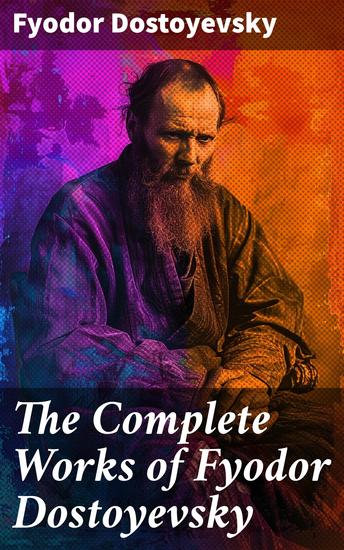
The Complete Works of Fyodor Dostoyevsky - Enriched edition Exploring the Depths of Human Psyche and Society in Russian Classics - cover

The Complete Works of Fyodor Dostoyevsky - Enriched edition Exploring the Depths of Human Psyche and Society in Russian Classics

Fyodor Dostoyevsky

Traducteur Constance Garnett, C. J. Hogarth, Ethel Colburn Mayne, Frederick Whishaw

Maison d'édition: Good Press

  • 0
  • 0
  • 0

Synopsis

The Complete Works of Fyodor Dostoyevsky encompasses the breadth of the author's literary genius, portraying the complexities of human psychology and morality. This monumental compilation includes his renowned novels, short stories, and philosophical writings, characterized by their profound existential themes and intricate character development. Dostoyevsky's distinctive style blends realism with deep psychological insight, often exploring the struggles between faith and doubt, freedom and determinism, and societal injustice, all set against the tumultuous backdrop of 19th-century Russia. Imbued with his own turbulent life experiences, the works invite readers to grapple with the sometimes unsettling depths of the human condition. Fyodor Dostoyevsky, a pivotal figure in world literature, influenced by his experiences with poverty, exile, and personal crises, delves into the darker aspects of human nature in a society rife with conflict. His background as a political exile in Siberia and his encounters with radical ideologies shaped his understanding of despair and redemption, themes which resonate throughout his oeuvre. This emotional authenticity, paired with his robust philosophical inquiries, positions Dostoyevsky as a profound thinker whose works remain relevant in contemporary discussions on morality and existence. This compilation is a must-read for anyone seeking an in-depth understanding of the human spirit. Dostoyevsky's rich narratives and complex characters urge readers to reflect on their own lives and beliefs. Whether you are a seasoned scholar or a curious newcomer to literature, The Complete Works of Fyodor Dostoyevsky serves as an essential exploration of not just literature, but the very essence of human experience.

In this enriched edition, we have carefully created added value for your reading experience:
- A comprehensive Introduction outlines these selected works' unifying features, themes, or stylistic evolutions.
- The Author Biography highlights personal milestones and literary influences that shape the entire body of writing.
- A Historical Context section situates the works in their broader era—social currents, cultural trends, and key events that underpin their creation.
- A concise Synopsis (Selection) offers an accessible overview of the included texts, helping readers navigate plotlines and main ideas without revealing critical twists.
- A unified Analysis examines recurring motifs and stylistic hallmarks across the collection, tying the stories together while spotlighting the different work's strengths.
- Reflection questions inspire deeper contemplation of the author's overarching message, inviting readers to draw connections among different texts and relate them to modern contexts.
- Lastly, our hand‐picked Memorable Quotes distill pivotal lines and turning points, serving as touchstones for the collection's central themes.
Disponible depuis: 30/12/2023.
Longueur d'impression: 5930 pages.
D'autres livres qui pourraient vous intéresser

  • Hunchback of Notre-Dame The - Audiobook - cover

    Hunchback of Notre-Dame The -...

    Víctor Hugo, Classic Audiobooks,...

    • 0
    • 0
    • 0
    The Hunchback of Notre-Dame is Victor Hugo's epic tale of love, fate, and social injustice, set against the backdrop of medieval Paris and its towering cathedral. The story follows the tragic lives of Esmeralda, a beautiful Romani dancer, and Quasimodo, the deformed bell-ringer of Notre-Dame. Caught in a web of desire, cruelty, and corruption, their lives are shaped by the forces of power, prejudice, and redemption.More than a romance or historical drama, Hugo's novel is a powerful commentary on architecture, culture, and the human condition. It celebrates the beauty of the marginalized, the sanctity of compassion, and the enduring importance of preserving history — making The Hunchback of Notre-Dame both timeless and hauntingly relevant.
    Voir livre
  • Top 10 Short Stories The - The 1860's - The Men - The top ten short stories written in the 1860s by male authors - cover

    Top 10 Short Stories The - The...

    Fyodor Dostoyevsky, Charles...

    • 0
    • 0
    • 0
    Short stories have always been a sort of instant access into an author’s brain, their soul and heart.  A few pages can lift our lives into locations, people and experiences with a sweep of landscape, narration, feelings and emotions that is difficult to achieve elsewhere. 
     
    In this series we try to offer up tried and trusted ‘Top Tens’ across many different themes and authors. But any anthology will immediately throw up the questions – Why that story? Why that author?  
     
    The theme itself will form the boundaries for our stories which range from well-known classics, newly told, to stories that modern times have overlooked but perfectly exemplify the theme.  Throughout the volume our authors whether of instant recognition or new to you are all leviathans of literature. 
     
    Some you may disagree with but they will get you thinking; about our choices and about those you would have made.  If this volume takes you on a path to discover more of these miniature masterpieces then we have all gained something. 
     
    This mid-century decade reveals a journey traversing continents and genres as authors explore and revel in the telling of tumultuous times of social upheaval as nations are divided by Civil War or expand with the brute force of Imperial Dreams.  Our writers are here to document and narrate more about this fascinating decade. 
     
    01 - The Top 10 - The 1860's - The Men - An Introduction 
    02 - The Crocodile. An Extraordinary Incident - Part 1 by Fyodor Dostoyevsky 
    03 - The Crocodile. An Extraordinary Incident - Part 2 by Fyodor Dostoyevsky 
    04 - The Signalman by Charles Dickens 
    05 - The Generous Gambler by Charles Baudelaire 
    06 - The Romance of Certain Old Clothes by Henry James 
    07 - Malachi's Cove by Anthony Trollope 
    08 - The Outcasts of Poker Flat by Bret Harte 
    05 - The Astounding Adventure of Wheeler J Calamity, Related by Himslef by W S Gilbert 
    10 - The Spectre Bridegroom by William Hunt 
    11 - The 9.30 Up-Train by Sabine Baring-Gould 
    12 - The Man Without a Country by Edward Everett Hale
    Voir livre
  • Hound The (Unabridged) - cover

    Hound The (Unabridged)

    H. P. Lovecraft

    • 0
    • 0
    • 0
    The story opens with the unnamed narrator preparing to commit suicide. Lamenting his fate, he reflects upon the events which led him to this moment. The narrator and his friend, St. John, are a pair of loners who both have a deranged interest in robbing graves. They constantly defile crypts and often keep souvenirs of their nocturnal expeditions. Since they reside in the same house, they have the opportunity to set up a sort of morbid museum in their basement. Using the objects collected from the various graves they have robbed, the two men organize a private exhibition. The collection consists of headstones, preserved bodies, skulls, and several heads in different phases of decomposition. It also included statues, frightful paintings, and a locked portfolio bound in tanned human skin. One day, the two learn of a particular grave, which sparks a profound interest in them: an old grave in a Holland cemetery which holds a legendary tomb raider within, one who is said to have stolen, many years ago, a "potent thing from a mighty sepulchre." They travel to the old cemetery where the man was buried. The thought of exhuming the final resting place of a former grave robber is irresistibly appealing to them. That, and the fact that the body had been buried several centuries before, drives them to travel such long distances to reach the site. Upon reaching the old cemetery, they notice the distant baying of a giant hound in the distance. They ignore it and begin their excavation. After some time, they hit a solid object in the ground. Clearing the last of the dirt from it, the two men unearth a strange and elaborately-made casket. Upon opening the casket, they see that several places on the skeletal remains appear torn and shattered, as if attacked by a wild animal, yet the whole of the skeleton is still completely distinguishable. At that moment, they notice a jade amulet hanging from the skeleton's neck. They examine it and, after some observation, they recognize the amulet as one mentioned in "the forbidden Necronomicon of the mad Arab Abdul Alhazred." They immediately know they must have the amulet at all cost. They remove it from the skeleton and flee into the night. As they do, they notice once again the continuous sound of a baying hound in the distance. After they return home to England, strange events begin to occur. Odd sounds can be heard within and around their house, including the distant howling they heard in the cemetery. One night, St. John is violently attacked and killed by a mysterious creature, which the narrator claims the amulet had brought unto him. He destroys the macabre museum he and his friend made, before fleeing from the house and traveling to London. Still plagued by bizarre occurrences, he decides that he must return the amulet to its rightful owner. He travels to Holland, but the amulet is stolen from him before he can return it. The next day, he reads in the newspaper about a band of thieves savagely killed by an unknown creature. Slowly going insane, he returns to the churchyard and exhumes the coffin once more, only to find the skeleton within covered in caked blood and bits of flesh and hair, holding the lost amulet in its hand. Suddenly, the skeleton begins howling, the same howl that had tormented him since he first stole the amulet. The narrator flees the graveyard, succumbing to madness and despair. He states that he intends to kill himself with a revolver, believing death to be his only refuge from the crawling horror which grows within him.
    Voir livre
  • Calash The (Unabridged) - cover

    Calash The (Unabridged)

    Nikolai Gogol

    • 0
    • 0
    • 0
    Nikolai Gogol was one of the first to use the technique of the grotesque. According to Viktor Shklovsky, Gogol's strange style of writing resembles the "ostranenie" technique of defamiliarization. His early works, such as Evenings on a Farm Near Dikanka, were influenced by his Ukrainian upbringing, Ukrainian culture and folklore.
    THE CALASH: The town of B had become very lively since a cavalry regiment had taken up its quarters in it. Up to that date it had been mortally wearisome there. When you happened to pass through the town and glanced at its little mud houses with their incredibly gloomy aspect, the pen refuses to express what you felt.
    Voir livre
  • Angèle au Couvent - A young girls search for happiness in art is challenged by her religious commitments and society - cover

    Angèle au Couvent - A young...

    Mary Butts

    • 0
    • 0
    • 0
    Mary Frances Butts was born on 13th December 1890 in Poole, Dorset. 
     
    Her early years were spent at Salterns, an 18th-century house overlooking Poole Harbour.  Sadly in 1905 her father died, and she was sent for boarding at St Leonard's school for girls in St Andrews. 
     
    Her mother remarried and, from 1909, Mary studied at Westfield College in London, and here, first became aware of her bisexual feelings.  She was sent down for organising a trip to Epsom races and only completed her degree in 1914 when she graduated from the London School of Economics.  By then Mary had become an admirer of the occultist Aleister Crowley and she was given a co-authorship credit on his ‘Magick (Book 4)’. 
     
    In 1916, she began the diary which would now detail her future life and be a constant reference point for her observations and her absorbing experiences. 
     
    During World War I, she was doing social work for the London County Council in Hackney Wick, and involved in a lesbian relationship.  Life changed after meeting the modernist poet, John Rodker and they married in 1918. 
     
    In 1921 she spent 3 months at Aleister Crowley's Abbey of Thelema in Sicily; she found the practices dreadful and also acquired a drug habit.  Mary now spent time writing in Dorset, including her celebrated book of short stories ‘Speed the Plough’ which saw fully develop her unique Modernist prose style. 
     
    Europe now beckoned and several years were spent in Paris befriending many artists and writing further extraordinary stories.   
     
    She was continually sought after by literary magazines and also published several short story collections as books. Although a Modernist writer she worked in other genres but is essentially only known for her short stories.  Mary was deeply committed to nature conservation and wrote several pamphlets attacking the growing pollution of the countryside. 
     
    In 1927, she divorced and the following year her novel ‘Armed with Madness’ was published.  A further marriage followed in 1930 and time was spent attempting to settle in London and Newcastle before setting up home on the western tip of Cornwall.  By 1934 the marriage had failed. 
     
    Mary Butts died on 5th March 1937, at the West Cornwall Hospital, Penzance, after an operation for a perforated gastric ulcer. She was 46. 
     
    In ‘Angèle Au Couvent’ Butts takes up the story of a young school girl desperate for friendships but wrestling with her fluid interpretation of religion.
    Voir livre
  • Two Tales From Algernon Blackwood - cover

    Two Tales From Algernon Blackwood

    Algernon Blackwood

    • 0
    • 0
    • 0
    Algernon Henry Blackwood (March 14, 1869 - December 10, 1951) was an English broadcasting narrator, journalist, novelist and short story writer, and among the most prolific ghost story writers in the history of the genre. The following recording includes the short stories, "The Olive" and "Ancient Lights."
    Voir livre