Begleiten Sie uns auf eine literarische Weltreise!
Buch zum Bücherregal hinzufügen
Grey
Einen neuen Kommentar schreiben Default profile 50px
Grey
Jetzt das ganze Buch im Abo oder die ersten Seiten gratis lesen!
All characters reduced
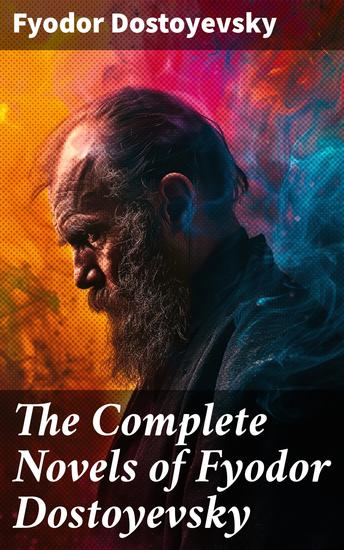
The Complete Novels of Fyodor Dostoyevsky - Exploring Existentialism & Morality in Dostoyevsky's Masterpiece Collection - cover

The Complete Novels of Fyodor Dostoyevsky - Exploring Existentialism & Morality in Dostoyevsky's Masterpiece Collection

Fyodor Dostoyevsky

Übersetzer Constance Garnett

Verlag: Good Press

  • 0
  • 0
  • 0

Beschreibung

The Complete Novels of Fyodor Dostoyevsky presents an extraordinary collection of the author's most significant works, encapsulating the psychological depth, existential inquiry, and moral complexity that define 19th-century Russian literature. Through novels such as 'Crime and Punishment,' 'The Brothers Karamazov,' and 'The Idiot,' Dostoyevsky delves into the labyrinth of the human psyche, exploring themes of guilt, redemption, faith, and the often turbulent relationship between the self and society. His narrative style blends raw, emotive prose with philosophical musings, making profound inquiries into the nature of free will and the human condition within the socio-political context of Russia at the time. Fyodor Dostoyevsky, a former political prisoner and exile, transformed his personal trials into a literary canvas that profoundly resonates with human experience. His insights into suffering and moral ambiguity stem from his own struggles with poverty, mental illness, and the repercussions of ideologies prevalent during the turbulent eras of his life. This backdrop profoundly influenced his literary output, infusing his characters with a haunting authenticity and existential urgency. The Complete Novels of Fyodor Dostoyevsky is an essential read for anyone seeking to understand the complexities of human emotion and morality. It invites readers into a world of philosophical exploration and ethical dilemmas, offering a timeless commentary on society's ills and personal redemption. Engage with these masterpieces to experience a profound journey through both the darkness and light of the human soul.
Verfügbar seit: 27.12.2023.
Drucklänge: 3800 Seiten.

Weitere Bücher, die Sie mögen werden

  • The Modern Soul - cover

    The Modern Soul

    Katherine Mansfield

    • 0
    • 0
    • 0
    The Modern Soul is more about characters than action. The story begins with the stereotype of the pompous German music professor explaining to the young English narrator why he incessantly eats cherries: “There is nothing like cherries for producing free saliva after trombone playing, especially after Grieg’s ‘Ich Liebe Dich’” He’s cherry eating is connected with a consuming desire for women. The two older Germans, the Professor and the German actress’ mother, talk incessantly of food and soul. They agree that the English are “fish blooded,” cold and without soul. The modern soul is posture and hypocrisy; the varieties of sexual attraction are puzzles and complexities that human beings cannot handle. Characterisation
    Zum Buch
  • Hunchback of Notre-Dame The (Book 3) - cover

    Hunchback of Notre-Dame The...

    Victor Hugo

    • 0
    • 0
    • 0
    Book 3: The Hunchback of Notre-Dame or Notre-Dame de Paris is a French Gothic novel by Victor Hugo, published in 1831. - The story is set in Paris in 1482 during the reign of Louis XI. The gypsy Esmeralda (born as Agnes) captures the hearts of many men, including those of Captain Phoebus and Pierre Gringoire, but especially Quasimodo and his guardian Archdeacon Claude Frollo. Frollo is torn between his obsessive lust for Esmeralda and the rules of Notre Dame Cathedral. He orders Quasimodo to kidnap her, but Quasimodo is captured by Phoebus and his guards, who save Esmeralda. Gringoire, who attempted to help Esmeralda but was knocked out by Quasimodo, is about to be hanged by beggars when Esmeralda saves him by agreeing to marry him for four years.
    Zum Buch
  • Casting the Runes - cover

    Casting the Runes

    M. R. James

    • 0
    • 0
    • 0
    'I am about to let loose on the world a plague which could destroy all mankind'
    Casting the Runes originally appeared in M.R. James' second published collection of ghost stories (1911) and has significantly influenced the horror genre, inspiring later writers and filmmakers with its emphasis on atmosphere and psychological tension.
    
    When academic Edward Dunning dismisses a manuscript by the sinister Mr. Karswell, he unwittingly becomes the target of a deadly curse. Almost immediately, he starts to experience strange and inexplicable phenomena, and as these eerie events escalate, Dunning must unravel the mystery of the runes before time runs out.
    Casting the Runes is a chilling tale of occult revenge that highlights the author's masterful ability to build tension through a distinctive blend of scholarly realism and creeping dread.
    Montague Rhodes James (1862–1936) was a distinguished English medievalist scholar and academic, serving as Provost of King's College, Cambridge, and later Eton College. His ghost stories, widely regarded as the finest in the English language, have been widely influential on modern horror and many - including Oh, Whistle and I'll Come For You, My Lad,The Tractate Middoth, A View from a Hill and Casting the Runes (aka Night of the Demon) - have been adapted for the screen
    Zum Buch
  • Creatures - Bierce -Doyle - Black - cover

    Creatures - Bierce -Doyle - Black

    Ambrose Bierce, Sir Aarthur...

    • 0
    • 0
    • 0
    Creatures - Short Stories 
     
    1) The Eyes of the Panther – Ambrose Bierce 
    2) The Horror of the Heights – Sir Arthur Conan Doyle 
    3) The Halloween Wraith – William Black 
     
    Additional Story 
    4) The Goblin of Adachigahara - Sadanami Sanjin
    Zum Buch
  • The Great Wall of China - cover

    The Great Wall of China

    Franz Kafka

    • 0
    • 0
    • 0
    "The Great Wall of China" is a short story by Franz Kafka. While written in 1917, it was not published until 1930, seven years after his death. Its first publication occurred in Der Morgen, a German literary magazine. A year later, Max Brod included it in Beim Bau der Chinesischen Mauer, the first posthumous collection of short stories by Franz Kafka.Contained within the story is a parable that was separately published as "A Message from the Emperor" ("Eine kaiserliche Botschaft") in 1919 in the collection Ein Landarzt (A Country Doctor). Some sub-themes of the story include why the wall was built piecemeal (in small sections in many different places), the relationship of the Chinese with the past and the present and the emperor's imperceptible presence. The story is told in the first person by an older man from a southern province.The first English translation, by Willa and Edwin Muir, was published by Martin Secker in London in 1933. It appeared in The Great Wall of China. Stories and Reflections (New York City: Schocken Books, 1946).
    Zum Buch
  • Agnes Grey - cover

    Agnes Grey

    Anne Brontë

    • 0
    • 0
    • 0
    When young Agnes Grey’s family falls on hard financial times, she decides to take a job as a governess with the wealthy Bloomfield family, and then later the even-wealthier Murray family. But they are cruel and unkind, and with them Agnes is lonely isolated, and very aware of how vulnerable she is.


    What Agnes wants is happiness and fulfillment, but are they out of reach for her?


    Agnes Grey is Anne Brontë’s first novel and based on the author’s own experiences of the challenges faced by young women born without many opportunities.
     
     
    Zum Buch