Rejoignez-nous pour un voyage dans le monde des livres!
Ajouter ce livre à l'électronique
Grey
Ecrivez un nouveau commentaire Default profile 50px
Grey
Abonnez-vous pour lire le livre complet ou lisez les premières pages gratuitement!
All characters reduced
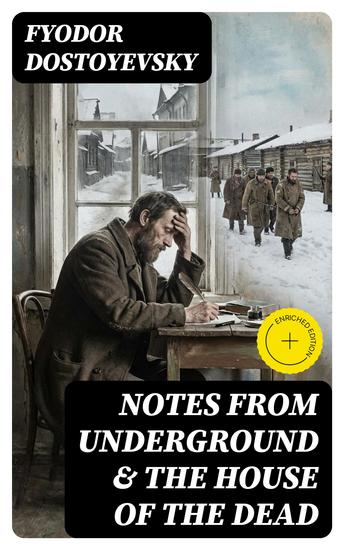
Notes from Underground & The House of the Dead - Enriched edition - cover

Notes from Underground & The House of the Dead - Enriched edition

Fyodor Dostoyevsky

Maison d'édition: DigiCat

  • 0
  • 0
  • 0

Synopsis

In "Notes from Underground" and "The House of the Dead," Fyodor Dostoyevsky presents a profound exploration of the human psyche amid the tumultuous backdrop of 19th-century Russia. The former work, often regarded as one of the first existential novels, delves into the conflicted mind of an unnamed narrator who grapples with isolation, societal norms, and moral ambiguity. In contrast, "The House of the Dead" draws on Dostoyevsky's own experiences in Siberian exile, presenting a raw depiction of life in a penal colony. Employing a blend of realism and psychological depth, Dostoyevsky's literary style oscillates between the intensely personal and the socially critical, reflecting the era's philosophical currents, including nihilism and the quest for authenticity. Fyodor Dostoyevsky (1821-1881) was a Russian novelist whose tumultuous life experiences, including imprisonment and suffering over political beliefs, deeply informed his writing. His encounters with poverty, crime, and the complexities of human morality led him to explore themes of existential dread and redemption. These themes in "Notes from Underground" and "The House of the Dead" showcase his ability to dissect the human condition, while also challenging prevailing notions of free will and societal constructs. For readers who seek to engage with the intricacies of Russian literature and the depths of the human experience, Dostoyevsky's "Notes from Underground" and "The House of the Dead" are essential readings. These works not only offer an insightful glimpse into social and psychological dilemmas but also invite reflection on one's own existential questions, making them timeless and relevant masterpieces in the literary canon.

In this enriched edition, we have carefully created added value for your reading experience:
- A comprehensive Introduction outlines these selected works' unifying features, themes, or stylistic evolutions.
- The Author Biography highlights personal milestones and literary influences that shape the entire body of writing.
- A Historical Context section situates the works in their broader era—social currents, cultural trends, and key events that underpin their creation.
- A concise Synopsis (Selection) offers an accessible overview of the included texts, helping readers navigate plotlines and main ideas without revealing critical twists.
- A unified Analysis examines recurring motifs and stylistic hallmarks across the collection, tying the stories together while spotlighting the different work's strengths.
- Reflection questions inspire deeper contemplation of the author's overarching message, inviting readers to draw connections among different texts and relate them to modern contexts.
- Lastly, our hand‐picked Memorable Quotes distill pivotal lines and turning points, serving as touchstones for the collection's central themes.
Disponible depuis: 24/12/2023.
Longueur d'impression: 240 pages.

D'autres livres qui pourraient vous intéresser

  • The Story of B24 - From their pens to your ears genius in every story - cover

    The Story of B24 - From their...

    Arthur Conan Doyle

    • 0
    • 0
    • 0
    Arthur Conan Doyle was born in Edinburgh, Scotland on 22nd May 1859.  His childhood was blighted by his father’s heavy drinking which for some years broke up the family. Fortunately, wealthy uncles were willing to support them by paying for education and clothing.  
    He was accepted at the University of Edinburgh to study medicine and also began to write short stories the first, ‘The Haunted Grange of Goresthorpe’, was published in Blackwood’s Magazine.  Despite several other stories and some articles in the British Medical Journal his medical studies took priority. 
    When these finished he was appointed as Doctor on the Greenland whaler ‘Hope of Peterhead’ in 1880 and then, after graduation, as ship’s surgeon on the SS Mayumba on its voyage to West Africa. 
    1882 saw a move to Plymouth and his own independent practice. With few patients he resumed writing and completed his first novel, ‘The Mystery of Cloomber’, although most of his output was short stories based on his experiences at sea.  
    He married Louisa Hawkins in 1885. However, two years later he met and fell in love with Jean Elizabeth Leckie, though they remained platonic out of respect for, and loyalty to, his wife. 
    His literary career suddenly burst into life in November 1886 with ‘A Study In Scarlet’, the first of the fabulously successful Sherlock Holmes stories.  
    With two children to support he now revisited his haphazard commercial arrangements and curtailed everything save for commissions from the Strand Magazine.  
    As a sportsman he was remarkably proficient. He was goalkeeper for Portsmouth Association Football Club and played ten first-class cricket matches for the Marylebone Cricket Club as well as captain of the Crowborough Beacon Golf Club in East Sussex.  
    In 1891 tired of writing Holmes stories, he began a series of historical novels and even went so far as to apparently kill off Holmes in a lethal brawl with his arch-nemesis Moriarty. 
    Despite heavy and sustained criticism he continued to write in support of the Boer War, a fact he thought contributed to his knighthood in 1902.  The following year to great relief and acclaim he brought Sherlock Holmes back from the dead in his first outing for a decade. 
    Sadly, his wife Louisa died from TB in 1906 and, a year later, he at last married Jean.  
    During the War and for several years after family deaths had left him depressed. In a search for solace and answers he alighted upon spiritualism and, such was his interest, that he wrote several books on the subject. 
    On 7th July 1930 Conan Doyle was discovered in the hall of Windlesham Manor, his house in East Sussex, clutching his chest dying of a heart attack.  He was 71.
    Voir livre
  • Be This Her Memorial - From their pens to your ears genius in every story - cover

    Be This Her Memorial - From...

    Caradoc Evans

    • 0
    • 0
    • 0
    The bookshelves of British literature are incredible collections that have gathered together centuries of very talented authors.  From these Isles their fame spread and whilst among their number many are now forgotten or neglected their talents endure.  Among them is Caradoc Evans.
    Voir livre
  • The Story of B24 - From their pens to your ears genius in every story - cover

    The Story of B24 - From their...

    Arthur Conan Doyle

    • 0
    • 0
    • 0
    Arthur Conan Doyle was born in Edinburgh, Scotland on 22nd May 1859.  His childhood was blighted by his father’s heavy drinking which for some years broke up the family. Fortunately, wealthy uncles were willing to support them by paying for education and clothing.  
    He was accepted at the University of Edinburgh to study medicine and also began to write short stories the first, ‘The Haunted Grange of Goresthorpe’, was published in Blackwood’s Magazine.  Despite several other stories and some articles in the British Medical Journal his medical studies took priority. 
    When these finished he was appointed as Doctor on the Greenland whaler ‘Hope of Peterhead’ in 1880 and then, after graduation, as ship’s surgeon on the SS Mayumba on its voyage to West Africa. 
    1882 saw a move to Plymouth and his own independent practice. With few patients he resumed writing and completed his first novel, ‘The Mystery of Cloomber’, although most of his output was short stories based on his experiences at sea.  
    He married Louisa Hawkins in 1885. However, two years later he met and fell in love with Jean Elizabeth Leckie, though they remained platonic out of respect for, and loyalty to, his wife. 
    His literary career suddenly burst into life in November 1886 with ‘A Study In Scarlet’, the first of the fabulously successful Sherlock Holmes stories.  
    With two children to support he now revisited his haphazard commercial arrangements and curtailed everything save for commissions from the Strand Magazine.  
    As a sportsman he was remarkably proficient. He was goalkeeper for Portsmouth Association Football Club and played ten first-class cricket matches for the Marylebone Cricket Club as well as captain of the Crowborough Beacon Golf Club in East Sussex.  
    In 1891 tired of writing Holmes stories, he began a series of historical novels and even went so far as to apparently kill off Holmes in a lethal brawl with his arch-nemesis Moriarty. 
    Despite heavy and sustained criticism he continued to write in support of the Boer War, a fact he thought contributed to his knighthood in 1902.  The following year to great relief and acclaim he brought Sherlock Holmes back from the dead in his first outing for a decade. 
    Sadly, his wife Louisa died from TB in 1906 and, a year later, he at last married Jean.  
    During the War and for several years after family deaths had left him depressed. In a search for solace and answers he alighted upon spiritualism and, such was his interest, that he wrote several books on the subject. 
    On 7th July 1930 Conan Doyle was discovered in the hall of Windlesham Manor, his house in East Sussex, clutching his chest dying of a heart attack.  He was 71.
    Voir livre
  • War and Peace (Book Fifteen: 1812-13) - cover

    War and Peace (Book Fifteen:...

    Leo Tolstoy

    • 0
    • 0
    • 0
    War and Peace is a literary work mixed with chapters on history and philosophy by the Russian author Leo Tolstoy. It was first published serially, then published in its entirety in 1869. It is regarded as one of Tolstoy's finest literary achievements and remains an internationally praised classic of world literature.
    Book 15: 1812-13: When seeing a dying animal a man feels a sense of horror: substance similar to his own is perishing before his eyes. But when it is a beloved and intimate human being that is dying, besides this horror at the extinction of life there is a severance, a spiritual wound, which like a physical wound is sometimes fatal and sometimes heals, but always aches and shrinks at any external irritating touch.
    Voir livre
  • David Swan - From their pens to your ears genius in every story - cover

    David Swan - From their pens to...

    Nathaniel Hawthorne

    • 0
    • 0
    • 0
    Nathaniel Hawthorne was born on 4th July 1804 in Salem, Massachusetts, a town synonymous with the earlier Salem Witch Trials. It was instrumental in Hawthorne’s later use of American Gothic and dark romanticism in his writing. 
    He was a mere four years old when his father died and his mother took him and his two sisters to live with her family and then on to their own home in Raymond, Maine. The young Hawthorne had a passion for fiction and poetry and voraciously read the works of Ann Radcliffe, Henry Fielding and Lord Byron.  
    He was sent to college at his maternal uncle’s insistence. During these years he met and befriended Henry Wadsworth Longfellow and future U S president Franklin Pierce. These friendships were lifelong and to have a crucial impact on his writings and career.  
    At college Hawthorne had made attempts at writing short stories and essays but without opportunities to publish. It was only in 1828 that he finally published his novel ‘Franshawe’ to little success and so he began work as editor for the American Magazine of Useful and Entertaining Knowledge.  
    Hawthorne’s short stories were first published in magazines but in 1837 were collected and published as ‘Twice-Told Tales’. A steady literary career still did not come his way and so he worked in a good position at Salem’s port and married the love of his life Sophia Peabody. They moved to live in ‘The Old Manse’ at Concord, Massachusetts.   
    Finally. in 1850 came spectacular literary and commercial success with ‘The Scarlet Letter’ followed by ‘The House of the Seven Gables’ the following year.  
    In 1852, Hawthorne published a biography of presidential candidate Franklin Pierce. After Pierce’s victory he was appointed consul in Liverpool, a position that offered prestige, money and fame. At the end of this appointment he returned several times to Europe before settling in Massachusetts and resuming writing and publication. 
    During the early 1860’s his health declined and on 19th May 1864 during a trip to Plymouth, New Hampshire. He was 59 and was buried in Sleepy Hollow Cemetery in Concord, Massachusetts.
    Voir livre
  • Small Star in the East A (Unabridged) - cover

    Small Star in the East A...

    Charles Dickens

    • 0
    • 0
    • 0
    Charles Dickens was a writer and social critic who created some of the world's best-known fictional characters and is regarded as the greatest novelist of the Victorian era. His works enjoyed unprecedented popularity during his lifetime, and by the twentieth century critics and scholars had recognised him as a literary genius. His novels and short stories enjoy lasting popularity.
    A SMALL STAR IN THE EAST: I Had been looking, yesternight, through the famous 'Dance of Death,' and to-day the grim old woodcuts arose in my mind with the new significance of a ghastly monotony not to be found in the original.
    Voir livre