Rejoignez-nous pour un voyage dans le monde des livres!
Ajouter ce livre à l'électronique
Grey
Ecrivez un nouveau commentaire Default profile 50px
Grey
Abonnez-vous pour lire le livre complet ou lisez les premières pages gratuitement!
All characters reduced
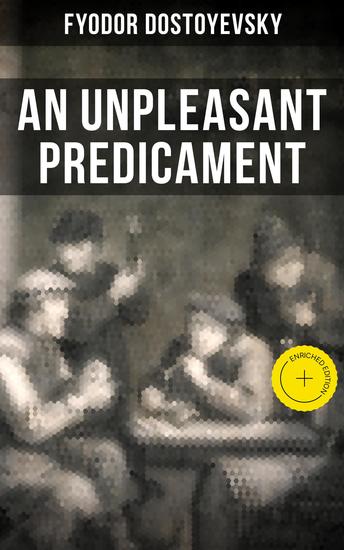
AN UNPLEASANT PREDICAMENT - Enriched edition A Satire - cover

AN UNPLEASANT PREDICAMENT - Enriched edition A Satire

Fyodor Dostoyevsky

Traducteur Constance Garnett

Maison d'édition: Musaicum Books

  • 0
  • 0
  • 0

Synopsis

In Fyodor Dostoyevsky's 'An Unpleasant Predicament', readers are immersed in a gripping tale of moral dilemmas, existential struggles, and the complexities of human nature. Written in Dostoyevsky's signature literary style characterized by deep psychological insight and philosophical depth, this novella explores themes of guilt, redemption, and free will. Set against the backdrop of 19th-century Russia, the story follows the protagonist as he navigates through a series of unfortunate events that ultimately lead to a profound internal reckoning. Dostoyevsky's evocative prose and nuanced characterizations elevate this work to a timeless literary masterpiece. Fyodor Dostoyevsky, a prominent Russian novelist and philosopher, drew inspiration from his own tumultuous life experiences to craft compelling narratives that delve into the darkest corners of the human psyche. His profound understanding of human nature and keen observations of society's moral decay are evident throughout 'An Unpleasant Predicament'. Dostoyevsky's enduring legacy as one of the greatest literary minds of his time solidifies his position as a master storyteller and provocateur of thought. I highly recommend 'An Unpleasant Predicament' to readers who appreciate thought-provoking literature that delves into the complexities of the human condition. Dostoyevsky's captivating narrative and profound insights make this novella a must-read for those seeking a literary exploration of morality, redemption, and the nature of human existence.

In this enriched edition, we have carefully created added value for your reading experience:
- A succinct Introduction situates the work's timeless appeal and themes.
- The Synopsis outlines the central plot, highlighting key developments without spoiling critical twists.
- A detailed Historical Context immerses you in the era's events and influences that shaped the writing.
- An Author Biography reveals milestones in the author's life, illuminating the personal insights behind the text.
- A thorough Analysis dissects symbols, motifs, and character arcs to unearth underlying meanings.
- Reflection questions prompt you to engage personally with the work's messages, connecting them to modern life.
- Hand‐picked Memorable Quotes shine a spotlight on moments of literary brilliance.
- Interactive footnotes clarify unusual references, historical allusions, and archaic phrases for an effortless, more informed read.
Disponible depuis: 06/10/2017.
Longueur d'impression: 200 pages.


D'autres livres qui pourraient vous intéresser

  • Rosicrucian Doctrines and Tenets - cover

    Rosicrucian Doctrines and Tenets

    Manly Palmer Hall

    • 0
    • 0
    • 0
    Trustworthy information is unavailable concerning the actual philosophical beliefs, political aspirations, and humanitarian activities of the Rosicrucian Fraternity. Today, as of old, the mysteries of the Society are preserved inviolate by virtue of their essential nature; and attempts to interpret Rosicrucian philosophy are but speculations, anything to the contrary notwithstanding. 
    Evidence points to the probable existence of two distinct Rosicrucian bodies: an inner organization whose members never revealed their identity or teachings to the world, and an outer body under the supervision of the inner group. In all probability, the symbolic tomb of Christian Rosencreutz, Knight of the Golden Stone, was in reality this outer body, the spirit of which is in a more exalted sphere. For a period of more than a century subsequent to 1614, the outer body circulated tracts and manifestoes under either its own name or the names of various initiated members. The purpose of these writings was apparently to confuse and mislead investigators, and thus effectively to conceal the actual designs of the Fraternity.
    Voir livre
  • Monkey to Man - The Evolution of the March of Progress Image - cover

    Monkey to Man - The Evolution of...

    Gowan Dawson

    • 0
    • 0
    • 0
    The first book to examine the iconic depiction of evolution, the "march of progress," and its role in shaping our understanding of how humans evolved 


    We are all familiar with the "march of progress," the representation of evolution that depicts a series of apelike creatures becoming progressively taller and more erect before finally reaching the upright human form. Its emphasis on linear progress has had a decisive impact on public understanding of evolution, yet the image contradicts modern scientific conceptions of evolution as complex and branching. 


    This book is the first to examine the origins and history of this ubiquitous and hugely consequential illustration. In a story spanning more than a century, from Victorian Britain to America in the Space Age, Gowan Dawson traces the interconnected histories of the two most important versions of the image: the frontispiece to Thomas Henry Huxley's Evidence as to Man's Place in Nature (1863) and "The Road to Homo Sapiens," a fold-out illustration in the bestselling book Early Man (1965). Dawson explores how the recurring appearances of this image pointed to shifting scientific and public perspectives on human evolution, as well as indicated novel artistic approaches, and advancements in technology.
    Voir livre
  • German Invasions of France during the World Wars The: The History of Germany’s Campaigns in World War I and World War II - cover

    German Invasions of France...

    Editors Charles River

    • 0
    • 0
    • 0
    If trench warfare was an inevitability during the war, it is only because the events leading up to the First Battle of the Marne were quite different. The armies at the beginning of the war moved quickly through the land, but the First Battle of the Marne devolved into a bloody pitched battle that led to the construction of trenches after the Germans retreated, blocked in their pursuit of Paris. When the aftermath disintegrated into a war between trenches, some Germans thought they had the upper hand since they were occupying French territory, but with fewer soldiers than the combined Allied nations and fewer resources and supplies, it was possibly only a matter of time before they were ultimately defeated. The commander of the German armies, General Helmuth von Moltke, allegedly said to Kaiser Wilhelm II immediately after the First Battle of the Marne, "Your Majesty, we have lost the war." 
    One of the most famous people in the world came to tour the city of Paris for the first time on June 28, 1940. Over the next three hours, he rode through the city’s streets, stopping to tour L’Opéra Paris. He rode down the Champs-Élysées toward the Trocadero and the Eiffel Tower, where he had his picture taken. After passing through the Arc de Triomphe, he toured the Pantheon and old medieval churches, though he did not manage to see the Louvre or the Palace of Justice. Heading back to the airport, he told his staff, “It was the dream of my life to be permitted to see Paris. I cannot say how happy I am to have that dream fulfilled today.” Four years after his tour, Adolf Hitler would order the city’s garrison commander, General Dietrich von Choltitz, to destroy Paris, warning his subordinate that the city "must not fall into the enemy's hand except lying in complete debris." 
    Voir livre
  • 7 Signs You May Be Unintentionally Manipulative - Recognizing and Correcting Harmful Behaviors - cover

    7 Signs You May Be...

    John Harpoon

    • 0
    • 0
    • 0
    Unintentional manipulation is a behavior that often goes unnoticed, even by the person exhibiting it. Many people associate manipulation with malicious intent, but the reality is that it can stem from deep-seated insecurities, learned behaviors, or a lack of self-awareness. When manipulation is unintentional, it can be especially difficult to recognize because the person engaging in it often believes they are acting out of necessity, self-protection, or even love. However, these behaviors can have lasting negative effects on relationships, creating tension, mistrust, and emotional exhaustion for both parties involved.  
      
    Understanding manipulation requires a willingness to look inward and examine patterns of communication and interaction. Some people use guilt, passive-aggression, or victimhood as a means of influencing others without realizing that these tactics can be harmful. Others may withdraw affection or communication to maintain control in situations where they feel vulnerable. In some cases, even excessive people-pleasing can be a form of manipulation, as it subtly pressures others to respond in a certain way. These behaviors are often unconscious, but they still impact those around us. Recognizing them is the first step toward change.   
      
    The purpose of this book is not to shame or condemn but to provide insight into these behaviors and offer practical steps for improvement. No one is perfect, and many people engage in manipulative behaviors at some point in their lives. However, when these behaviors become patterns, they can erode trust and create unhealthy dynamics. By identifying the signs of unintentional manipulation, individuals can develop healthier ways of expressing their needs, setting boundaries, and maintaining relationships based on mutual respect and honesty. 
    Voir livre
  • Rise and Fall of the Stuart Dynasty in Britain The: The History of the Stuarts from the Tudor Era to the Glorious Revolution and the Jacobites - cover

    Rise and Fall of the Stuart...

    Editors Charles River

    • 0
    • 0
    • 0
    England has more often been faced with the claims of competing kings and queens than with a period of no monarch at all. The major exception to that rule came in the 11 years between 1649 and 1660, when England was a republic. Following the disastrous reign of Charles I and the civil wars that led to his execution, Parliament and the army ruled England. England’s republican experiment started out as a work of collaboration and compromise; lords, army officers and members of Parliament (MPs) worked together to find a political settlement that did not include the despised royal House of Stuart. Nonetheless, religious and political division made collective rule unworkable, and ultimately, one man emerged from the chaos to rule the country. He had risen from a humble background to become the leading general of the Civil Wars, and as a man of staunch beliefs and ruthless pragmatism, he controlled England from 1653-1658 under the title of Lord Protector. In essence, he was a king in all but name. That man was Oliver Cromwell, and in the popular imagination, Cromwell has overshadowed the rest of the leaders of the parliamentary cause and the New Model Army.  
    Cromwell’s death would lead to a restoration of the royal line, but an uprising of a completely different nature would soon unfold on English soil – the Glorious Revolution, an intriguing story of a power war exacerbated by ruthless ambition, under-the-table plotting, and the treachery of familial betrayal. That said, it’s important to remember that the deposed James II did try to return to England, and there would be generations of war waged for the Stuart cause by the Jacobites, who were not only supporters of the exiled Stuart monarchy, but also against the political and religious settlements agreed to across the British Isles. It’s no surprise the Jacobites continue to interest so many people, as do the plot twists, near misses, and “what-ifs” involved. 
    Voir livre
  • Resilience - cover

    Resilience

    Harvard Business Review

    • 0
    • 0
    • 0
    How do some people bounce back with vigor from daily setbacks, professional crises, or even intense personal trauma? 


    This book reveals the key traits of those who emerge stronger from challenges, helps you train your brain to withstand the stresses of daily life, and presents an approach to an effective career reboot. 


    This collection of articles from HBR includes "How Resilience Works," by Diane Coutu; "Resilience for the Rest of Us," by Daniel Goleman; "How to Evaluate, Manage, and Strengthen Your Resilience," by David Kopans; "Find the Coaching in Criticism," by Sheila Heen and Douglas Stone; "Firing Back: How Great Leaders Rebound After Career Disasters," by Jeffrey A. Sonnenfeld and Andrew J. Ward; and "Resilience Is About How You Recharge, Not How You Endure," by Shawn Achor and Michelle Gielan.
    Voir livre