¡Acompáñanos a viajar por el mundo de los libros!
Añadir este libro a la estantería
Grey
Escribe un nuevo comentario Default profile 50px
Grey
Suscríbete para leer el libro completo o lee las primeras páginas gratis.
All characters reduced
White nights - cover

White nights

Fyodor Dostoevsky

Editorial: REA Multimedia

  • 0
  • 1
  • 0

Sinopsis

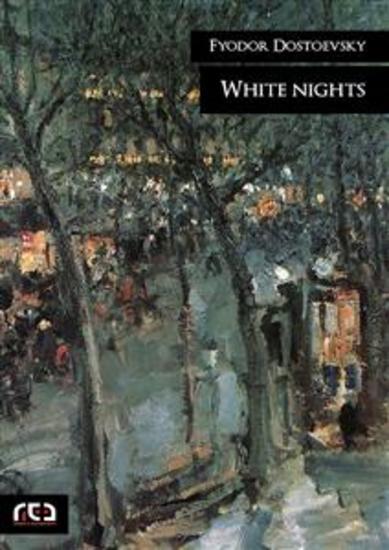
White Nights is a short story by Fyodor Dostoevsky, originally published in 1848, early in the writer's career.
Like many of Dostoevsky's stories, "White Nights" is told in the first person by a nameless narrator. The narrator is a young man living in Saint Petersburg who suffers from loneliness. He gets to know and falls in love with a young woman, but the love remains unrequited as the woman misses her lover, with whom she is finally reunited.
Translated by Constance Garnett (1861-1946)
 
Disponible desde: 02/04/2024.
Otros libros que te pueden interesar

  • The Food of the Gods and How It Came to Earth - cover

    The Food of the Gods and How It...

    H. G. Wells

    • 0
    • 0
    • 0
    "In the world of the small, the large is always a monster."
    
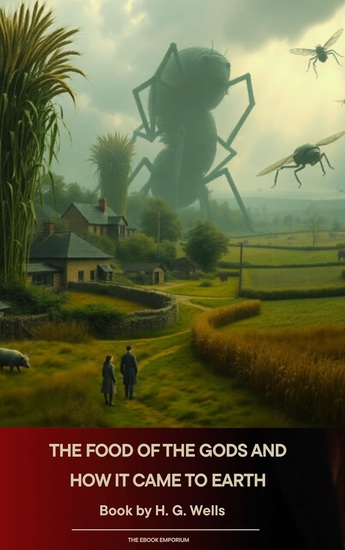
    What happens when science outpaces morality? When two eccentric scientists, Mr. Bensington and Professor Redwood, develop "Herakleophorbia"—a substance that allows for continuous, limitless growth—they envision a world of giant livestock and abundant food. Instead, they unleash a biological revolution. From giant wasps and man-eating rats to a new generation of human "Giants" who stand forty feet tall, the world is irrevocably changed. Wells uses this fantastic premise to craft a biting satire of a society that fears progress and a moving epic about the struggle for a larger, more noble existence.
    
    The Chaos of the Small: The first half of the novel is a brilliant dark comedy. Due to the negligence of a pair of sloppy caretakers, the "Food" leaks into the English countryside, creating a nightmare of gargantuan pests. Wells meticulously describes the terror of a world where common insects and rodents become apex predators, forcing humanity to confront the dangers of its own tinkering.
    
    The War of the Worlds (Small vs. Large): As the human "Children of the Food" grow to adulthood, they find themselves outcasts in a world built for "little people." The novel shifts from science fiction to political allegory, as the "old" world, led by the populist politician Caterham (the "Jack the Giant-killer"), attempts to suppress and destroy the giants. It is a powerful meditation on the "growing pains" of civilization and the fear of the unknown.
    
    A Prophecy of the Future: Wells leaves the reader with a haunting question: Can humanity evolve fast enough to inhabit the world its science has created? The Food of the Gods is an essential read for anyone interested in the ethics of biotechnology and the eternal struggle between the status quo and the future.
    
    Witness the growth of a new world. Purchase "The Food of the Gods" today and see the world through the eyes of a giant.
    Ver libro
  • The Elusive Pimpernel - cover

    The Elusive Pimpernel

    Baroness Orczy

    • 1
    • 0
    • 0
    A novel of swashbuckling action in the series featuring the classic hero who saves innocents from the guillotine in Revolutionary France . . .“We seek him here! we seek him there!Those Frenchies seek him everywhere!Is he in heaven? Is he in hell?That demmed elusive Pimpernel?” Sir Percy thought he left his enemy vanquished, humiliated, and debased in Calais. Oh, how foolish he was. Now Chauvelin is bent on revenge . . .  As punishment for letting the Scarlet Pimpernel escape the clutches of the French Republic, Chauvelin was demoted from the ranks of Robespierre’s trusted few. But he will have his day. Laying a trap for the wife of Sir Percy, Lady Marguerite, is only the first step.  Can Sir Percy elude the blade of Madame Guillotine a second time, defend his honor as the Scarlet Pimpernel, and save his wife from a fate worse than death?  Baroness Emma Orczy brings us the third thrilling installment in her iconic adventures of the Scarlet Pimpernel, pitting Sir Percy against the wily Chauvelin once again in a battle of wit and cunning that stands between thousands of innocent lives and the ignominious bite of Madame Guillotine. Credited with the introduction of the “hero with a secret identity” trope, the Scarlet Pimpernel and his exploits have captured the imaginations of readers for over a century. The series housing the most historical accuracies of French Revolution-centric fiction of its time, it also inspired a stage play garnering over 2,000 performances in four years. Join the League of the Scarlet Pimpernel and dive into the rollicking adventures of the masked hero of the French Revolution!
    Ver libro
  • Horror at Sea - 15 Nautical Nightmares - cover

    Horror at Sea - 15 Nautical...

    William Hope Hodgson, H.P....

    • 0
    • 0
    • 0
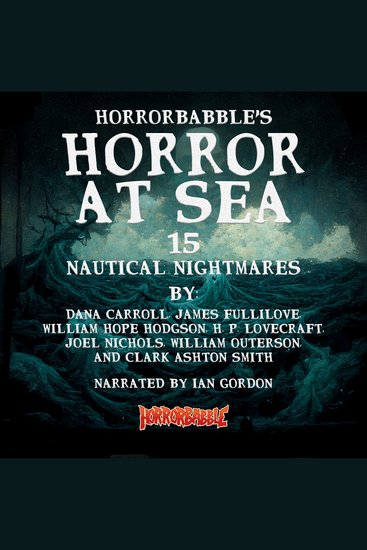
    HorrorBabble's complete "Horror at Sea" collection. 15 nautical nightmares: from the discovery and subsequent investigation of a mysterious vessel in The Derelict; to the terrifying ordeal of a lighthouse keeper stationed at the remote, Three Skeleton Key. 
    "There’ll be restless nights for thee, upon these seven seas…" 
    Contents: 
    The Derelict by W. H. Hodgson (Red Magazine, Dec 1912) 
    The Ocean Ogre by D. Carroll (Weird Tales, July 1937) -- A stranded ship. 
    Ghouls of the Sea by J. B. S. Fullilove (WT, March 1934) -- Death aboard the "Kay Marie". 
    The Voice in the Night by W. H. Hodgson (Blue Book Magazine, Nov 1907) -- A schooner, approached in the night. 
    The Black, Dead Thing by F. B. Long (WT, Oct 1933) -- A dreadful thing came aboard the ship. 
    The Temple by H. P. Lovecraft (WT, Sep 1925) -- A submarine on a strange descent. 
    The Lure of Atlantis by J. M. Nichols, Jr. (WT, April 1925) -- An expedition into a lost city. 
    The Uncharted Isle by C. A. Smith (WT, Nov 1930) -- A sailor lost at sea. 
    The Night Ocean by H. P. Lovecraft (Californian, Winter 1936) -- An artist, unsettled by the ocean. 
    Fire in the Galley Stove by W. Outerson (Atlantic, May 1937) -- An attack on the "Unicorn". 
    The Black Kiss by R. Bloch (WT, June 1937) -- The thing that swam in black waters. 
    Lost by A. M. Schnirring (WT, July 1943) -- A tale of the marshes. 
    The Thing in the Weeds by W. H. Hodgson (Story-teller, Jan 1913) -- A Sargasso Sea story. 
    The Brain-Eaters by F. B. Long (WT, June 1932) -- A horror from four-dimensional space. 
    Three Skeleton Key by G. G. Toudouze (Esquire, Jan 1937)
    Ver libro
  • A Man Could Stand Up — - cover

    A Man Could Stand Up —

    Madox Ford

    • 0
    • 0
    • 0
    There are not many English novels which deserve to be called great: Parade's End is one of them. — W. H. Auden  
    A Man Could Stand Up — is the third of four installments in Ford Madox Ford's Parade's End tetralogy, which follows Christopher Tietjens, a wealthy British landowner and the last British Tory; his unfaithful wife, Sylvia; and his mistress, Valentine Wannop.   
    Opening on Armistice Day (November 11, 1918), A Man Could Stand Up — serves as the climax of the series. Highlighting the tension between traditional values and a rapidly changing social order, the novel details Christopher and Valentine's trials as the post-war world takes shape around them.  
    Unique among other war fiction of the time, the Parade's End tetralogy privileges not the conflict of World War I itself, but the impact the war had on its participants and upon society writ large. With it's publication, Ford hoped to contribute to the obviating of all future wars. Parade's End is often referred to as one of the greatest 20th century novels, and one of the best depictions of war in literature. The 2012 television adaptation, written by Tom Stoppard and starring Benedict Cumberbatch and Rebecca Hall, was nominated for two Primetime Emmy Awards and seven BAFTA Television Awards.
    Ver libro
  • The Fall of the House of Usher - cover

    The Fall of the House of Usher

    Edgar Allan Poe

    • 0
    • 0
    • 0
    Experience the gothic horror of Edgar Allan Poe with "The Fall of the House of Usher," the third part of an Edgar Allan Poe short story collection, read by Jake Urry. In this dark tale, the writer visits his friend Roderick Usher's decaying mansion and becomes entangled in the eerie atmosphere and psychological terror that pervade the house. As the story unfolds, secrets are revealed, leading to a chilling and unforgettable climax. 
    Jake Urry's narration captures the brooding tension and sinister beauty of Poe's writing, making this audiobook a must-listen for fans of classic horror. His rich voice and expert pacing bring the haunted house and its doomed inhabitants to life, offering an immersive experience that will leave listeners spellbound.
    Ver libro
  • Middlemarch - cover

    Middlemarch

    George Eliot

    • 0
    • 0
    • 0
    Considered one of the great English novels, George Eliot's Middlemarch, A Study of Provincial Life follows myriad characters and their lives in the eponymous town, Middlemarch, in the 1800s. Utilizing a realistic style, Eliot considers issues such as religion, education, and the status of women—to name just a few.
    Ver libro