Rejoignez-nous pour un voyage dans le monde des livres!
Ajouter ce livre à l'électronique
Grey
Ecrivez un nouveau commentaire Default profile 50px
Grey
Abonnez-vous pour lire le livre complet ou lisez les premières pages gratuitement!
All characters reduced
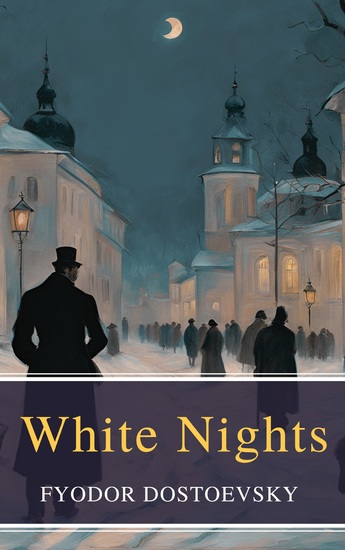
White Nights - A Timeless Tale of Love and Longing by Fyodor Dostoevsky - cover

White Nights - A Timeless Tale of Love and Longing by Fyodor Dostoevsky

Fyodor Dostoevsky, MyBooks Classics

Maison d'édition: MyBooks Classics

  • 0
  • 0
  • 0

Synopsis

"A fleeting encounter, a lasting impression."
Step into the dreamlike world of Dostoevsky's White Nights, where love blooms under the luminous sky of St. Petersburg. This masterpiece weaves a tender story of a solitary dreamer who, in a city that never sleeps, finds an unexpected companion during the magical "white nights."

Dive into a tale that captures the beauty of fleeting moments and the hope of new beginnings. Fyodor Dostoevsky's White Nights is a heartwarming blend of romance, introspection, and the bittersweet nature of unfulfilled desires. Its profound storytelling will leave you filled with joy, nostalgia, and a comforting sense of connection to the characters' emotional journeys.

Praise for Fyodor Dostoevsky:
"Dostoevsky's narratives penetrate the essence of the human soul." – The Guardian
"A literary treasure, White Nights shines with its emotional depth and timeless relevance." – Literary Classics Review

Join the countless readers who have been moved by this captivating novella. Don't miss the chance to experience one of Dostoevsky's most beloved works.

Add White Nights to your collection today and let the magic of Dostoevsky's words light up your reading experience.
Disponible depuis: 17/09/2024.
Longueur d'impression: 90 pages.

D'autres livres qui pourraient vous intéresser

  • The Case of Laker Absconded - cover

    The Case of Laker Absconded

    Arthur Morrison

    • 0
    • 0
    • 0
    The Case of Laker, Absconded is part of The Chronicles of Martin Hewitt. A junior bank clerk elopes with a fortune-but without his fiance. The police reconstruct the absconder's route, from bank to train station to the Continent. However, Martin Hewitt believes the trail is a little too easy to follow. With the help of the jilted lover, he embarks on a search to discover what really happened to the missing man.
    Voir livre
  • Quantum Love: Parallel Hearts - cover

    Quantum Love: Parallel Hearts

    Ella Stories

    • 0
    • 0
    • 0
    A quantum physicist invents a device that lets him converse with alternate versions of himself in parallel universes. In a quest to find the best version of his life, he stumbles upon a reality in which he is deeply in love with his best friend, a friendship he always took for granted in his own world. Now, he must confront his newfound feelings and navigate the complexities of love and friendship, all while coming to terms with the life he truly wants.
    Voir livre
  • War And Peace - cover

    War And Peace

    Leo Tolstoy

    • 0
    • 0
    • 0
    War and Peace is a literary work by the Russian author Leo Tolstoy that mixes fictional narrative with chapters on history and philosophy. It was first published serially, then published in its entirety in 1869. It is regarded as Tolstoy's finest literary achievement and remains an internationally praised classic of world literature.The novel chronicles the French invasion of Russia and the impact of the Napoleonic era on Tsarist society through the stories of five Russian aristocratic families. Portions of an earlier version, titled The Year 1805, were serialized in The Russian Messenger from 1865 to 1867 before the novel was published in its entirety in 1869.Tolstoy said that the best Russian literature does not conform to standards and hence hesitated to classify War and Peace, saying it is "not a novel, even less is it a poem, and still less a historical chronicle". Large sections, especially the later chapters, are philosophical discussions rather than narrative. He regarded Anna Karenina as his first true novel.Before he can marry his fiancée Mercédès, Edmond Dantès, a French nineteen-year-old first mate of the Pharaon, is falsely accused of treason, arrested, and imprisoned without trial in the Château d'If, a grim island fortress off Marseille. A fellow prisoner, Abbé Faria, correctly deduces that romantic rival Fernand Mondego, envious crewmate Danglars, and double-dealing magistrate De Villefort are responsible. Over the course of their long imprisonment, Faria educates Dantès and tells him of a cache of treasure he found. After Faria dies, Dantès escapes and finds the treasure. As the powerful and mysterious Count of Monte Cristo, he enters the fashionable Parisian world of the 1830s to avenge himself.
    Voir livre
  • Before the Supreme Court - From their pens to your ears genius in every story - cover

    Before the Supreme Court - From...

    Lafcadio Hearn

    • 0
    • 0
    • 0
    Lafcadio Hearn was born on the 27th June 1850 on the Ionian isle of Levkás in Greece to a British Army officer and a Greek Mother. 
    His father, fearing for his career prospects at being married to a Greek Orthodox wife, sent them to Dublin whilst he continued to advance his career with further postings.  Life there was difficult for mother and son.  His father returned, wounded and traumatised, when Lafcadio was three.  He annulled the marriage and she remarried but had to give up care of Lafcadio to her sister-in law.   
    After brief periods for Catholic education in England and France he emigrated to Ohio in the United States when he was 19, taking on a series of casual jobs before embarking on a career as a journalist, publishing poems and essays in Cincinnati.  It was whilst here that he began a side-line in translating, starting with Gautier and Flaubert.  He married in 1874 to a 20 year old African-American woman in violation of Ohio's anti-miscegenation law.  The marriage soon failed. 
    In 1877 he relocated to New Orleans to write on a variety of themes before picking up a two year assignment from Harper’s to write in the West Indies, where he also wrote his first novel. 
    In 1890 Harper’s sent him to Japan.  Here he left journalism and took the remarkable decision to become a schoolteacher in the north of Japan.   Enraptured by the culture he was driven to explain it in various Western publications to those who had little, if any, knowledge of its culture.  Within the year he had fallen in love with, and married, a high-born Japanese lady, together they would have four children.   
    In 1895 he became a Japanese national and took the name Koizumi Yakumo, Koizumi being his wife’s family name. 
    The following few years, whilst a professor of Literature at the Imperial University of Japan, were his most creative and admired period.   
    Lafcadio Hearn died of heart failure on the 26th of September 1904, in Tokyo, Japan shortly before leaving to deliver a series of lectures at Cornell University in New York State.  He was 54.
    Voir livre
  • The Upper Berth - A sailor recounts his time on a mysterious ship unexplained forces and horror awaits - cover

    The Upper Berth - A sailor...

    F. Marion Crawford

    • 0
    • 0
    • 0
    Francis Marion Crawford, an only child, was born on 2nd August 1854 at Bagni di Lucca, Italy. He was a nephew to Julia Ward Howe, the American poet and writer of ‘The Battle Hymn of the Republic’.  
     
    Crawford was educated at St Paul's School, Concord, New Hampshire and then on to Cambridge University, the University of Heidelberg and the University of Rome.  
     
    In 1879 he went to India, to study Sanskrit and then to edit The Indian Herald. In 1881 he returned to America to continue his Sanskrit studies at Harvard University. 
     
    His family became increasingly concerned about his employment prospects.  After an attempt at a singing career as a baritone was ruled out, he was encouraged to write.  
     
    In December 1882 his first novel, ‘Mr Isaacs’, was published and was an immediate hit as was his second novel ‘Dr Claudius’ in 1883.  
     
    In October 1884 he married Elizabeth Berdan and encouraged by his excellent start to a literary career they returned to Sant Agnello, Italy to make a permanent home, buying the Villa Renzi that then became Villa Crawford.  
     
    In the late 1890s, Crawford began work on his historical works which would later include ‘Corleone’, in 1897, the first major treatment of the Mafia in literature.  
     
    Crawford is also exceedingly popular and anthologized as a short story writer of bizarre and creepy tales.   
     
    In 1908 came his classic ‘The Screaming Skull’. Without doubt its unsettling nature is heightened as the reader/listener is drawn into to the story by its narrator.  Everything is explained and plausible until, of course, it isn’t. 
     
    Francis Marion Crawford died at Sorrento on Good Friday 1909 at Villa Crawford of a heart attack.  
     
    In this classic supernatural story by F Marion Crawford a man takes a room on a liner and discovers that its previous occupants have all committed suicide.  When his room mate on the Upper Berth also disappears the evidence points to some unearthly sequence of happenings.
    Voir livre
  • A Lickpenny Lover - From their pens to your ears genius in every story - cover

    A Lickpenny Lover - From their...

    O Henry

    • 0
    • 0
    • 0
    William Sydney Porter was born on 11th September 1862 in Greensboro, North Carolina. At age 3 his mother died from tuberculosis. From an early age it was clear Porter had a large appetite for reading as he absorbed the world around him. 
    He first attended at a school run by his aunt before enrolling at the Lindsey Street High School and then worked at his uncle’s drugstore and gained a pharmacists’ license in 1881.  
    A persistent cough took him to Texas in the hope that a change of climate would help his symptoms. He took on various types of work, initially from ranch hand and cook and then as varied as pharmacist, draftsman, bank teller and journalist. He also began to write, though for now, purely as a hobby. 
    He was a member of several singing and dramatic groups when he met 17 year old Athol Estes, daughter of a wealthy Austin family. Despite her mother’s objection owing to Athol’s tuberculosis, they began courting and in July 1887, they eloped and soon married. 
    Athol, impressed by his writing, encouraged him to get them published. A job as a draftsman at the Texas General Land Office paid a healthy $100 dollars per month and life was good. 
    But then life turned cruel. His son died a few hours after birth although a daughter, Margaret, came the following year.  His job had to be vacated but another was found at the First National Bank of Austin. The bank operated informally and Porter was careless in keeping the books. He lost that job but began writing for the humourous weekly The Rolling Stone and the Houston Post. Some time later the federal Bank auditors went through his former accounts and he was arrested on charges of embezzlement. 
    Porter fled the day before his trial to Honduras. Holed up for several months he began to write.  Athol had become too ill to travel to meet him and learning that her health was deteriorating he surrendered to the court in February 1897.  Bail was obtained so that he could stay with Athol during her final days.  
    Porter was sentenced to five years at the Ohio Penitentiary in Columbus. His pharmacy qualifications got him the job of night druggist.  His sentence also gave him time to write and publish fourteen short stories. In December 1899 in McClure’s Magazine he published a short story as O Henry.  
    He was released two years early in July 1901, and reunited with Margaret, now 11, in Pittsburgh.  He now began his most prolific period of writing; a short story per week for the New York World, while also publishing works in other magazines.  Eventually over 600 of his short stories were published. 
    Porter was a heavy drinker and in 1908 his health, which had deteriorated for several years, took a dramatic turn for the worse, as did his writing.  
    O Henry died of cirrhosis of the liver complicated by diabetes and an enlarged heart on 5th June 1910.
    Voir livre