Rejoignez-nous pour un voyage dans le monde des livres!
Ajouter ce livre à l'électronique
Grey
Ecrivez un nouveau commentaire Default profile 50px
Grey
Abonnez-vous pour lire le livre complet ou lisez les premiĂšres pages gratuitement!
All characters reduced
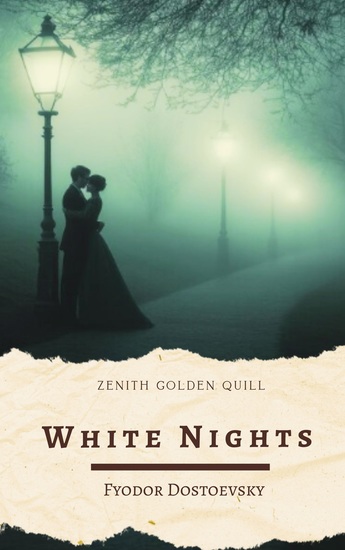
White Nights - A Melancholic Masterpiece of Dreamers Delusion and Heartbreak in St Petersburg - cover

White Nights - A Melancholic Masterpiece of Dreamers Delusion and Heartbreak in St Petersburg

Fyodor Dostoevsky, Zenith Golden Quill

Maison d'édition: Zenith Golden Quill

  • 0
  • 0
  • 0

Synopsis

🌙 Four nights. One dreamer. A love story suspended between hope and heartbreak.

In White Nights, Dostoevsky presents a poignant tale of a lonely narrator who wanders the moonlit streets of St. Petersburg and meets a mysterious young woman, Nastenka. Across four emotional nights and one heart-wrenching morning, they share stories, dreams, and the aching beauty of unfulfilled love đŸ’”đŸ•Żïž.

Blending lyrical prose with deep psychological insight, this short story captures the yearning of the human soul for connection and meaning. This edition includes annotations, historical background, and thematic notes—ideal for students, romantics, and fans of Russian literature.

"A brief but unforgettable portrait of unspoken emotion." — The Moscow Times
"One of Dostoevsky's most delicate and moving works." — Literary Review

📘 Click Buy Now to experience one of the most intimate and bittersweet stories of love and solitude in classic literature.
Disponible depuis: 22/05/2025.
Longueur d'impression: 69 pages.

D'autres livres qui pourraient vous intéresser

  • Free Air - cover

    Free Air

    Sinclair Lewis

    • 0
    • 0
    • 0
    “Free Air” is a novel written by Sinclair Lewis, published in 1919. It’s one of the first novels to celebrate the adventure and freedom that road trips introduced to America at the start of the twentieth century, thanks to the invention of the automobile. The story revolves around Claire Boltwood, a rich young woman from Brooklyn, and her father who drive across the country to help him regain his health. Travel by automobile in the first part of the twentieth century was difficult as many roads were not paved and many small towns had few hotels.
    Voir livre
  • Walk in a Workhouse A (Unabridged) - cover

    Walk in a Workhouse A (Unabridged)

    Charles Dickens

    • 0
    • 0
    • 0
    Charles Dickens was a writer and social critic who created some of the world's best-known fictional characters and is regarded as the greatest novelist of the Victorian era. His works enjoyed unprecedented popularity during his lifetime, and by the twentieth century critics and scholars had recognised him as a literary genius. His novels and short stories enjoy lasting popularity.
    A WALK IN A WORKHOUSE: On a certain Sunday, I formed one of the congregation assembled in the chapel of a large metropolitan Workhouse. With the exception of the clergyman and clerk, and a very few officials, there were none but paupers present. The children sat in the galleries; the women in the body of the chapel, and in one of the side aisles; the men in the remaining aisle.
    Voir livre
  • The Voyage Out - The Lost Manuscript - cover

    The Voyage Out - The Lost...

    Virginia Woolf

    • 0
    • 0
    • 0
      
    "The Voyage Out" is the debut novel written by Virginia Woolf, a prominent English modernist writer. Published in 1915, the novel follows the journey of Rachel Vinrace, a young woman who embarks on a voyage to South America with her aunt and uncle. The novel explores themes of self-discovery, social conventions, and the constraints placed upon women in early 20th-century society. 
     
    As Rachel sets sail on her voyage, she encounters a diverse group of passengers, each representing different social classes, backgrounds, and personalities. Through her interactions with them, Rachel undergoes a transformative journey of personal growth and awakening. Woolf skillfully captures Rachel's internal thoughts and emotions, delving into her inner world as she navigates her way through the complexities of life and relationships. 
     
    "The Voyage Out" also provides a critical examination of societal norms and gender roles during the Edwardian era. Woolf challenges the traditional expectations placed upon women and explores the limitations and frustrations they face. Rachel's journey serves as a metaphor for breaking free from societal constraints and seeking personal fulfillment and independence. 
     
    Virginia Woolf's writing style in "The Voyage Out" is characterized by its lyrical prose, stream-of-consciousness narrative technique, and keen observations of human psychology. Through vivid descriptions and introspective passages, Woolf explores themes of identity, love, and the search for meaning in a rapidly changing world 
    . 
    "The Voyage Out" is a significant novel in Woolf's body of work and serves as a precursor to her later, more experimental novels. It provides an early glimpse into Woolf's mastery of character development, psychological insight, and her unique literary style that would go on to shape the landscape of modernist literature.
    Voir livre
  • Lady Susan - cover

    Lady Susan

    Jane Austen

    • 0
    • 0
    • 0
    Step into the world of Regency-era England with Jane Austen's "Lady Susan" in digital audiobook format! 
     
    Experience the scandalous tale of Lady Susan Vernon, a cunning and captivating widow navigating the intricate social landscape of the time. With wit and manipulation, she orchestrates romantic entanglements while evading societal norms. 
     
    In this audiobook, immerse yourself in Austen's classic storytelling, filled with intrigue, romance, and the sharp commentary on societal expectations. Perfect for both Austen enthusiasts and newcomers, this rendition offers a captivating journey into the heart of Austen's literary brilliance. 
     
    Indulge in the allure of "Lady Susan" through our digital audiobook – where classic storytelling meets modern convenience!
    Voir livre
  • The Adventure of the Mazarin Stone - cover

    The Adventure of the Mazarin Stone

    Arthur Conan Doyle

    • 0
    • 0
    • 0
    The Adventure of the Mazarin Stone is one of 12 Sherlock Holmes short stories by Arthur Conan Doyle in The Case-Book of Sherlock Holmes. It was first published in the Strand Magazine in October 1921.Watson arrives in 221B Baker Street where the page boy Billy shows him a wax effigy of Holmes placed near a curtained window in the sitting room. The effigy produces a shadow on the curtain that, when viewed from outside, is the unmistakable profile of Sherlock Holmes. Using this visual trick, Holmes aims to give a perfect target to a would-be murderer with a rifle. Holmes names his murderer as Count Negretto Sylvius, the diamond thief he has been following in disguise. He gives the criminal's address to Watson, then sends the doctor out the back for the police. As the Count arrives, Holmes has Billy invite him inside, then takes him by surprise when he attempts an assault on the effigy. Holmes then offers the Count and his helper, boxer Sam Merton, freedom if they give up the jewel, or jail if not.He invites them to discuss the deal while he plays violin in the next room. When the Count decides to double-cross Holmes and takes the stone from his secret pocket to show Sam in window light, the detective springs from the chair in place of his replica and grabs the £100K jewel. His bedroom has a gramophone and secret passage to behind the curtain.After the police take away the villains, Lord Cantlemere sweeps in. Unlike the Prime Minister and Home Secretary, he did not want Holmes. When tricked into insisting on arrest for whoever is found possessing the diamond, he finds the jewel in his pocket – where Holmes has placed it – and apologizes. Finally, Holmes can eat.Famous works of the author Arthur Conan Doyle: A Study in Scarlet, The Sign of the Four, The Adventures of Sherlock Holmes, The Memoirs of Sherlock Holmes, The Hound of the Baskervilles, The Return of Sherlock Holmes, The Valley of Fear, His Last Bow, The Case-Book of Sherlock Holmes, Stories of Sherlock Holmes, The Lost World.
    Voir livre
  • A Journey of Little Profit - From their pens to your ears genius in every story - cover

    A Journey of Little Profit -...

    John Buchan

    • 0
    • 0
    • 0
    The Scottish novelist John Buchan enjoyed a remarkable career as politician, historian and Governor General. He was born John Buchan on 26th August 1875 and later added 1st Baron Tweedsmuir PC GCMG GCVO CH to his name.  
    Buchan studied at Hutchesons’ Grammar School, Glasgow and at seventeen won a scholarship to the University of Glasgow to study classics. There he began to write poetry. In 1895 he transferred to Oxford to continue his study of Classics and in 1896 ‘Sir Quixote of the Moors’ was published followed by the non-fiction ‘Scholar-Gipsies’. His prolific literary output now hardly faltered. 
    He graduated in 1900 and became the private secretary to Alfred Milner, the High Commissioner for Southern Africa and other colonies. Buchan found the same inspiration in the African landscape as he had in the Scottish Borders, and would later set many works here. Returning to London he became a partner in a publishing house, and garnered an editorial role at The Spectator. He also completed his law studies. He was called to the bar in 1901 but never practiced.  
    On 15th July 1907 Buchan married Susan Charlotte Grosvenor, the cousin of the Duke of Westminster. In 1910 he wrote ‘Prester John’, the first of a series set in South Africa.  
    In 1911 Buchan entered politics as a Unionist candidate in the Scottish Borders advocating the support of free trade, women’s suffrage, national insurance, and reducing the power of the House of Lords.  
    The Great War saw Buchan writing for the War Propaganda Bureau and as Times correspondent in France. In 1915, he published ‘The Thirty-Nine Steps’, his most famous book and a follow-up Richard Hannay novel, ‘Greenmantle’, in 1916.  
    In 1916 Buchan enlisted in the Intelligence Corps which included writing speeches for Sir Douglas Haig. By 1917 he was Director of Information under Lord Beaverbrook. Buchan called it “the toughest job he ever took on”. He somehow found time to assist in a history of the war magazine. This was later published in 24 volumes: Nelson’s History of the War. 
    After the war his writing focused on historical studies. In 1927 Buchan became the Unionist Party Member of Parliament for the Combined Scottish Universities. In a speech to Parliament he said “I believe every Scotsman should be a Scottish nationalist. If it could be proved that a Scottish parliament were desirable
 Scotsmen should support it.”  
    Over the next decade he continued to distinguish himself politically and in literature.  On the 1st June 1935 he became 1st Baron Tweedsmuir of Elsfield in the County of Oxford.  
    He was now also given the position of Governor General in Canada and resolved to travel all over Canada to gain a better insight of the country. Having crossed both length and breadth he saw the cultural shift between areas and their common ground and helped bring about a clear national Canadian identity. 
    On the 6th February 1940 he collapsed from a stroke and sustained a very serious head injury in falling. Two rounds of surgery to stabilise his condition were unsuccessful and Buchan died on the 11th February. After a state funeral in Ottawa his ashes were returned to his estate in Oxfordshire.
    Voir livre