Begleiten Sie uns auf eine literarische Weltreise!
Buch zum Bücherregal hinzufügen
Grey
Einen neuen Kommentar schreiben Default profile 50px
Grey
Jetzt das ganze Buch im Abo oder die ersten Seiten gratis lesen!
All characters reduced
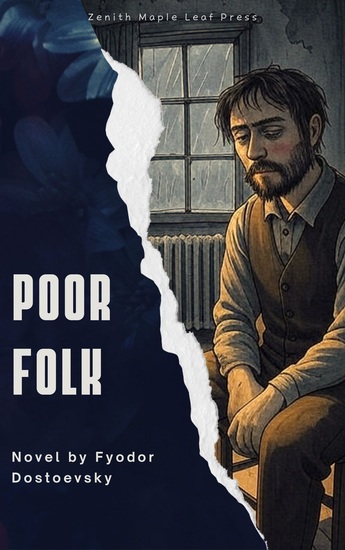
Poor Folk - A Heartfelt Epistolary Novel of Poverty Dignity and the Human Spirit - cover

Poor Folk - A Heartfelt Epistolary Novel of Poverty Dignity and the Human Spirit

Fyodor Dostoevsky, Zenith Maple Leaf Press

Verlag: Zenith Maple Leaf Press

  • 0
  • 0
  • 0

Beschreibung

Two souls bound by letters, love, and hardship.
In Poor Folk, Fyodor Dostoevsky's debut novel, the struggles of poverty are brought vividly to life through an intimate exchange of letters between Makar Devushkin, a humble government clerk, and Varvara Dobroselova, a young woman facing her own trials. Through their correspondence, we witness a tender friendship—and possibly love—blossoming in the shadow of social inequality.

First published in 1846, Poor Folk earned Dostoevsky immediate acclaim and introduced the compassion, psychological insight, and social awareness that would define his later masterpieces. This deeply human story captures the dignity, resilience, and quiet tragedies of everyday life among Russia's poor.

"The novel that announced Dostoevsky's genius to the world."
– The Guardian

"A compassionate and timeless portrait of the human condition."
– The New York Times

✅ Why Readers Love It:
💌 Told entirely through moving personal letters

🇷🇺 A touching glimpse into 19th-century Russian life

📚 Dostoevsky's remarkable literary debut

🎯 Click 'Buy Now' to discover the heartfelt story that began Dostoevsky's journey as one of literature's greatest voices.
Verfügbar seit: 12.08.2025.
Drucklänge: 133 Seiten.

Weitere Bücher, die Sie mögen werden

  • Clay (Unabridged) - cover

    Clay (Unabridged)

    James Joyce

    • 0
    • 0
    • 0
    James Augustine Aloysius Joyce (2 February 1882 - 13 January 1941) was an Irish novelist, short story writer, poet and literary critic. He contributed to the modernist avant-garde movement and is regarded as one of the most influential and important writers of the 20th century.
    CLAY: The matron had given her leave to go out as soon as the women's tea was over and Maria looked forward to her evening out. The kitchen was spick and span: the cook said you could see yourself in the big copper boilers.
    Zum Buch
  • Tales of the Jazz Age - cover

    Tales of the Jazz Age

    F. Scott Fitzgerald

    • 0
    • 0
    • 0
    Tales of the Jazz Age (1922) is a collection of eleven short stories by F. Scott Fitzgerald. Divided into three separate parts, according to subject matter, it includes one of his better-known short stories, The Curious Case of Benjamin Button. All of the stories had been published earlier, independently, in either Metropolitan Magazine, The Saturday Evening Post, Smart Set, Collier's, the Chicago Sunday Tribune, or Vanity Fair.
    Included in this collection:
    1. The Jelly-Bean
    2. The Camel's Back
    3. May Day
    4. Porcelain and Pink
    5. The Diamond as Big as the Ritz
    6. The Curious Case of Benjamin Button
    7. Tarquin of Cheapside
    8. "O Russet Witch!"
    9. The Lees of Happiness
    10. Mr. Icky
    11. Jemina
    Zum Buch
  • The Ambassadors - cover

    The Ambassadors

    Henry James

    • 0
    • 0
    • 0
    "The Ambassadors" is a 1903 novel by Henry James, originally published as a serial in the North American Review (NAR). This dark comedy follows the journey of the protagonist, Lewis Lambert Strether, to Europe. His mission is to bring back the son of his widowed fiancée to the family business. The novel is entirely told from Strether's point of view, chronicling his transformation from an American to a European perspective.
    Zum Buch
  • Gidget - cover

    Gidget

    Frederick Kohner, Kathy Kohner...

    • 0
    • 0
    • 0
    A surfing, boy-crazy teenager comes of age in the summer of 1957 in this classic novel that inspired movies, television, and created an American pop culture icon. 


    "My English comp teacher Mr. Glicksberg says if you want to be a writer you have to—quote—sit on a window sill and get all pensive and stuff and jot down descriptions. Unquote Glicksberg! I don't know what kind of things he writes but I found my inspiration in Malibu with a radio, my best girlfriends, and absolutely zillions of boys for miles. I absolutely had to write everything down because I heard that when you get older you forget things, and I'd be the most miserable woman in the world if I forgot about Moondoggie and what happened this summer. I absolutely owe the world my story. (And every word is true. I swear.)" 


    This is Franzie, part Holden Caulfield, part Lolita. The guys call her Gidget—short for girl midget. Based on the experiences of his daughter, Frederick Kohner's novel became an international sensation with an irrepressible heroine whose voice still echoes every thrill, every fear, and every hope that every teenager ever had about growing up. 


    Includes a foreword by Kathy Kohner Zuckerman (aka the real Gidget)
    Zum Buch
  • Man Overboard - A horror tale set on a ship full of mystery and twists along the way - cover

    Man Overboard - A horror tale...

    F. Marion Crawford

    • 0
    • 0
    • 0
    Francis Marion Crawford, an only child, was born on 2nd August 1854 at Bagni di Lucca, Italy. He was a nephew to Julia Ward Howe, the American poet and writer of ‘The Battle Hymn of the Republic’.  
     
    Crawford was educated at St Paul's School, Concord, New Hampshire and then on to Cambridge University, the University of Heidelberg and the University of Rome.  
     
    In 1879 he went to India, to study Sanskrit and then to edit The Indian Herald. In 1881 he returned to America to continue his Sanskrit studies at Harvard University. 
     
    His family became increasingly concerned about his employment prospects.  After an attempt at a singing career as a baritone was ruled out, he was encouraged to write.  
     
    In December 1882 his first novel, ‘Mr Isaacs’, was published and was an immediate hit as was his second novel ‘Dr Claudius’ in 1883.  
     
    In October 1884 he married Elizabeth Berdan and encouraged by his excellent start to a literary career they returned to Sant Agnello, Italy to make a permanent home, buying the Villa Renzi that then became Villa Crawford.  
     
    In the late 1890s, Crawford began work on his historical works which would later include ‘Corleone’, in 1897, the first major treatment of the Mafia in literature.  
     
    Crawford is also exceedingly popular and anthologized as a short story writer of bizarre and creepy tales.   
     
    In 1908 came his classic ‘The Screaming Skull’. Without doubt its unsettling nature is heightened as the reader/listener is drawn into to the story by its narrator.  Everything is explained and plausible until, of course, it isn’t. 
     
    Francis Marion Crawford died at Sorrento on Good Friday 1909 at Villa Crawford of a heart attack.  
     
    In ‘Man Overboard’ Crawford uncovers the story of identical twins.  When one falls overboard it unravels a sequence of events that take years to complete, all with a growing sense of uneasiness that further misery awaits
    Zum Buch
  • A Middle-Sized Artist - From their pens to your ears genius in every story - cover

    A Middle-Sized Artist - From...

    Charlotte Perkins Gilman

    • 0
    • 0
    • 0
    Charlotte Perkins Gilman was born on 3rd July 1860 in Hartford, Connecticut, to an unaffectionate mother and a father who abandoned her and her older brother to a life of poverty. 
    Inevitably her schooling was limited and by 15 she had attended seven different schools but received only four years education.  However Charlotte was resourceful and did spend time with her father’s aunts – the suffragist Isabella Beecher Hooker and the ‘Uncle Tom Cabin’s’ author, Harriet Beecher Stowe as well as many hours at the public library studying ancient civilisations. 
    In 1878, she enrolled in classes at the Rhode Island School of Design where she met Martha Luther and they developed a close relationship until Luther married in 1881. Charlotte was devastated and detested romance and love until she met and married the artist Charles Walter Stetson.  
    Their only child, Katharine Beecher Stetson, was born in 1885 but left Charlotte with post-natal depression, then often dismissed as a case of hysteria or nerves.  Unsuited to domestic life she ruptured her life and moved to California with Katherine.  She divorced in 1894 and then sent Katharine east to live with her father and his second wife confirming that his paternal rights be acknowledged and that Katherine establish a relationship with her father. 
    After her mother died in 1893, Charlotte moved back east and became involved with her first cousin, Wall Street attorney, Houghton Gilman who she married in 1900. After his death she moved back to California, where Katherine now lived.   
    Her most popular story is ‘The Yellow Wallpaper’ which touched on her own post-partum depression and underlined the need for women to be responsible for their mental and physical well-being, as the narrator is ordered by her husband/doctor to take compete rest in her room where she is isolated and becomes obsessed with the revolting yellow wallpaper.   
    She wrote other notable short stories the best of which we also include.   
    Charlotte lectured widely for social reform, wrote important non-fiction works that questioned our patriarchal system and left a legacy as a leading and positive spokesperson for feminism.  
    She was diagnosed with incurable breast cancer in 1932 and, as she wrote in her suicide note and autobiography, she ‘chose chloroform over cancer’    
    Charlotte Perkins Gilman took her own life on 17th August 1935, aged 75, in Pasadena, California.
    Zum Buch