Rejoignez-nous pour un voyage dans le monde des livres!
Ajouter ce livre à l'électronique
Grey
Ecrivez un nouveau commentaire Default profile 50px
Grey
Abonnez-vous pour lire le livre complet ou lisez les premières pages gratuitement!
All characters reduced
The Thirty Years War — Complete - cover

The Thirty Years War — Complete

Friedrich Schiller

Traducteur A. J. W. Morrison

Maison d'édition: DigiCat

  • 0
  • 0
  • 0

Synopsis

Friedrich Schiller's "The Thirty Years War — Complete" is a profound exploration of one of the most transformative periods in European history. Written in the early 19th century, Schiller employs a rich, evocative literary style, blending historical narrative with artistic dramatization to present the complexities of the war. This work is not merely a recounting of the struggle between Protestant and Catholic states; it serves as a philosophical reflection on human nature, political power, and the devastating impact of conflict on society. Schiller's engagement with historical material is deeply informed by the tumultuous socio-political climate of his time, particularly the aftermath of the French Revolution and the rise of nationalism in Europe. Schiller, a prominent figure of German literary and philosophical thought, was deeply influenced by the Enlightenment ideals of liberty, human dignity, and self-determination. His experiences in the shadow of tyrannical regimes and his fervent belief in the power of art as a vehicle for social change shaped his perspective on history. The portrayal of humanity's struggles, whether on the battlefield or in the realm of ideas, reveals Schiller's commitment to exploring the moral and ethical dimensions of historical events. This book is a must-read for scholars and enthusiasts of history and literature alike. Schiller's thoughtful insights and dramatic narrative offer readers a nuanced understanding of the Thirty Years War and its implications for modern Europe. Engaging with this text will not only deepen your appreciation for Schiller's literary genius but also provide a crucial lens through which to view the perennial conflicts that shape our world.
Disponible depuis: 28/05/2022.
Longueur d'impression: 919 pages.


D'autres livres qui pourraient vous intéresser

  • Mysterious Losses of the USS Thresher and USS Scorpion The: The History of the Only American Nuclear Submarines Lost at Sea - cover

    Mysterious Losses of the USS...

    Editors Charles River

    • 0
    • 0
    • 0
    In April 1963, one of the most advanced U.S. hunter-killer nuclear submarines and the 129 men onboard vanished while on a routine voyage. The USS Thresher was one of the country’s most advanced ships, but it had the misfortune of becoming the first American nuclear submarine to be lost at sea, prompting obvious questions over what had happened. Had it accidentally collided with a Soviet ship? Was it destroyed by a new and secret Soviet weapon? Was it secretly captured and taken back to the Soviet Union to reveal its secrets? 
    For those who choose to make the careers as submariners, there is no more beloved service. That is, one hopes, how it was for the 99 men who were serving on the USS Scorpion on May 22, 1968, the fateful day the submarine is believed to have sank. It appears that the crew members died quickly, but however it happened, the grief experienced by their family members dragged on for decades, exacerbated both by the Navy’s lack of information about the submarine’s final moments and the government’s unwillingness to share what little knowledge it had. 
    It is easy in hindsight to criticize the military for its secrecy, but it must be remembered that the Scorpion disappeared at the height of the Cold War, and therefore, little could be said publicly about its fate. Coincidentally, 3 other nuclear submarines suffered mysterious sinkings the same year, and the Cold War adversaries were interested in locating them and gleaning any secrets or technology that they could from the other side’s bad luck. Indeed, it was only after the fall of the Soviet Union that the truth could be told, bringing closure to family members and a dark lesson in espionage to the American people.
    Voir livre
  • Hegel's Theory of Intelligibility - cover

    Hegel's Theory of Intelligibility

    Rocío Zambrana

    • 0
    • 0
    • 0
    Hegel’s Theory of Intelligibility picks up on recent revisionist readings of Hegel to offer a productive new interpretation of his notoriously difficult work, the Science of Logic. Rocío Zambrana transforms the revisionist tradition by distilling the theory of normativity that Hegel elaborates in the Science of Logic within the context of his signature treatment of negativity, unveiling how both features of his system of thought operate on his theory of intelligibility.              Zambrana clarifies crucial features of Hegel’s theory of normativity previously thought to be absent from the argument of the Science of Logic—what she calls normative precariousness and normative ambivalence. She shows that Hegel’s theory of determinacy views intelligibility as both precarious, the result of practices and institutions that gain and lose authority throughout history, and ambivalent, accommodating opposite meanings and valences even when enjoying normative authority. In this way, Zambrana shows that the Science of Logic provides the philosophical justification for the necessary historicity of intelligibility. Intervening in several recent developments in the study of Kant, Hegel, and German Idealism more broadly, this book provides a productive new understanding of the value of Hegel’s systematic ambitions.
    Voir livre
  • Learn to Act as If Nothing Bothers You - Master The Art of Unshakeable Peace (Emotional Mastery) - cover

    Learn to Act as If Nothing...

    Victor O. Carl

    • 0
    • 0
    • 0
    Do you get triggered easily? Feel like you’re always explaining yourself? Struggling to stay calm in a world that never stops testing your patience? 
    Have you ever asked yourself, “Why do I let people get to me?” 
    Do you wish you could walk through life with unshakable peace, no matter what chaos surrounds you? 
    If you answered yes to any of these questions—there is a reason you found this book. And no, it’s not because you’re weak… it’s because you’re ready to become powerful. 
    In today’s hyper-reactive world, true power lies in one skill: emotional composure. 
    But contrary to what you’ve been told, emotional mastery isn’t about becoming cold or detached. It’s about developing inner strength so deep, the noise outside no longer shakes you. 
    In Learn to Act As If Nothing Bothers You, author Victor O. Carl unveils the blueprint to becoming calm, unreadable, and untouchable—without losing your humanity. 
    You’ll meet unforgettable characters—like The Ice General, Andrea the Invincible, Jessa the Silent Storm, and Carter, the man who learned too late. Their stories will break your heart, stir your soul, and awaken a new kind of self-respect within you. 
    By the time you finish this book, you won’t just be acting unbothered. 
    You’ll be the calm in the storm. The presence no one can shake. The storm they can’t predict. 
    Stop reacting. Start mastering. 
    Take control of your energy and emotional destiny today  
    Your future self—the unbothered, unbreakable one—is waiting.
    Voir livre
  • Medieval Conspiracy Theories: The History of the Most Popular Conspiracy Theories about the Middle Ages - cover

    Medieval Conspiracy Theories:...

    Editors Charles River

    • 0
    • 0
    • 0
    Few eras are easier to let the imagination run wild than the Middle Ages, which have often been coined the Dark Ages based on a perceived lack of progress and information.[1] Indeed, we can say that it is not completely unfounded because we know less about that historical period compared to those that come after it. In addition, it is a period marked by a great number of deaths caused by plague epidemics, crusades, and inquisitorial persecutions. Often, researchers are not even sure how and why certain events happened, and these mysteries still occupy the attention of historians. 
    	This era was very harsh, difficult, and often gloomy. In that greyness, burdened by various fears, people were looking for something that would light up their lives and bring them a feeling of beauty and joy. People experienced all things and events around them more intensely than people do today. They often exaggerated the events that happened, giving them a mystical and divine character. For this reason, medieval sources are taken with a grain of salt and are first carefully examined before believing.  
    	At the same time, some historical mysteries about the era may never be solved, if only because the relevant excavated material has been lost or the archaeological site has been destroyed. In other cases, it is because new evidence is unlikely to emerge, or the surviving evidence is too vague to lead to a consensus. Of course, the lack of answers only makes these enigmas more intriguing. 	For example, the topic of witchcraft in Europe, once considered marginal and even frivolous, has become the subject of international debate among historians since the early 1970s. However, only a few of the many studies have paid attention to the sabbath - the nocturnal gathering of witches and sorceresses - even though the sabbath is clearly of crucial importance in the history of witchcraft and witch-hunting.
    Voir livre
  • Travel Adventures of Harvey & Smudge The - In Dublin's Fair City - cover

    Travel Adventures of Harvey &...

    Martin Whelan

    • 0
    • 0
    • 0
    The Travel Adventures of Harvey & Smudge - In Dublin's Fair City, is part of a series of Audiobooks which follow two dogs as they visit Cities around the world. The stories are full of facts and amusing content, with the strap line 'Laugh & Learn through the Travel Adventures of Harvey & Smudge.' In Dublin's Fair City finds the friends visiting the famous Guinness Factory, the site of the Irish uprising, Oscar Wilde's school and the Garden of Remembrance, whilst learning to perform the art of Irish Dancing! Fans of the Audiobooks say they love the way the facts about the cities are interwoven into a funny story, with Harvey always getting into trouble and Smudge always trying to be the calming influence. Come along and join them on their crazy adventures.
    Voir livre
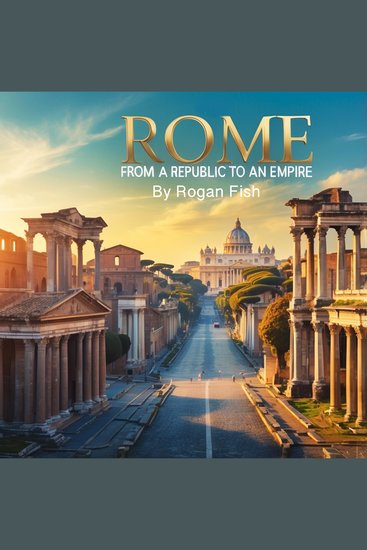
  • Rome - From a Republic to an Empire - cover

    Rome - From a Republic to an Empire

    Rogan Fish

    • 0
    • 0
    • 0
    The story of Rome’s foundation is a captivating blend of myth and history, shaping the identity of one of the greatest civilizations in human history. Rooted in legend and forged through early struggles, the foundation of Rome reflects both its mythological beginnings and the realities of its initial development as a small settlement along the Tiber River. 
    The legendary origin of Rome is steeped in the myth of Romulus and Remus, twin brothers born to the god Mars and a mortal princess named Rhea Silvia. Abandoned at birth and raised by a she-wolf, the brothers grew strong and brave. Eventually, they sought to establish a city where they had been rescued. However, a dispute over the location led to Romulus killing Remus, and Romulus became the sole founder of the city, naming it Rome after himself. This myth, while dramatic and symbolic, represents Rome’s spirit of resilience and its connection to both divine and mortal heritage. 
    Historically, Rome’s beginnings were far more modest. Archaeological evidence points to the establishment of small villages on the Palatine Hill around the 8th century BCE. These communities were primarily Latin-speaking shepherds and farmers who gradually united for mutual protection and trade. Over time, the settlement expanded, eventually forming a cohesive community governed by local chieftains. The choice of location along the Tiber River proved strategic, offering both a water source and a means of trade and communication.
    Voir livre