Rejoignez-nous pour un voyage dans le monde des livres!
Ajouter ce livre à l'électronique
Grey
Ecrivez un nouveau commentaire Default profile 50px
Grey
Abonnez-vous pour lire le livre complet ou lisez les premières pages gratuitement!
All characters reduced
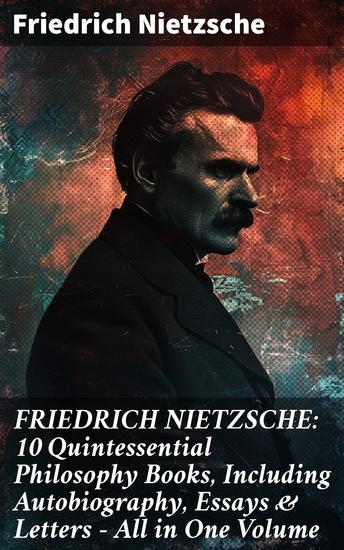
FRIEDRICH NIETZSCHE: 10 Quintessential Philosophy Books Including Autobiography Essays & Letters – All in One Volume - Exploring Nietzsche's Revolutionary Philosophy - cover

FRIEDRICH NIETZSCHE: 10 Quintessential Philosophy Books Including Autobiography Essays & Letters – All in One Volume - Exploring Nietzsche's Revolutionary Philosophy

Friedrich Nietzsche

Traducteur Anthony M. Ludovici, H. L. Mencken, Helen Zimmern, Thomas Common, G. T. Wrench, John McFarland Kennedy, Wm. A. Haussmann, Maude D. Petre, Paul V. Cohn, Francis Bickley, Herman Scheffauer, Maximilian A. Mügge

Maison d'édition: Good Press

  • 0
  • 0
  • 0

Synopsis

Friedrich Nietzsche: 10 Quintessential Philosophy Books, Including Autobiography, Essays & Letters 'Äì All in One Volume presents a comprehensive exploration of Nietzsche's profound philosophical inquiries. This collection marries the eloquent prose of Nietzsche's essays with the intimate reflection found in his autobiographical writings, offering readers a literary journey through the development of his thought. Set against the backdrop of 19th-century European philosophy, the volume interweaves themes of individualism, morality, and the critique of religion with Nietzsche's trademark aphoristic style, making complex ideas accessible yet deeply challenging to the intellect. Friedrich Nietzsche, a pivotal figure in Western philosophy, grappled with the implications of modernity and the decline of traditional values, experiences that undoubtedly shaped his writings. Known for his provocative ideas on the 'will to power' and the concept of the '√úbermensch,' Nietzsche's works reflect a profound personal struggle and a revolutionary vision for humanity's potential. His background as a classical philologist and his tumultuous life, marked by health issues and alienation, imbue his works with a unique authenticity and urgency. This collected volume is a treasure trove for both seasoned scholars and curious newcomers to Nietzsche's thought. By encapsulating the essence of his philosophical journey, it invites readers to engage with Nietzsche's bold critiques and transformations of moral and existential paradigms, making it an indispensable addition to any philosophical library.
Disponible depuis: 16/01/2024.
Longueur d'impression: 2442 pages.

D'autres livres qui pourraient vous intéresser

  • Anglo-Saxons - History of the Germanic Inhabitants of England - cover

    Anglo-Saxons - History of the...

    Kelly Mass

    • 0
    • 0
    • 0
    In the Early Middle Ages, the Anglo-Saxons were a cultural group that resided in England. They traced their roots back to the arrival of incomers to Britain in the fifth century, who originated from the North Sea coastlands of continental Europe. The ethnogenesis of the Anglo-Saxons, on the other hand, happened in Britain, and the identity wasn't just imported. The contact between getting in groups of people from some Germanic tribe, both amongst themselves and with native British populations, led to the facility of an Anglo-Saxon identity. A lot of the native tribes ultimately incorporated and embraced Anglo-Saxon society and language. The Anglo-Saxons established the idea of England and the Kingdom of England, and while the modern English language owes practically 26% of its vocabulary to them, this includes the great bulk of words used in daily discussion. 
    The Anglo-Saxon period in history describes the period in Britain from roughly 450 and 1066, starting with their preliminary settlement and ending with the Norman Conquest. 
    Let’s have a look at how this time period has influenced European history, and what else was so significant about the Anglo-Saxon civilization.
    Voir livre
  • Hume’s Dialogues Concerning Natural Religion - cover

    Hume’s Dialogues Concerning...

    David Hume

    • 0
    • 0
    • 0
    David Hume’s Dialogues Concerning Natural Religion had not yet been published when he died in 1776. Even though the manuscript was mostly written during the 1750s, it did not appear until 1779. The subject itself was too delicate and controversial, and Hume’s dialectical examination of religious knowledge was especially provocative. What should we teach young people about religion?
     
    The characters Demea, Cleanthes, and Philo passionately present and defend three sharply different answers to that question. Demea opens the dialogue with a position derived from Rene; Descartes and Father Malebranche—God’s nature is a mystery, but God’s existence can be proved logically. Cleanthes attacks that view, both because it leads to mysticism and because it attempts the impossible task of trying to establish existence on the basis pure reason, without appeal to sense experience.
     
    As an alternative, he offers a proof of both God’s existence and God’s nature based on the same kind of scientific reasoning established by Copernicus, Galileo, and Newton. Taking a skeptical approach, Philo presents a series of arguments that question any attempt to use reason as a basis for religious faith. He suggests that human beings might be better off without religion.
     
    The dialogue ends without agreement among the characters, justifying Hume’s choice of dialogue as the literary style for this topic.
    Voir livre
  • Big Questions of Philosophy The: Book Summary & Analysis - cover

    Big Questions of Philosophy The:...

    Briefly Summaries

    • 0
    • 0
    • 0
    This is a concise summary and analysis of ,The Big Questions of Philosophy by 
    David Edmonds.
     
    It is not the original book and is not affiliated with or endorsed by David Edmonds.
    Ideal those seeking a quick and insightful overview.
     
    Delve into life's most profound questions with clarity and wit in The Big Questions of Philosophy. This thought-provoking exploration tackles timeless issues such as morality, free will, the nature of consciousness, and the existence of God. Blending ancient wisdom with contemporary insights, the book provides accessible explanations of complex philosophical ideas, inviting readers to engage with the fundamental questions that shape human understanding and experience.
    Voir livre
  • Dear White Peacemakers - Dismantling Racism with Grit and Grace - cover

    Dear White Peacemakers -...

    Osheta Moore

    • 0
    • 1
    • 0
    Dear White Peacemakers is a breakup letter to division, a love letter to God’s beloved community, and an eviction notice to the violent powers that have sustained racism for centuries.   Race is one of the hardest topics to discuss in America. Many white Christians avoid talking about it altogether. But a commitment to peacemaking requires white people to step out of their comfort and privilege and into the work of anti-racism. Dear White Peacemakers is an invitation to white Christians to come to the table and join this hard work and holy calling. Rooted in the life, ministry, and teachings of Jesus, this book is a challenging call to transform white shame, fragility, saviorism, and privilege, in order to work together to build the Beloved Community as anti-racism peacemakers.   Written in the wake of George Floyd’s death, Dear White Peacemakers draws on the Sermon on the Mount, Spirituals, and personal stories from author Osheta Moore’s work as a pastor in St. Paul, Minnesota. Enter into this story of shalom and join in the urgent work of anti-racism peacemaking.  
    Voir livre
  • Complete Freedom From Thought - Brockwood Park 1972 Public Talk 1 - cover

    Complete Freedom From Thought -...

    Jiddu Krishnamurti

    • 0
    • 0
    • 0
    Complete freedom from thought - 9 September 1972 
    • Learning is instant perception and action. What place has thought in learning? 
    • To learn about freedom must thought be completely silent? Does insight into 
    freedom take time? 
    • Can thinking, however rational, bring about a psychological revolution in us? 
    • Is thought always conditioned? Is freedom the non-existence of thought? 
    • My very being is related to thought. If you want to see something new, what do 
    you do? 
    • To have insight, let go of the old and listen. 
    • Learning is not memorizing. 
    • Q: Is feeling another way of thinking? 
    • Q: Isn’t the need to love and be loved essential? 
    • Needing love is love of self.
    Voir livre
  • Illuminati Origins - cover

    Illuminati Origins

    Raphael Terra

    • 0
    • 0
    • 0
    This audiobook has been recorded using Text to speech (TTS). 
     
    This audiobook delves into the enigmatic world of the Illuminati and secret societies, unveiling their history and influence over global affairs. The Illuminati, real and fictional, are portrayed as elusive elites shaping our world. Their origin dates back to the late 1700s with the Bavarian Illuminati, founded by Adam Weishaupt and guided by the enigmatic 'Father of Illumination'. Since then, numerous groups have claimed Illuminati status, their links to Weishaupt's vision uncertain. These legends have fostered a culture of secrecy and fear, intertwining conspiracies of unimaginable power with Illuminati symbolism. Celebrities, musicians, and politicians have been implicated in this narrative, but does the Illuminati truly wield world control? 
     
    This audiobook investigates the historical ties between the Illuminati and secret societies and their impact on global events. We delve into Weishaupt's legacy and explore potentially nefarious activities within these organisations. The audiobook scrutinizes whether these groups possess the power to dominate the world and, if so, contemplates potential countermeasures. 
     
    Join us on this illuminating journey as we plunge into the shadowy realm of the Illuminati and secret societies that exert influence over our world.
    Voir livre