Join us on a literary world trip!
Add this book to bookshelf
Grey
Write a new comment Default profile 50px
Grey
Subscribe to read the full book or read the first pages for free!
All characters reduced
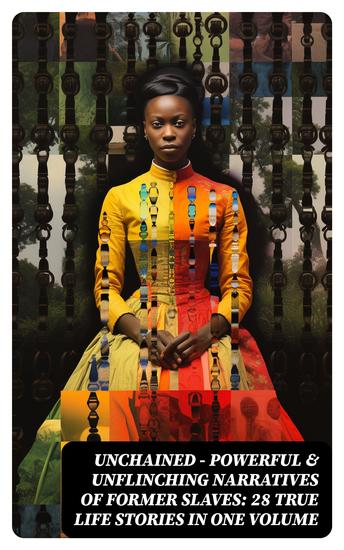
UNCHAINED - Powerful & Unflinching Narratives Of Former Slaves: 28 True Life Stories in One Volume - cover

UNCHAINED - Powerful & Unflinching Narratives Of Former Slaves: 28 True Life Stories in One Volume

Frederick Douglass, Booker T. Washington, William Wells Brown, William Craft, Ellen Craft, Sojourner Truth, Lydia Maria Child, Harriet Jacobs, Solomon Northup, Stephen Smith, Louis Hughes, Elizabeth Keckley, Nat Turner, Mary Prince, Olaudah Equiano, Charles Ball, Willie Lynch, John Gabriel Stedman, Ida B. Wells-Barnett, William Still, Henry Bibb, Josiah Henson, Brantz Mayer, Moses Grandy, Sarah H. Bradford, Jacob D. Green, Austin Steward, L. S. Thompson, Kate Drumgoold, Lucy A. Delaney, Henry Box Brown, Margaretta Matilda Odell, Thomas S. Gaines, Theodore Canot, Daniel Drayton, Thomas Clarkson, F. G. De Fontaine, John Dixon Long, Joseph Mountain

Publisher: DigiCat

  • 0
  • 0
  • 0

Summary

In 'UNCHAINED - Powerful & Unflinching Narratives Of Former Slaves: 28 True Life Stories in One Volume,' readers are transported through the harrowing and inspiring journeys of former slaves as recounted in their own words. The anthology masterfully intertwines themes of resilience, freedom, and the relentless pursuit of dignity, offering an indispensable glimpse into one of the darkest yet most transformative periods of history. Featuring an array of narrative styles—from stark, unadorned accounts to eloquently vivid descriptions—these texts capture the heart-wrenching realities and triumphs of those who endured the inhumanity of slavery. With standout pieces that echo the pain and hope of generations, this collection stands as an essential literary work with timeless relevance. The contributors, ranging from iconic figures like Frederick Douglass and Ida B. Wells-Barnett to lesser-known yet equally compelling voices like Ellen Craft and Charles Ball, bring diverse perspectives that significantly enhance the anthology's depth. Emerging from a confluence of African-American history, abolitionist literature, and early civil rights discourse, these narratives forge a powerful tapestry of experience. This alignment with abolitionist and emancipation movements creates a mosaic of testimonies that enrich the reader's understanding of the enduring legacies of slavery and perseverance. This anthology is a must-read for anyone seeking to grasp the multitude of experiences and human stories that shaped the struggle for freedom. 'UNCHAINED' provides an unparalleled opportunity to engage with a broad spectrum of first-hand accounts, offering clarity and insight into each narrator's unique perspective. As an educational treasure trove, it invites readers to immerse themselves in the profound dialogues of the past, appreciating the varied voices that drive home universal themes of hope, courage, and justice. Through this collection, readers will gain indispensable insights into the indomitable spirit of survival and the complex fabric of history.
Available since: 12/11/2023.
Print length: 5659 pages.

Other books that might interest you

  • Zoroastrianism: The History and Legacy of One of the World’s Oldest Religions - cover

    Zoroastrianism: The History and...

    Charles River Editors

    • 0
    • 0
    • 0
    The Sasanian Empire was important for a number of reasons. Besides being the last of three great Persian dynasties, they carried on many Persian cultural traditions relating to religion and kingship. The Sasanians fostered and promoted the native religion of Zoroastrianism to the point of persecuting other religions from time to time. It was during the Sasanian period that the numerous Zoroastrian hymns, prayers, and rituals were collected under one book, known as the Avesta.  
    	Thanks to the Sasanians’ efforts with regard to religion, modern scholars know much more about Zoroastrianism than they would have if the religion continued to disseminate orally. Their efforts also protected Zoroastrian knowledge in later years after the dynasty was long gone and Islam became ascendant in Persia. Zoroastrianism is technically still a living religion today, but the religion is mysterious and not widely known among those who don’t study it, and historians themselves are divided over when the religion’s prophet lived and when the religion was officially adopted in Persia. Zoroastrianism’s historical development has also failed to intrigue significant numbers of people, perhaps due to its geographical location and cultural background. Zoroastrianism developed among the Persian people, who have traditionally not been part of the standard Western, early Islamic, or Far Eastern cultural groupings, and when Persia later became part of the greater Islamic world, it was to the detriment of Zoroastrianism. Finally, Zoroastrianism is a “closed” religion, which has also kept it shrouded in mystery to a certain degree. Although contemporary Zoroastrians are quite open about their faith and willing to help non-Zoroastrian scholars, converts are rarely accepted by the faithful, adding a sense of insularity to the faith.
    Show book
  • The One Story Beneath All Religions - How the World’s Traditions Remember the Same Pattern of Life - cover

    The One Story Beneath All...

    María García

    • 0
    • 0
    • 0
    What if every religion is repeating the same forgotten truth? 
    Across continents and thousands of years, humanity has told different stories about creation, morality, collapse, and renewal. Yet beneath every tradition lies one universal pattern, older than scripture and deeper than doctrine. A pattern that explains why civilizations rise and fall, why life tightens and breaks, and how renewal always returns. 
    This book reveals that pattern with clarity: 
    Flow → Separation → Structure → Collapse → Flow 
    For the first time, myths, world religions, Indigenous teachings, and modern systems are shown as different expressions of the same rhythm. 
    Inside, you will discover: 
    • The hidden cycle behind every religion and civilization 
    • Why humanity keeps getting trapped in the Trauma Loop 
    • Why collapse is not destruction but the beginning of healing 
    • How Indigenous cultures preserved the complete cycle 
    • Why modern society is entering its largest collapse yet 
    • How to notice the return of Flow in your own life 
    • Why unity is not achieved but remembered 
    This is not a critique of religion, it is a translation. 
    It shows how Sumerian, Egyptian, Hindu, Buddhist, Chinese, Greek, Jewish, Christian, Islamic, Sámi, Norse, and Indigenous traditions were all describing the same recurring truth in different language. 
    Why this matters now: 
    The world is tightening. Structures are hardening. Systems are reaching their limit. 
    This book helps you understand what is happening and what comes next. Not through prediction or belief, but through the living pattern that has shaped human life from the beginning. 
    If you feel the world shifting, this book reveals the map beneath the movement. 
    One rhythm. Many traditions. One human story.
    Show book
  • Rise and Fall of the Third Reich The: The History and Legacy of Nazi Germany under Adolf Hitler - cover

    Rise and Fall of the Third Reich...

    Editors Charles River

    • 0
    • 0
    • 0
    The early 1930s were a tumultuous period for German politics, even in comparison to the ongoing transition to the modern era that caused various forms of chaos throughout the rest of the world. In the United States, reliance on the outdated gold standard and an absurdly parsimonious monetary policy helped bring about the Great Depression. Meanwhile, the Empire of Japan began its ultimately fatal adventurism with the invasion of Manchuria, alienating the rest of the world with the atrocities it committed. Around the same time, Gandhi began his drive for the peaceful independence of India through nonviolent protests against the British. 
    	It was in Germany, however, that the strongest seeds of future tragedy were sown. The struggling Weimar Republic had become a breeding ground for extremist politics, including two opposed and powerful authoritarian entities: the right-wing National Socialists and the left-wing KPD Communist Party. As the 1930s dawned, these two totalitarian groups held one another in a temporary stalemate, enabling the fragile ghost of democracy to continue a largely illusory survival for a few more years.  
    	That stalemate was broken in dramatic fashion on a bitterly cold night in late February 1933, and it was the Nazis who emerged decisively as the victors. A single act of arson against the famous Reichstag building proved to be the catalyst that propelled Adolf Hitler to victory in the elections of March 1933, which set the German nation irrevocably on the path towards World War II. That war would plunge much of the planet into an existential battle that ultimately cost an estimated 60 million lives. 
    Show book
  • Slavic Mythology for Beginners - Baba Yaga Domovoi and the Forest Spirits of Eastern Europe - cover

    Slavic Mythology for Beginners -...

    Johnny Nelson

    • 0
    • 0
    • 0
    Embark on a captivating journey into the heart of Eastern Europe's rich tapestry of folklore with "Slavic Mythology for Beginners: Baba Yaga, Domovoi, and the Forest Spirits of Eastern Europe." This immersive audiobook delves deep into the enchanting world of Slavic myths, unraveling tales that have been whispered through generations, shaping the cultural and spiritual landscape of nations. 
    Discover the enigmatic Baba Yaga, the fearsome witch of the woods who dwells in a hut perched on chicken legs, simultaneously a guardian and a menace. Explore the mysteries of the Domovoi, the benevolent household spirits believed to protect families and bring prosperity. Venture into the dense forests to meet the Leshy, mischievous woodland beings who guard the secrets of the trees, and uncover the lore of the Rusalka, ethereal water nymphs with tales as deep as the rivers they inhabit. 
    This audiobook offers more than just stories; it provides a comprehensive exploration of the origins, symbolism, and cultural significance of these myths. Through engaging narratives and insightful commentary, listeners will gain an understanding of how these legends reflect the values, fears, and hopes of the Slavic people. 
    Perfect for enthusiasts of mythology, folklore, and cultural history, this audiobook serves as an accessible introduction to Slavic mythological traditions. Whether you're a curious newcomer or a seasoned scholar, you'll find a wealth of knowledge and inspiration in these tales. 
    With its rich storytelling and informative insights, "Slavic Mythology for Beginners" invites you to step into a world where the line between the natural and the supernatural blurs, and where every shadow in the forest holds a story waiting to be told. 
    Ideal for listeners seeking to deepen their understanding of Slavic cultures, explore comparative mythology, or simply enjoy timeless tales of magic and mystery.
    Show book
  • Avoiding the Worst - How to Prevent a Moral Catastrophe - cover

    Avoiding the Worst - How to...

    Tobias Baumann

    • 0
    • 0
    • 0
    How can we avoid worst-case scenarios? 
    From Nineteen Eighty-Four to Black Mirror, we are all familiar with the tropes of dystopian science fiction. But what if worst-case scenarios could actually become reality? And what if we could do something now to put the world on a better path? 
    In Avoiding the Worst, Tobias Baumann lays out the concept of risks of future suffering (s-risks). With a focus on s-risks that are both realistic and avoidable, he argues that we have strong reasons to consider their reduction a top priority. Finally, he turns to the question of what we can do to help steer the world away from s-risks and towards a brighter future.
    Show book
  • Fake news - cover

    Fake news

    Mike Graham

    • 0
    • 0
    • 0
    MIKE GRAHAM TAKES AIM AT THE MAINSTREAM MEDIA IN FAKE NEWS 
    Veteran journalist and broadcaster Mike Graham turns his attention to the state of modern journalism in Fake News, a provocative examination of the relationship between the media, politics, government and the increasingly powerful forces shaping what the public is allowed to see and hear. 
    Drawing on decades spent inside British newspapers and broadcasting, Graham argues that journalism has undergone a profound transformation. In his account, reporters have increasingly become commentators, political sympathies have displaced impartiality and once-powerful newspapers and television networks are losing audiences and influence. 
    From Brexit and the Covid years to censorship, social-media platforms and political reporting, Fake News combines Graham’s personal experiences with his uncompromising assessment of the industry. He recalls broadcasting throughout lockdown, working with figures including Neil Oliver and Peter Hitchens, and questioning policies and narratives that he believes much of the established media failed adequately to challenge. 
    Graham also recounts TalkRADIO’s sudden removal from YouTube after alleged breaches of the platform’s community guidelines, an episode he presents as evidence of the extraordinary power technology companies can exercise over publishers and broadcasters. 
    At the heart of Fake News is a wider warning about freedom of expression. Graham argues that journalists, particularly those working in independent media, can no longer assume that their freedom to question prevailing orthodoxies will remain unchallenged. 
    Part memoir, part polemic and part insider account of British journalism, Fake News asks a fundamental question: when trust in traditional media collapses, who gets to decide what the truth is? 
    For Graham, the future increasingly belongs to independent journalism — and to audiences prepared to question what they are told.
    Show book