Unisciti a noi in un viaggio nel mondo dei libri!
Aggiungi questo libro allo scaffale
Grey
Scrivi un nuovo commento Default profile 50px
Grey
Iscriviti per leggere l'intero libro o leggi le prime pagine gratuitamente!
All characters reduced
'Look Back to Look Forward' - Frank O'Connor's Complete Translations from the Irish - cover

'Look Back to Look Forward' - Frank O'Connor's Complete Translations from the Irish

Frank O'Connor

Casa editrice: The Lilliput Press

  • 0
  • 0
  • 0

Sinossi

While Frank O'Connor was known primarily as one of Ireland's finest short-story writers, he was also an accomplished translator. In the long line of Irish writers given to translating poems in Irish into poems written in English – a tradition stretching back at least as far as Jonathan Swift – he stands out above all the rest.
Between the mid-1920s and the mid-1960s, O'Connor published 121 translations that give voice to the full range of this centuries-old tradition. Collected here in full for the first time, O'Connor's work shows an uncanny aptitude for carrying over into English verse many of the riches to be found in the originals – the ancient voice of the Hag of Beare lamenting her decline into old age; the voices of the early monks describing the Irish landscape, Irish weather, their religious faith, and, in at least one instance, their cat; the voice of Hugh O'Rourke's wife torn between loyalty to her husband and a rising desire for her seducer. All these voices haunted O'Connor throughout his career, whatever else he was doing. The collection includes the Irish-language sources for all 121 translations along with literal translations, enabling the reader to see what O'Connor started from.
O'Connor's translations sprang from a compulsive desire to breathe life into Ireland's past, to 'look back to look forward,' as he once put it; for him the Irish-language tradition was not for scholars and archives alone, but formed a living body of work vitally relevant to an Ireland that seemed puzzlingly indifferent to it.
Thanks to O'Connor's profound love of his country's language and its rich, literary subsoil – 'a literature of which no Irishman need feel ashamed', he once said – these voices from Ireland's past can still be heard. Strikingly modern in tone, they conjoin flesh and spirit, the sacred and the secular, in a way that speaks to humankind.
Disponibile da: 13/04/2023.
Lunghezza di stampa: 432 pagine.

Altri libri che potrebbero interessarti

  • The Unlikely Event of Flying: Poetry Ireland Introductions Céadlínte 2024 - cover

    The Unlikely Event of Flying:...

    Julie O'Gorman

    • 0
    • 0
    • 0
    Poetry Ireland Introductions / Céadlínte 2025 offers poets in the early stages of their careers the opportunity to showcase their work through workshops, an e-publication and performance. This year's poets were selected by adjudicators Jessica Traynor and Aifric Mac Aodha in partnership with Poetry Ireland, the national poetry organisation. For the anthology, each poet has provided a pair of poems and a short, personal prose piece exploring topics from music and travel to more personal reflections, establishing a dynamic collection of work.
    Mostra libro
  • The Holy Sonnets - Incredible sonnets often compared to that of Shakespeares - cover

    The Holy Sonnets - Incredible...

    John Donne

    • 0
    • 0
    • 0
    John Donne was born on the 22nd January 1572 in London, into a Roman Catholic family when Catholicism was illegal in England, and there was turbulence and unrest with both state and church throughout much of Europe.  
     
    His father, also named John, died when he was four, and his mother, Elizabeth Haywood, married a wealthy widower, ensuring the family were looked after.  He received a good education at both Oxford and Cambridge but was unable to obtain a degree without taking the oath of supremacy, which as a Catholic he refused to do.  
     
    During the 1590s, Donne wrote a wide range of verses, including both erotic and sacred poems, creating two major volumes of work.  His strong vivacious and sensual style fusing intellect and passion, as well as inventive use of subtle argument and syntax, provided a new radical perspective that reached beyond his contemporaries, and continued to chime and charm poetry lovers throughout the ages.  
     
    Difficult to believe that with this enormous talent, Donne lived in poverty for many years, exacerbated by his secret marriage to Anne Moore, which meant no dowry, and they having twelve children.  Later he served in Parliament and became Dean of St Paul's in 1621, noted for his learned and charismatic sermons.  
     
    John Donne died in London on the 31st March 1631, but leaves an enormous legacy of many splendid influential poems.  He was known as the founder of the Metaphysical Movement and is widely regarded as one of Britain's best-loved poets.
    Mostra libro
  • A Young Boy Named David Book 22 - cover

    A Young Boy Named David Book 22

    David M. Smith

    • 0
    • 0
    • 0
    The “Young Boy Named David” series is designed to help young people deal with difficult situations that are hard to talk about and adults reconnect to their disconnected childhood helping heal broken pasts. In Book 22, the very real and pressing issue of guns enters David's life. He learns a lesson about this that will definitely help our young ones growing up in this crazy world.
    Mostra libro
  • Death Be Not Proud - cover

    Death Be Not Proud

    John Donne

    • 0
    • 0
    • 0
    This week we’re marking the American Memorial Day with eleven readings of a John Donne poem. Memorial Day was conceived as a time to remember military men and women who had lost their lives in war. Kings and presidents come and go and some of the reasons that wars have come about are now lost from memory or are obscured in our history texts.    A consistent aspect of war is that those who fight them are not those who arrange them. The soldiers and sailors who suffer loss of limb, scarred minds or forfeit their lives mostly come from the lower and middle rungs of our societal ladder. They are our sons and daughters, husbands and wives, fathers and mothers, brothers and sisters.    Once gone, it is the family who notices the empty chair at the family table while society at large knows not their name. Death has captured them and taken them forever from our midst. It has become personal and not a vague philosophical idea. The theme of Donne’s poem is that, though Death is irresistible, it has no cause to be proud. The human spirit and its hope for redemption is indomitable. This was the weekly poetry project for the week of May 27th, 2006.    (Summary by Robert Garrison)
    Mostra libro
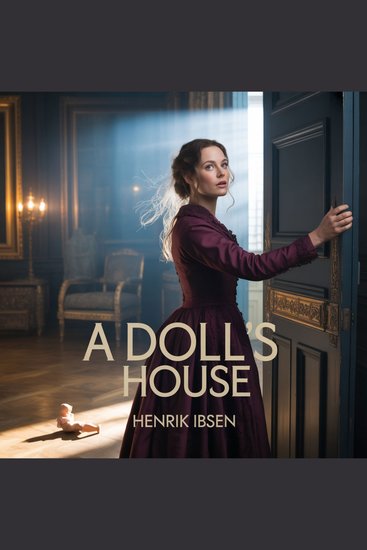
  • A Doll's House - cover

    A Doll's House

    Henrik Ibsen

    • 0
    • 0
    • 0
    This audiobook is narrated by an AI Voice.   
    A Doll’s House is a groundbreaking three-act play by Henrik Ibsen that revolutionized modern drama. First performed in 1879, this powerful story explores marriage, identity, gender roles, and personal freedom in 19th-century Europe. 
    Nora Helmer appears to live a comfortable life with her husband, Torvald. But beneath the surface lies a secret that threatens everything. As long-hidden truths come to light, Nora is forced to confront the reality of her marriage and her place in society. 
    Bold, controversial, and emotionally gripping, A Doll’s House remains one of the most influential works in world literature. Ibsen’s sharp dialogue and psychological depth make this play as relevant today as it was over a century ago. 
    This edition includes a reader-friendly presentation designed for clarity and modern accessibility while preserving the integrity of the original classic text.
    Mostra libro
  • Kalevala The Land of the Heroes (Kirby translation) - cover

    Kalevala The Land of the Heroes...

    Elias Lönnrot

    • 0
    • 0
    • 0
    The Kalevala is a 19th-century work of epic poetry compiled by Elias Lönnrot from Karelian and Finnish oral folklore and mythology.  It is regarded as the national epic of Karelia and Finland and is one of the most significant works of Finnish literature. The Kalevala played an instrumental role in the development of the Finnish national identity, the intensification of Finland's language strife and the growing sense of nationality that ultimately led to Finland's independence from Russia in 1917.  The first version of The Kalevala (called The Old Kalevala) was published in 1835. The version most commonly known today was first published in 1849 and consists of 22,795 verses, divided into fifty songs.  The title can be interpreted as "The Land of Kaleva" or "Kalevia."  If the rhythm of the poetry sounds familiar to American readers, it is probably because Henry Wadsworth Longfellow borrowed its trochaic tetrameter form for his famous "Song of Hiawatha."  Of the five complete translations of the Kalevala into English, it is only the older translations by John Martin Crawford (1888) and William Forsell Kirby (1907) which attempt strictly to follow the original rhythm (Kalevala meter) of the poems.  Modern writers influenced by the Kalevala include J. R. R. Tolkien, whose epic "Lord of the Rings" trilogy make use of both style and content from the Finnish work. - Summary by Wikipedia (edited and supplemented by Expatriate)
    Mostra libro