¡Acompáñanos a viajar por el mundo de los libros!
Añadir este libro a la estantería
Grey
Escribe un nuevo comentario Default profile 50px
Grey
Suscríbete para leer el libro completo o lee las primeras páginas gratis.
All characters reduced
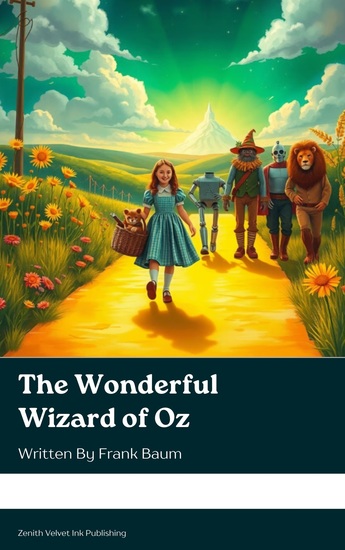
The Wonderful Wizard of Oz - cover

The Wonderful Wizard of Oz

Frank Baum

Editorial: Zenith Velvet Ink Publishing

  • 0
  • 0
  • 0

Sinopsis

What if a single whirlwind could carry you from ordinary life into a world of dazzling magic and unforgettable friends? 🌪️

In The Wonderful Wizard of Oz, L. Frank Baum invites readers into one of the most beloved fantasy worlds ever imagined. When young Dorothy Gale is swept away to the magical Land of Oz, she embarks on a thrilling adventure filled with wonder, danger, and heartwarming companionship.

This beautifully formatted edition brings Baum's enchanting tale to life with:

Dorothy's unforgettable quest down the Yellow Brick Road

Iconic companions—the Scarecrow, Tin Woodman, and Cowardly Lion

Breathtaking lands, from Munchkin Country to the Emerald City

Magical encounters with witches, flying monkeys, and mysterious creatures

Timeless themes of courage, love, home, and self-discovery

More than a children's story, Baum's masterpiece speaks to readers of all ages. Its imaginative world, bold characters, and uplifting message have inspired movies, musicals, and countless adaptations across generations.

Whether you're revisiting a childhood favorite or discovering Oz for the first time, this edition offers a clean, immersive reading experience that captures all the charm, humor, and adventure of Baum's original vision.

Follow the Yellow Brick Road—add this magical classic to your library today and rediscover the wonder of Oz.
Disponible desde: 17/11/2025.
Longitud de impresión: 494 páginas.

Otros libros que te pueden interesar

  • Claude Gueux - cover

    Claude Gueux

    Victor Hugo

    • 0
    • 0
    • 0
    Claude Gueux is a powerful and deeply moving novella by Victor Hugo that confronts the harsh realities of poverty, injustice, and the brutal nature of the 19th-century penal system. Written with moral intensity and social conviction, this short yet impactful work stands as one of Hugo's earliest and most direct critiques of systemic inequality and capital punishment.
    
    The story follows Claude Gueux, a poor but intelligent working-class man who is driven to theft by desperate circumstances. Unable to provide for himself and the woman he loves, Claude commits a crime not out of malice, but out of necessity. For this act, he is sentenced to prison — a place where the rigid structure of authority, deprivation, and humiliation tests the limits of human dignity.
    
    Inside the prison walls, Claude quickly distinguishes himself through his intelligence, quiet strength, and natural leadership. He earns the respect and admiration of fellow inmates and even gains a measure of influence among them. However, his moral character and popularity attract the hostility of the prison director, whose arbitrary cruelty and abuse of power create a growing tension between authority and humanity.
    
    When Claude forms a deep and compassionate bond with a young prisoner, the director deliberately separates them as an act of control and punishment. This calculated act of psychological cruelty pushes Claude toward a tragic and inevitable confrontation. What follows is not merely a crime of violence, but a dramatic statement on injustice, oppression, and the failure of society to uplift its most vulnerable members.
    
    Victor Hugo uses Claude's story to raise urgent social questions: Who is truly responsible for crime — the individual or the society that neglects him? What role do poverty, lack of education, and systemic inequality play in shaping human fate? Hugo argues passionately that crime is often born from social injustice, and that punishment without reform only deepens the cycle of suffering.
    
    Though brief, Claude Gueux delivers a profound emotional and philosophical impact. Hugo's prose is direct yet eloquent, blending narrative storytelling with moral reflection. The novella anticipates many of the themes later developed in his masterpiece Les Misérables, particularly the call for compassion, justice reform, and the recognition of human dignity in all people.
    
    More than a tragic tale, Claude Gueux is a bold social indictment — a plea for education instead of execution, for reform instead of retribution, and for humanity within institutions designed to punish. Hugo transforms one man's fate into a broader commentary on society's responsibility toward its poorest and most marginalized citizens.
    
    Timeless, thought-provoking, and morally urgent, Claude Gueux remains a compelling read for those interested in classic literature, social justice themes, and the enduring question of how societies treat their most vulnerable members.
    Ver libro
  • The Jungle Book - cover

    The Jungle Book

    Rudyard Kipling

    • 0
    • 0
    • 0
    "The Jungle Book" is a literary classic penned by British author Rudyard Kipling and first published in 1894. Set in the heart of the Indian jungle, it is a captivating collection of stories that combine adventure, morality, and the relationship between humans and animals. At its core, the book explores the idea of the "Law of the Jungle," which represents the rules and principles that govern life in the wild. 
    The central character of "The Jungle Book" is Mowgli, a young boy who finds himself orphaned in the jungle and subsequently raised by a pack of wolves. His upbringing in the jungle introduces him to the intricate web of life and survival strategies that animals employ. Mowgli learns to communicate with various creatures, developing unique friendships and alliances with the jungle's inhabitants. 
    Among his closest animal companions are Baloo, the jovial and wise bear who imparts valuable life lessons to Mowgli, and Bagheera, the sleek and protective black panther who serves as his guardian. Together, they guide Mowgli through the challenges of the jungle, instilling in him the importance of respecting nature and the Law of the Jungle. 
     
    However, not all of Mowgli's encounters in the jungle are friendly. Shere Khan, a fearsome Bengal tiger, serves as one of his primary adversaries. Shere Khan harbors a deep-seated animosity toward humans and poses a constant threat to Mowgli, leading to numerous confrontations throughout the story. 
     
    Rudyard Kipling (1865-1936) was a British author best known for his works of fiction and poetry, often set in the context of the British Empire. He was born in Bombay, India, and spent a significant part of his life there, which greatly influenced his writing. Kipling's notable works include "The Jungle Book," "Kim," "Just So Stories,".
    Ver libro
  • Tarzan - cover

    Tarzan

    Edgar Rice Burroughs

    • 0
    • 0
    • 0
    From the jungles of Africa comes one of the most Iconic heroes of all time in a wonderful new audio editionIn the untamed heart of the African jungle, Edgar Rice Burroughs unfolds the riveting tale of Tarzan of the Apes. Orphaned and raised by a band of apes, a young boy emerges as the formidable Tarzan, mastering the perils of the wild with unparalleled bravery and agility. But his primal world is forever altered with the arrival of the compassionate Jane Porter, igniting a conflict between his savage upbringing and the stirrings of a civilized heart.Since his debut, Tarzan has become a cultural icon, symbolizing the clash between nature and civilization, and continues to resonate in popular consciousness. This timeless epic invites readers to discover the hero within, through a saga that has captivated fans and inspired countless adaptations across generations. Step into the jungle with Tarzan, the second volume of the lovingly produced series Literature’s Greatest Heroes.
    Ver libro
  • Notes From Underground - cover

    Notes From Underground

    Fyodor Dostoyevsky

    • 0
    • 0
    • 0
    "Notes from Underground" (sometimes translated as "Notes from the Underground" or "Letters from the Underworld") is a novella by Fyodor Dostoyevsky, first published in 1864. It is often considered one of the first existentialist novels. The work is divided into two parts: the first is a rambling monologue by an unnamed narrator, often referred to as the "underground man", who is a retired civil servant living in St. Petersburg. This monologue is a bitter critique of utopianism, rational egoism, and utilitarianism. The second part of the novella, titled "Apropos of the Wet Snow", recounts episodes from the narrator's life that exemplify his philosophical arguments.
    Ver libro
  • The Cricket on the Hearth The Lost Christmas Classic - Stories For Everyone - cover

    The Cricket on the Hearth The...

    Charles Dickens

    • 0
    • 0
    • 0
    The Cricket on the Heart is a novella by Charles Dickens, published by Bradbury and Evans, and released 20 December 1845. Dickens began writing the book in October 1845 and finished it by December. Like all of Dickens’s Christmas books, it was published in book form, not as a serial. Dickens described the novel as “quiet and domestic innocent and pretty.” It is subdivided into chapters called “Chirps”, similar to the “Quarters” of The Chimes or the “Staves” of A Christmas Carol. It is the third of Dickens’s five Christmas books, preceded by A Christmas Carol (1843) and The Chimes (1844), and followed by The Battle of Life (1846) and The Haunted Man and the Ghost’s Bargain (1848).
    Ver libro
  • A Doll's House - cover

    A Doll's House

    Henrik Ibsen

    • 0
    • 0
    • 0
    A Doll's House is a three-act play written by Norwegian playwright Henrik Ibsen. It premiered at the Royal Theatre in Copenhagen, Denmark, on 21 December 1879, having been published earlier that month. The play is set in a Norwegian town circa 1879.The play is significant for the way it deals with the fate of a married woman, who at the time in Norway lacked reasonable opportunities for self-fulfillment in a male-dominated world, despite the fact that Ibsen denied it was his intent to write a feminist play. It aroused a great sensation at the time and caused a "storm of outraged controversy" that went beyond the theatre to the world of newspapers and society.Henrik Johan Ibsen was a Norwegian playwright and theatre director. As one of the founders of modernism in theatre, Ibsen is often referred to as "the father of realism" and one of the most influential playwrights of his time. Ibsen is the most frequently performed dramatist in the world after Shakespeare, and A Doll's House was the world's most performed play in 2006.Ibsen is often ranked as one of the most distinguished playwrights in the European tradition and is widely regarded as the foremost playwright of the nineteenth century. Ibsen was nominated for the Nobel Prize in Literature in 1902, 1903, and 1904.
    Ver libro