Join us on a literary world trip!
Add this book to bookshelf
Grey
Write a new comment Default profile 50px
Grey
Subscribe to read the full book or read the first pages for free!
All characters reduced
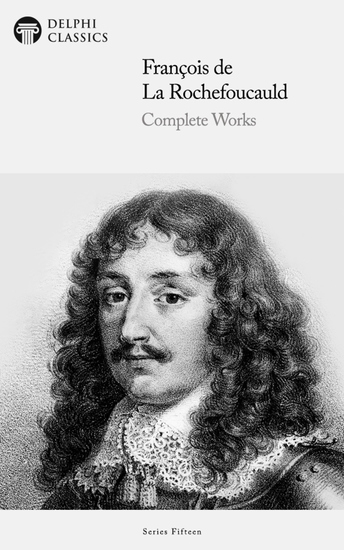
Delphi Complete Works of François de La Rochefoucauld Illustrated - cover

Delphi Complete Works of François de La Rochefoucauld Illustrated

François de la Rochefoucauld

Publisher: Delphi Publishing Ltd

  • 0
  • 0
  • 0

Summary

François VI, duc de La Rochefoucauld was a seventeenth century moralist, who became the leading exponent of the ‘maxime’, a French literary form of epigram that expresses a harsh or paradoxical truth with brevity. He muses on honour, fate, friendship, love and the human tendency for self-delusion. His experience with the royal court during the Fronde influenced his thinking immensely. An exemplar of the older noblesse, La Rochefoucauld influenced numerous philosophers and men of letters, including Nietzsche, who sought to imitate his aphoristic style. This eBook presents La Rochefoucauld’s complete works, with numerous illustrations, rare texts, informative introductions and the usual Delphi bonus material. (Version 1)

 
* Beautifully illustrated with images relating to La Rochefoucauld’s life and works* Concise introduction to the moralist* Both the Maxims and Memoirs of La Rochefoucauld, with individual contents tables* Rare texts appearing for the first time in digital publishing * Images of how the books were first published, giving your eReader a taste of the original texts* Excellent formatting of the texts* Features four biographies – discover La Rochefoucauld’s intriguing life

 
CONTENTS:

 
The NovelsMaxims (translated by J. W. Willis Bund and J. Hain Friswell, 1871)The Memoirs of the Duke de La Rochefoucauld (Anonymous translation, 1683)

 
The BiographiesRochefoucauld (1838) by Mary Wollstonecraft ShelleyLa Rochefoucauld (1909) by William Cleaver WilkinsonFrançois de La Rochefoucauld (1911) by George SaintsburyLa Rochefoucauld (1918) by Edmund Gosse
Available since: 11/12/2024.
Print length: 1157 pages.

Other books that might interest you

  • The Story of Football in 100 Objects - cover

    The Story of Football in 100...

    National Football Museum

    • 0
    • 0
    • 0
    The captivating story of football told through 100 amazing objects collected from its rich history – a must-read for any football fan 
    What do a Paul Gascoigne puppet, the 1895 British Ladies’ kit, John Motson’s coat, an inflatable unicorn or the 1966 World Cup Final ball tell us about the beautiful game? 
    Carefully selected from the unique archive of Manchester’s National Football Museum, these and many other artefacts give an amazing account of football itself, but also of the clubs, players and fans at all levels. They take us inside moments of high drama, crushing heartbreak and euphoric success, and together reflect a diverse, inclusive and surprising vision of the world’s favourite sport. 
    Perfect for fans of all ages, this compendium of cup glories and bittersweet away-days will appeal to anyone with a love of the game. 
    Immerse yourself in the rich history and culture of football, as this non-fiction masterpiece takes you on a journey through Europe's most memorable sports moments. From the latest popular trends to the top players, this book is a must-read for any football enthusiast. 
    nan 
    HarperCollins 2025
    Show book
  • Dheean Vala Ghar - cover

    Dheean Vala Ghar

    Prof Jagtar Singh

    • 0
    • 0
    • 0
    The author has included 15 stories in this book, which depict the ups and downs of social interactions and the tragedies faced by the oppressed and marginalized people in society. Additionally, the book attempts to highlight people's struggles by portraying simple and rural characters, capturing the essence of their pain. According to the author, some of the stories in this collection are based on real-life events
    Show book
  • Matisse at War - cover

    Matisse at War

    Christopher C. Gorham

    • 0
    • 0
    • 0
    In 1940, with the Nazis sweeping through France, Henri Matisse found himself at a personal and artistic crossroads. His marriage had ended, he was gravely ill, and after decades at the forefront of modern art, he was beset by doubt. As scores of famous figures escaped the country, Matisse took refuge in Nice, with his companion, Lydia. By defiantly remaining, Matisse was a source of inspiration for his nation. 


    While enemy agents and Resistance fighters played cat-and-mouse in the alleyways of Nice, Matisse's son, Jean, engaged in sabotage efforts with the Allies. In Paris, under the swastika, Matisse's estranged wife worked for the Communist underground. His daughter, Marguerite, active in the French Resistance, was arrested and tortured by the Gestapo, sentenced to Ravensbruck concentration camp—and miraculously escaped when her train was halted by Allied bombs. His younger son, Pierre helped Jewish artists escape to New York; even his grandson risked his life by defying the Germans and their Vichy collaborators. Amidst this chaos, Matisse responded to the dark days of war by inventing a dazzling new paper technique that led to some of his most iconic pieces, including The Fall of Icarus, his profile of Charles De Gaulle, Monsieur Loyal, and his groundbreaking cut-out book, Jazz. His wartime works were acts of resistance, subtly patriotic, and daringly new.
    Show book
  • A Rare Recording of President John F Kennedy’s Last Speech Before His Assassination - cover

    A Rare Recording of President...

    President John Fitzgerald Kennedy

    • 0
    • 0
    • 0
    On November 22, 1963, President John F. Kennedy made a speech to the Fort Worth, Texas, Chamber of Commerce; he was assassinated later that afternoon. Kennedy had traveled to the state to unite Texas Democrats where party leaders were feuding and extremists were contributing to political tensions. Kennedy knew an intra-party feud in Texas could jeopardize his chances of carrying the state for his 1964 re-election campaign.
    Show book
  • Modern Man - Neanderthal with Manners - cover

    Modern Man - Neanderthal with...

    Mike Blake

    • 0
    • 0
    • 0
    Modern Man ~ Neanderthal with Manners 
    Poem about the comparison of what it is to be a Modern man today. What it may have been yesterday, and what it 
    was to compare it to our relatively recent ancestors from just a hundred thousand years or so 
    - The Neanderthals. 
    Would they have been as cruel to their fellow beings as possibly we are today. What does it mean to be classified as 
    MODERN ! A modern Human ? 
    *NO A.I. has been used in the creation of this Poem.  
    Purely 100% inspirational from the Author.   * As for all my poems.* 
    To see more other Poems by the same Author please click the Link HERE: 
    https://www.amazon.com/-/e/B00SG40RM8 
    ***** Please leave your Review/feedback, many thanks. 
    To contact the Author: 
    Please add me Mike Miko on Facebook & then message me, thanks. 
    https://www.facebook.com/mike.cco1 I will then contact the Author your behalf. 
    or on Twitter: Miko_1_Dollar ~  
    Instagram: wild_poetrys // wild.poetry.webs 
    Tiktok: @Wild_poetrys 
    Website: www.wild-poetry.com 
    Facebook: https://www.facebook.com/New.Poets.Corner 
    WOW https://www.facebook.com/wow.fact
    Show book
  • Reading the Times - A Literary and Theological Inquiry into the News - cover

    Reading the Times - A Literary...

    Jeffrey Bilbro

    • 0
    • 0
    • 0
    "Reading the morning newspaper is the realist's morning prayer."—G. W. F. Hegel 
    Whenever we reach for our phones or scan a newspaper to get "caught up," we are being not merely informed but also formed. News consumption can shape our sense of belonging, how we judge the value of our lives, and even how our brains function. Christians mustn't let the news replace prayer as Hegel envisioned, but neither should we simply discard the daily feed. We need a better understanding of what the news is for and how to read it well. 
    Jeffrey Bilbro invites readers to take a step back and gain some theological and historical perspective on the nature and very purpose of news. In Reading the Times he reflects on how we pay attention, how we discern the nature of time and history, and how we form communities through what we read and discuss. Drawing on writers from Thoreau and Dante to Merton and Berry, along with activist-journalists such as Frederick Douglass and Dorothy Day, Bilbro offers an alternative vision of the rhythms of life, one in which we understand our times in light of what is timeless. Throughout, he suggests practices to counteract common maladies tied to media consumption in order to cultivate healthier ways of reading and being. 
    When the news sets itself up as the light of the world, it usurps the role of the living Word. But when it helps us attend together to the work of Christ—down through history and within our daily contexts—it can play a vital part in enabling us to love our neighbors. Reading the Times is a refreshing and humane call to put the news in its place.
    Show book