Rejoignez-nous pour un voyage dans le monde des livres!
Ajouter ce livre à l'électronique
Grey
Ecrivez un nouveau commentaire Default profile 50px
Grey
Abonnez-vous pour lire le livre complet ou lisez les premières pages gratuitement!
All characters reduced
T Tembarom - cover

T Tembarom

Frances Hodgson Burnett

Maison d'édition: Bu Classics Books

  • 0
  • 0
  • 0

Synopsis

Thrust from the bustling streets of New York into the rigid traditions of an English manor, T. Tembarom faces a destiny he never expected. The sudden weight of inheritance threatens to crush his spirit as he navigates a world of secrets and aristocracy. Romance and mystery intertwine as he struggles to prove his worth without losing his soul. A charming yet tense exploration of identity and the price of fortune.
Disponible depuis: 04/03/2026.
Longueur d'impression: 721 pages.
D'autres livres qui pourraient vous intéresser

  • Second Best - From their pens to your ears genius in every story - cover

    Second Best - From their pens to...

    D H Lawrence

    • 0
    • 0
    • 0
    David Herbert Lawrence was born on the 11th September 1885 in Eastwood, Nottinghamshire, a coal mining town where the reality of a harsh life was only useful as experiences for future literary works. 
    He was educated at Beauvale Board School and became the first local boy to receive a scholarship to attend Nottingham High School. After 3 years he became a junior clerk in Haywood’s surgical appliances factory. He was also attempting a literary career which, in the short term, led to a teacher training position in Eastwood and later a teaching qualification from University College, Nottingham.  
    Lawrence’s first efforts were poems, short stories and a draft of ‘The White Peacock’. Moving to London and a teaching position in Croydon his writing attracted the attention of Ford Madox Ford, editor of The English Review, and he commissioned him to write ‘Odour of Chrysanthemums’.  
    Wanting to write full-time he now began work on what would become ‘Sons and Lovers.   
    In 1912 he met the older and married mother-of-three Frieda Weekley. They eloped to Germany and here Lawrence could see for himself the growing tensions with France.  So keen was his interest that he was arrested and accused of being a British spy.  
    In early 1914 Frieda obtained her divorce and they returned to Britain to be married just days before the outbreak of war. Owing to her German parentage, and his own public dislike of militarism and violence, the couple were treated with contempt and suspicion throughout the war years.  
    Despite this he continued to write but his reputation in England was so tarnished and, mirrored by his own disdain for the country, he and Frieda left England in November 1919, first for Europe and then America via Ceylon and Australia. 
    They bought a ranch in Taos, New Mexico and visited Mexico several times. The third visit in March 1925 caused a near fatal attack of malaria. To convalesce they moved to Florence. Here he continued work on ‘Lady Chatterley’s Lover’ which for many years would cause controversy. A renewed interest in oil painting resulted in an exhibition in 1929 which was raided by the police and several works were confiscated.  
    D H Lawrence died of complications arising from a bout of tuberculosis on the 2nd of March 1930 in Vence, France.  He was 44.
    Voir livre
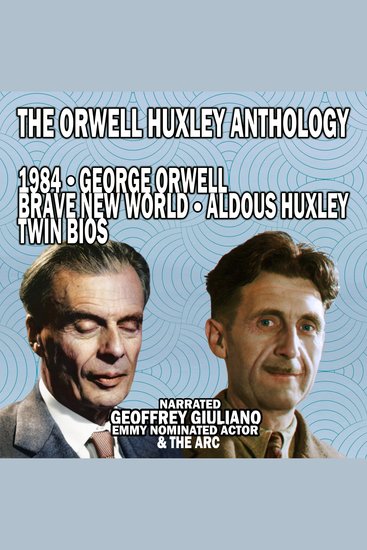
  • The Orwell Huxley Anthology - 1984 Brave New World Twin Bios - cover

    The Orwell Huxley Anthology -...

    George Orwell, Aldous Huxley

    • 0
    • 0
    • 0
    1984 by George Orwell and Brave New World by Aldous Huxley are two of the most famous and influential dystopian novels ever written. Both books depict a future world in which individual freedom and privacy are subordinated to the demands of a totalitarian state, and citizens are manipulated and controlled through technology, propaganda, and social conditioning. 
     
    1984 is set in a grim, authoritarian society in which all citizens are monitored and controlled by the ruling Party. The novel's protagonist, Winston Smith, begins to question the oppressive regime and becomes involved in a dangerous and ultimately doomed rebellion. Orwell's writing in 1984 is characterized by its stark realism and its unflinching depiction of the horrors of totalitarianism. The novel remains a powerful warning about the dangers of unchecked government power and the importance of individual freedom. 
     
    Brave New World, on the other hand, is set in a more technologically advanced and ostensibly utopian society, in which citizens are conditioned from birth to be content with their predetermined place in the social hierarchy. The novel's protagonist, Bernard Marx, rebels against the conformity and emptiness of his society, but ultimately finds himself unable to escape its grip. Huxley's writing in Brave New World is characterized by its irony and satire, as well as its incisive critique of the impact of technology on human nature. 
    . The two novels have often been compared and contrasted, and both are considered to be among the most important works of literature of the 20th century. 
     
    Here is the ultimate Audiobook celebration of this great enduring artist narrated by Emmy-nominated actor and author Geoffrey Giuliano.
    Voir livre
  • After the Race - From their pens to your ears genius in every story - cover

    After the Race - From their pens...

    James Joyce

    • 0
    • 0
    • 0
    James Augustine Aloysius Joyce was born on the 2nd February 1882 in Dublin into a middle-class family, and the eldest of ten surviving siblings 
    Admired as a brilliant student he briefly attended the Christian Brothers-run O'Connell School before excelling at the Jesuit schools of Clongowes and Belvedere.  From there he went on to attend University College Dublin from 1898, studying English, French and Italian 
    In 1902, Joyce was now in his early twenties, and went to Paris to study Medicine but soon abandoned his teachings.  Back in Dublin to attend to his dying Mother he met Nora Barnacle. They bonded immediately into a life-long match. Together they decided to emigrate to Europe.  The couple lived in Trieste, Rome, Paris, and finally Zürich where Joyce pursued a variety of jobs and ventures to supplement his literary pursuits but none of these paid off.  
    After publishing a poetry volume, ‘Chamber Music’, in 1907, his short story collection ‘The Dubliners’, in 1914, helped establish his talent in the rapidly changing world.  
    Although far from home Joyce’s literary heart and works were set in his recollections of Dublin.  Characters are close resemblances of family and friends and indeed enemies.  His landmark work ‘Ulysses’, published in 1922, is set in the streets and alleyways of the city as it parallels Homer’s Odyssey in a variety of styles including its famed stream of consciousness. 
    His pen continued to produce classics of the order of ‘A Portrait of the Artist as A Young Man’ and ‘Finnegan’s Wake’ together with several volumes of poetry and a play ‘The Exiles, in 1918.   
    On the 11th January 1941, Joyce underwent surgery in Zürich for a perforated duodenal ulcer. The next day he fell into a coma. On the 13th after a brief period of lucidity in which he called for his wife and son he passed.  He was 58.
    Voir livre
  • The Chronicles of Count Antonio - cover

    The Chronicles of Count Antonio

    Anthony Hope

    • 0
    • 0
    • 0
    How it fell out that Count Antonio, a man of high lineage, forsook the service of his Prince, disdained the obligation of his rank, set law at naught, and did what seemed indeed in his own eyes to be good but was held by many to be nothing other than the work of a rebel and a brigand. Yet, although it is by these names that men often speak of him, they love his memory; and I also, Ambrose the Franciscan, having gathered diligently all that I could come by in the archives of the city or from the lips of aged folk, have learned to love it in some sort. A tale that lovers must read in pride and sorrow, and, if this be not too high a hope, that princes may study for profit and for warning. (Summary by Anthony Hope)This project was proof listened by Eden Rea-Hedrick and Theresa L. Downey
    Voir livre
  • Before Adam - cover

    Before Adam

    Jack London

    • 0
    • 0
    • 0
    Written in 1906, Before Adam is a bit of a departure from London's other novels. Still an adventure novel, this one revolves around the dreams of a young boy, dreams that involve racial memories and the knowledge of his prior existence as a man-like creature named Big Tooth living in prehistoric times. "These are our ancestors, and their history is our history. Remember that as surely as we one day swung down out of the trees and walked upright, just as surely, on a far earlier day, did we crawl up out of the sea and achieve our first adventure on land."
    Voir livre
  • The Eclogues - cover

    The Eclogues

    Virgil

    • 0
    • 0
    • 0
    Virgil’s Eclogues (also known as Bucolics) is a collection of ten pastoral poems that idealize rural life in the Italian countryside. Written in the tradition of Greek bucolic poetry, particularly inspired by Theocritus, the Eclogues depict shepherds singing, competing in poetic contests, and lamenting lost love and displacement. Set against the backdrop of civil unrest and land confiscations in 1st-century BCE Rome, the poems blend idyllic imagery with subtle political commentary. Figures of hope, such as the prophesied birth of a divine child in the Fourth Eclogue, reflect contemporary longing for peace and renewal. Through lush language and elegant form, Virgil explores themes of love, loss, nature’s beauty, and the contrast between urban turmoil and rural harmony. The Eclogues established the pastoral tradition in Western literature, influencing poets for centuries with their lyrical grace and emotional depth.
    Voir livre