Begleiten Sie uns auf eine literarische Weltreise!
Buch zum Bücherregal hinzufügen
Grey
Einen neuen Kommentar schreiben Default profile 50px
Grey
Jetzt das ganze Buch im Abo oder die ersten Seiten gratis lesen!
All characters reduced
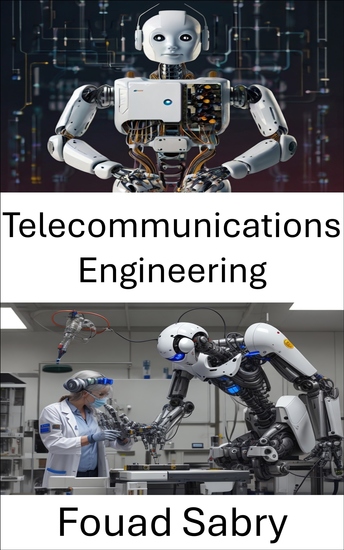
Telecommunications Engineering - Integrating Communication Systems for Autonomous Robotics - cover

Telecommunications Engineering - Integrating Communication Systems for Autonomous Robotics

Fouad Sabry

Verlag: One Billion Knowledgeable

  • 0
  • 0
  • 0

Beschreibung

"Telecommunications Engineering," authored by Fouad Sabry, offers an indepth exploration of the vital field of telecommunications. This book is an essential read for professionals, students, and enthusiasts in the domain of Robotics Science. Understanding the technological, political, and practical aspects of telecommunications is more important than ever as connectivity drives the global landscape. With a clear focus on key regions and technologies, this book bridges the gap between theory and practice in modern telecommunications.
 
Chapters Brief Overview:
 
1: Telecommunications engineering: This chapter lays the foundation, explaining key concepts and the role of telecommunications in engineering.
 
2: Telecommunications in China: A detailed analysis of China's telecommunications evolution and its global influence.
 
3: Telecommunications in Russia: Explores Russia's telecommunications infrastructure and its challenges in the modern era.
 
4: Telecommunications in Tanzania: Examines Tanzania's growth in telecommunications and its impact on regional connectivity.
 
5: Repeater: Introduces the concept of repeaters, discussing their function in signal transmission and network enhancement.
 
6: Transmission medium: Discusses various transmission mediums, including fiber optics, copper cables, and wireless systems.
 
7: Data communication: Explores how data is transmitted, focusing on protocols, encryption, and network standards.
 
8: Wireless: A deep dive into wireless communication technologies and their applications in today's society.
 
9: Telecommunications policy of the United States: An overview of U.S. telecommunications policy and its effect on the global market.
 
10: Last mile (telecommunications): Focuses on the challenges and solutions for the critical "last mile" in communication networks.
 
11: Internet access: Covers the importance of internet access in modern society and the infrastructure required to deliver it.
 
12: Duplex (telecommunications): Explores the concept of duplex communication and its significance in network efficiency.
 
13: Twowire circuit: Examines the role of twowire circuits in telecommunications, focusing on simplicity and reliability.
 
14: History of telecommunication: Traces the history of telecommunications, highlighting key milestones and technological breakthroughs.
 
15: Fiber to the x: Delves into fiber optic technologies, focusing on fiber to the home and business models.
 
16: Computer network: An exploration of computer networks, their design, and their connection to telecommunications.
 
17: Backhaul (telecommunications): Focuses on the backhaul network, essential for maintaining efficient communication over long distances.
 
18: Wired communication: Discusses the evolution and continued relevance of wired communication systems in telecommunications.
 
19: Telecommunications: Offers a broad view of telecommunications, encompassing emerging trends and global challenges.
 
20: Communications law: Explores the legal framework surrounding telecommunications, including regulations and policy challenges.
 
21: Telecommunications in Burkina Faso: Provides an indepth look at Burkina Faso's telecommunications landscape, challenges, and growth.
 
The book comprehensively covers the technological, policy, and regional perspectives of telecommunications. By reading this book, professionals, students, and enthusiasts will gain valuable insights into telecommunications engineering and its pivotal role in shaping the future of connectivity, making it an indispensable resource for anyone in the field.
Verfügbar seit: 02.01.2025.
Drucklänge: 319 Seiten.


Weitere Bücher, die Sie mögen werden

  • Hands-on Cryptography with Python - Master Cryptographic Foundations with Real-World Implementation for Secure System Development Using Python - cover

    Hands-on Cryptography with...

    Md Rasid Ali

    • 0
    • 0
    • 0
    Master Cryptography with Python: From History to Real-World Implementation.
    Book Description
    Cryptography is the backbone of modern digital security, and Python makes it accessible for everyone. Hands-on Cryptography with Python takes readers from foundational concepts to advanced cryptographic systems, equipping them with both theoretical understanding and practical implementation skills using Python.
    You’ll begin with setting up the platform and Installation and move on to understanding the basics of cryptography—exploring classic ciphers, their evolution, and their role in secure communication. Next, you’ll advance to Symmetric Key Cryptography and Asymmetric Key Cryptography, learning how to implement encryption algorithms step-by-step with Python.
    As you progress, you’ll dive into essential cryptographic components like Hashing and Message Integrity, enabling you to safeguard data and verify its authenticity. The book then introduces miscellaneous cryptographic schemes and highlights the principle that “Security is Only as Strong as the Weakest Link”, encouraging you to identify and address vulnerabilities.
    Toward the final stages, you’ll gain hands-on expertise in TLS Communication, the backbone of secure data exchange on the web. The journey culminates with an exploration of current trends in cryptography, including lightweight cryptography and post-quantum solutions, ensuring you stay ahead in this ever-evolving field.
    Table of Contents
    1. Platform Setup and Installation
    2. Introduction to Cryptography
    3. Symmetric Key Cryptography
    4. Asymmetric Key Cryptography
    5. Hashing
    6. Message Integrity
    7. Miscellaneous Crypto Schemes
    8. Security is Only as Strong as the Weakest Link
    9. TLS Communication
    10. Latest Trends in Cryptography      
    
    Index
    Zum Buch
  • Pull Don’t Push - cover

    Pull Don’t Push

    Julie Newman

    • 0
    • 0
    • 0
    You need to hear the bad news first: the results of STEM outreach to girls haven’t improved in twenty years. The good news? This book will tell you why, and how to fix it. Currently, dated narratives push girls away in fear, and blind spots result in missed opportunities to pull them in. While efforts to increase diversity in science and mathematics have succeeded, outreach has largely ignored engineering—where there is still only one woman for every five men. This is especially troubling because engineering offers vastly more jobs than other STEM fields. Plus, girls are telling us they’re eager for the kind of work engineering offers—yet we fail to help them connect the dots. As a woman enjoying a career in STEM, author Julie Newman is committed to changing this. With extensive research and actionable steps, Pull, Don’t Push clarifies the challenges facing STEM outreach and will help you create a new framework for your efforts. Following the guidelines in this book could literally put a million women into STEM jobs within the next decade. Learn how to stop pushing girls away and instead pull them toward unexplored paths to fulfillment.
    Zum Buch
  • The Wanderer - An Alaska Wolf's Final Journey - cover

    The Wanderer - An Alaska Wolf's...

    Tom Walker

    • 0
    • 0
    • 0
    The Wanderer is the first book ever to chart a wolf's movement, almost to the day, for an extended period of time. Informed by unique access to research and field notes, award-winning author, photographer, and naturalist Tom Walker shares the story of Wolf 258, nicknamed "the Wanderer," part of a research project that studied wolves in Alaska's Yukon–Charley Rivers National Preserve for more than two decades. A GPS collar recorded the animal's coordinates once a day as it moved through the wilderness. To the amazement of all, the Wanderer traveled more than 2,700 miles in less than six months. To tell this story, Walker had unparalleled access to research and field notes, including the cooperation of the biologist who first collared the Wanderer and the wolf researcher now assigned to Yukon–Charley. 


    The Wanderer recounts the compelling life of one particular wolf, while examining the broader complexity of the species as a whole and its struggle for survival. Walker explores not only the natural history of wolves, but the relationship of people—Indigenous, pioneers and settlers, biologists, politicians—to this predator, shedding light on the long northern traditions of trapping and hunting, the tangled politics of wolf management, and the futility of borders to contain large mammals.
    Zum Buch
  • Secularity and Science - What Scientists Around the World Really Think About Religion - cover

    Secularity and Science - What...

    Anonym

    • 0
    • 0
    • 0
    Do scientists see conflict between science and faith? Which cultural factors shape the attitudes of scientists toward religion? Can scientists help show us a way to build collaboration between scientific and religious communities, if such collaborations are even possible? 


    To answer these questions and more, the authors of Secularity and Science: What Scientists Around the World Really Think About Religion completed the most comprehensive international study of scientists' attitudes toward religion ever undertaken, surveying more than 20,000 scientists and conducting in-depth interviews with over 600 of them. From this wealth of data, the authors extract the real story of the relationship between science and religion in the lives of scientists around the world. The book makes four key claims: there are more religious scientists than we might think; religion and science overlap in scientific work; scientists—even atheist scientists—see spirituality in science; and finally, the idea that religion and science must conflict is primarily an invention of the West. Secularity and Science leaves inaccurate assumptions about science and religion behind, offering a new, more nuanced understanding of how science and religion interact and how they can be integrated for the common good.
    Zum Buch
  • The Secrets of the Human Brain – Unlocking Intelligence & Consciousness - How Neuroscience is Decoding the Mind and the Future of Human Intelligence - cover

    The Secrets of the Human Brain –...

    Waylon Ward

    • 0
    • 0
    • 0
    The human brain is the most complex and powerful structure in the universe, but how does it really work? What makes us intelligent, self-aware, and creative? 
    This audiobook takes you on a journey through the cutting-edge world of neuroscience and cognitive science, revealing the mysteries of intelligence, consciousness, and the future of brain enhancement. Discover: 
    ✅ How memories are formed and why we forget 
    ✅ The difference between human intelligence and artificial intelligence 
    ✅ What modern neuroscience reveals about consciousness and free will 
    ✅ How brain injuries and disorders unlock hidden brain functions 
    ✅ The future of brain-computer interfaces and neural implants 
    The Secrets of the Human Brain – Unlocking Intelligence & Consciousness is a must-listen for *science lovers, psychologists, students, and anyone fascinated by the power of the mind.
    Zum Buch
  • Without Our Consent - - cover

    Without Our Consent -

    Bob Skerstonas

    • 0
    • 0
    • 0
    “Without Our Consent” is a trailblazing story on pesticides, herbicides, and fungicides from his own experience and allergies to these chemicals. An immense amount of research has been used to paint a picture of abundance use by agriculture and livestock farming in the USA. Researching this topic our author Bob Skerstonas has provided us with a wealth of information backing this up with over 395 footnotes for a reader to dig deeper into the overuse of pesticides, herbicides, and fungicides. 90% of the US population has detectable concentrations of pesticides or their metabolites in their urine or blood samples.Pesticides have been linked to a variety of health problems, including cancer, birth defects, and hormonal imbalances.Farmworkers and pesticide applicators are particularly at risk of pesticide exposure and related health problems.
    Zum Buch