Rejoignez-nous pour un voyage dans le monde des livres!
Ajouter ce livre à l'électronique
Grey
Ecrivez un nouveau commentaire Default profile 50px
Grey
Abonnez-vous pour lire le livre complet ou lisez les premières pages gratuitement!
All characters reduced
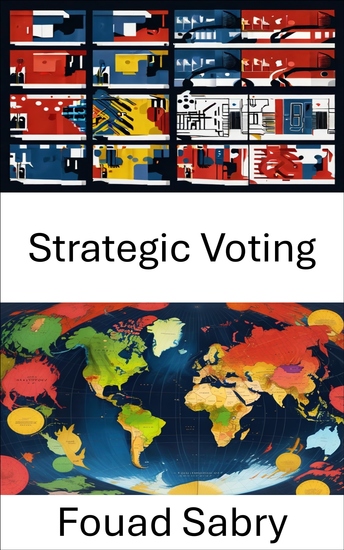
Strategic Voting - Tactical Choices in Democratic Systems - cover

Strategic Voting - Tactical Choices in Democratic Systems

Fouad Sabry

Maison d'édition: One Billion Knowledgeable

  • 0
  • 0
  • 0

Synopsis

Strategic Voting
 
Discover how "Strategic Voting" shapes democratic processes with this vital addition to the "Political Science" series. In today's ever-changing political landscape, understanding voters' strategic use of their votes is crucial for grasping the complexity of elections and democratic representation.
 
Chapters Brief Overviews
 
1: Strategic Voting - Explore how voters make strategic decisions to influence election results.
 
2: Approval Voting - Learn how voters select multiple candidates and how strategic choices emerge.
 
3: Plurality Voting - Investigate the strategic effects of electing the candidate with the most votes.
 
4: Proportional Representation - Understand how seats are allocated in proportion to votes, reducing strategic voting.
 
5: Score Voting - Discover how rating candidates on a scale reveals strategic behavior.
 
6: Two-Round System - Examine voters' tactics when a second round of voting is required.
 
7: First-Past-the-Post Voting - Uncover the strategic dilemmas such as vote splitting and tactical voting.
 
8: Vote Splitting - Analyze how similar candidates divide the vote and its effect on results.
 
9: Condorcet Winner Criterion - Explore electing the candidate who wins all head-to-head matchups.
 
10: Majority Criterion - Evaluate electing a candidate with majority support and its strategic impact.
 
11: Parallel Voting - Assess the complexities of using multiple voting systems in one election.
 
12: Wasted Vote - Understand when voters avoid supporting weaker candidates to prevent a wasted vote.
 
13: Condorcet Loser Criterion - Learn how this prevents the election of a broadly disliked candidate.
 
14: Later-No-Harm Criterion - See how ranking candidates doesn't harm others’ chances.
 
15: Single Transferable Vote - Explore how ranking candidates affects their viability.
 
16: Borda Count - Analyze how strategic ranking in Borda Count maximizes influence.
 
17: Instant-Runoff Voting - Investigate how eliminating lower-ranked candidates impacts strategies.
 
18: Electoral System - Compare how different electoral systems influence voter behavior.
 
19: Comparison of Systems - Discover how systems either encourage or reduce strategic voting.
 
20: STAR Voting - Explore the combination of score voting and instant-runoff.
 
21: Multiwinner Approval Voting - Assess how multiple selections ensure broader representation.
 
This book caters to professionals, students, and anyone interested in understanding the deeper mechanics of strategic voting. Readers will gain essential insights into how voting systems shape elections and how their choices can wield significant influence over democratic outcomes.
Disponible depuis: 16/10/2024.
Longueur d'impression: 368 pages.


D'autres livres qui pourraient vous intéresser

  • Warfare in Ancient Greece: The History of the Greeks’ Wars on Land and Sea in Antiquity - cover

    Warfare in Ancient Greece: The...

    Editors Charles River

    • 0
    • 0
    • 0
    Although the armies of the ancient Greek, or “Hellenic”, city-states (poleis, singular polis) included both cavalry (hippeis) and light infantry (psiloi, peltastes, gymnetes), their mainstay was undoubtedly the heavy infantry known today as hoplites. Armed to the teeth with their distinctive round shield (aspis or hoplon), high-crested helmet (corys) and long spear (dory), the hoplites were some of the most efficient soldiers of their time. They fought in the tight phalanx formation, and beyond the confines of their small poleis, Greek hoplites were also prized as mercenaries throughout the ancient world.  
    	Most historians believe that the hoplite became the dominant infantry soldier in nearly all the Greek city-states around the 8th century BCE. Hoplites were responsible for acquiring their own equipment, so not every hoplite might have been equally armed, but considering the style of warfare, they needed as much uniformity as possible. Like most infantry outside of Greece, the hoplites also carried spears, but while the Persian weapons were short and light for example, the Greek spears were thick shafts anywhere between seven and nine feet long. These spears were topped by a 9-inch spearhead, with a “lizard-sticker” buttspike at the bottom which could be used as a secondary spearhead if the main weapon was snapped off, or to plant the spear upright when at rest. Each hoplite also carried a shortsword, designed specifically for thrusting in the close confines of a melee (the Spartan weapon, the xiphos, was so short as to be virtually a dagger, its blade barely over a foot long).  
    It was only with the advent of the more mobile Roman legion, and the defeat of phalanxes in battles like Cynoscephalae (197 BCE) and Pydna (168 BCE), that the hoplite phalanx was finally outclassed
    Voir livre
  • United Kingdom - History of Scotland and England - cover

    United Kingdom - History of...

    Kelly Mass

    • 0
    • 0
    • 0
    The following topics will be addressed in this book about Great Britain and its history: 
    1 Horatio Nelson 
    2 The British Raj 
    3 The Cathars 
    4 The Great Fire of London 
    5 Ghosts of Scotland 
    6 Scottish History 
    7 Wars of Scottish Independence 
    8 William Wallace
    Voir livre
  • Happy Dreams of Liberty - An American Family in Slavery and Freedom - cover

    Happy Dreams of Liberty - An...

    R. Isabela Morales

    • 0
    • 0
    • 0
    When Samuel Townsend died at his home in Madison County, Alabama, in November 1856, the fifty-two-year-old white planter left behind hundreds of slaves, thousands of acres of rich cotton land, and a net worth of approximately $200,000. In life, Samuel had done little to distinguish himself from other members of the South's elite slaveholding class. But he made a name for himself in death by leaving almost the entirety of his fortune to his five sons, four daughters, and two nieces: all of them his slaves. 


    In this deeply researched, movingly narrated portrait of the extended Townsend family, R. Isabela Morales reconstructs the migration of this mixed-race family across the American West and South over the second half of the nineteenth century. Searching for communities where they could exercise their newfound freedom and wealth to the fullest, members of the family homesteaded and attended college in Ohio and Kansas; fought for the Union Army in Mississippi; mined for silver in the Colorado Rockies; and, in the case of one son, returned to Alabama to purchase part of the old plantation where he had once been held as a slave. In Morales's telling, the Townsends' story maps a new landscape of opportunity and oppression, where the meanings of race and freedom—as well as opportunities for social and economic mobility—were dictated by highly local circumstances.
    Voir livre
  • The Limits of Critique - cover

    The Limits of Critique

    Rita Felski

    • 0
    • 0
    • 0
    Why must critics unmask and demystify literary works? Why do they believe that language is always withholding some truth, that the critic’s task is to reveal the unsaid or repressed? In this book, Rita Felski examines critique, the dominant form of interpretation in literary studies, and situates it as but one method among many, a method with strong allure—but also definite limits.Felski argues that critique is a sensibility best captured by Paul Ricoeur’s phrase “the hermeneutics of suspicion.” She shows how this suspicion toward texts forecloses many potential readings while providing no guarantee of rigorous or radical thought. Instead, she suggests, literary scholars should try what she calls “postcritical reading”: rather than looking behind a text for hidden causes and motives, literary scholars should place themselves in front of it and reflect on what it suggests and makes possible.By bringing critique down to earth and exploring new modes of interpretation, The Limits of Critique offers a fresh approach to the relationship between artistic works and the social world.
    Voir livre
  • His New Body - Gender Swap - cover

    His New Body - Gender Swap

    Kinky Press

    • 0
    • 0
    • 0
    What would you do if you went to sleep as a forty year old man and woke up in the body of a nineteen your old woman? 
      
    Tom's body is quitting on him, and there is only one option left if he wants to live. He needs to transplant his brain and consciousness into another body – any body.  
      
    The procedure is done, and Tom wakes up in a body so fundamentally different from his own that he doesn't know how to feel. His reflection shows a nineteen year old woman's face and body. How is a man supposed to react to that? How will his wife react? 
      
    Tom explores what it means to be a woman, how pleasure feels to a woman, and if he has what it takes to follow his wife's wish – that he submits to a man. Tom will turn into Sarah. Sarah embraces her newfound femininity as she quivers and quakes – and moans and mewls – while she explores her own body, her wife's body, and the body of Donnie, the man who has been chosen for her.  
      
    PSA: This story contains a man in a woman’s body. There will be fingers and plastic molds shoved into places – and he never knew how good a woman has it. He’ll be satisfied by his wife and have his newfound innocence removed by a strangers stiff piston.
    Voir livre
  • Marijuana Legalization - What Everyone Needs to Know® - cover

    Marijuana Legalization - What...

    Mark A.R. Kleiman, Beau Kilmer,...

    • 0
    • 0
    • 0
    Should we legalize marijuana? If we legalize, what in particular should be legal? Just possessing marijuana and growing your own? Selling and advertising? If selling becomes legal, who gets to sell? Corporations? Co-ops? The government? What regulations should apply? How high should taxes be? Different forms of legalization could bring very different results. 


    This second edition of Marijuana Legalization: What Everyone Needs to Know® discusses what is happening with marijuana policy, describing both the risks and the benefits of using marijuana, without taking sides in the legalization debate. The book details the potential gains and losses from legalization, explores the "middle ground" options between prohibition and commercialized production, and considers the likely impacts of legal marijuana on occasional users, daily users, patients, parents, and employers—and even on drug traffickers.
    Voir livre